1995issue C071-7
Cup-completion cheat before the handle breakout
The cup-completion cheat takes the first buy after the 1-2-3 change of trend, from the post-turn pause, instead of waiting for a handle at higher prices. The archive cases treat that early rule-based entry as a way to keep the stop under the last higher low.
- A valid left-side downtrend line is drawn through the last lower high before the lowest low. The 1-2-3 change of trend is the breach of that line, a retest or tight pause, then a break of the decline's reaction high.
- The cup-completion cheat is the lift from the quiet post-step-3 pause, taken only with a low-volume cup floor, expanding volume on the step-1 and step-3 rallies, an A or B accumulation-distribution rating, a relative-strength ranking of 90 or higher, and volume at least 40 percent above the 50-day average.
- A later handle breakout can place an 8 percent money-management stop above the handle low, so a normal retest can force an exit while the uptrend structure is still intact.
- Buying half on the cup-completion lift and the rest on the handle break, or taking a full early position, is presented as a way to lower average cost so the stop can sit at the last higher low without being tighter than the money-management limit.
Early entry as a stop problem
The archive workflow times a rule-based entry at the cup-completion cheat: the first buy comes from the pause that follows the 1-2-3 change of trend, rather than from a completed handle at higher prices. Confirmation is still required. The early lift has to clear the post-turn pause on a volume surge, and the later handle is treated as leftover supply near the old highs, not as the first valid signal.
This is the historical sequence. The archive does not state when that early buy is the sounder place for the protective exit.
How the rounded bottom turns
A rounded bottom is a U-shaped corrective base whose left-side decline, low-volume trough, and right-side recovery together mark the end of a prior downtrend. A valid downtrend line on the left side is drawn through the last lower high that precedes the lowest low. Step 1 of the turn is the breach of that line.
Step 2 is a retest of the lows or, often, a multi-week consolidation that never returns near those lows. Step 3 is the break of the minor reaction high created on the decline, which is the first higher high after a higher low. Those three steps are the 1-2-3 change of trend.
The cup-completion cheat
The cup-completion cheat is an entry taken just after step 3, from the post-turn pause, instead of waiting for a handle to form at higher prices. That early entry is conditioned on a low-volume cup floor, rising volume on the step-1 and step-3 rallies, a quiet post-step-3 pause, an A or B accumulation-distribution rating, a relative-strength ranking of 90 or higher, and a lift from the pause on volume at least 40 percent above the 50-day average.
A is preferred and B is still acceptable at this checkpoint. The relative-strength screen requires the name to already be in the upper decile of its universe while the new base is still forming. The breakout is that lift through the nearby pause, judged against the volume surge versus the recent average.
Leftover supply and the handle
After the cheat breakout, leftover supply near the old highs typically stalls price and completes the right rim into a handle. The handle is the short, higher consolidation that forms after the right rim meets that supply. The rule is to hold through that pause if the prior volume and leadership filters remain intact.
Where the later stop sits
A later handle breakout can place an 8 percent money-management stop above the handle low, so a normal retest of that higher low can force an exit while the uptrend structure is still intact. Buying half the allocation on the cup-completion lift and the rest on the handle break, or taking a full early position, is presented as a way to lower average cost so the stop can sit at the last higher low without being tighter than the money-management limit.
The Micro Healthsystems case
In the Micro Healthsystems 1990-91 case, an early buy near 8 7/8 with an 8 percent stop at 8 1/8 sat below the 8 3/8 handle low. A handle-breakout buy near 10 with an 8 percent stop at 9 1/4 was tagged on a January retest that stayed above the handle floor.
Rim overruns and the spike-and-roll
A cup rim that slightly exceeds the left-side high can still be treated as the same structure. Tencor's right-side high of 49 1/4 cleared 47 5/8 by 3 1/2 percent, and Three Coms peaked at 34 5/8 versus 31 7/8, an 8.6 percent overrun.
Some rounded bottoms in the case set also show a spike-and-roll: a post-advance spike whose subsequent cup floor holds above the spike low, as labeled on Wholesome and Hearty Foods and noted on Micro Healthsystems, US Delivery Systems, and Tencor Instruments.
Micro Healthsystems cup-completion cheat versus the later handle-breakout stop
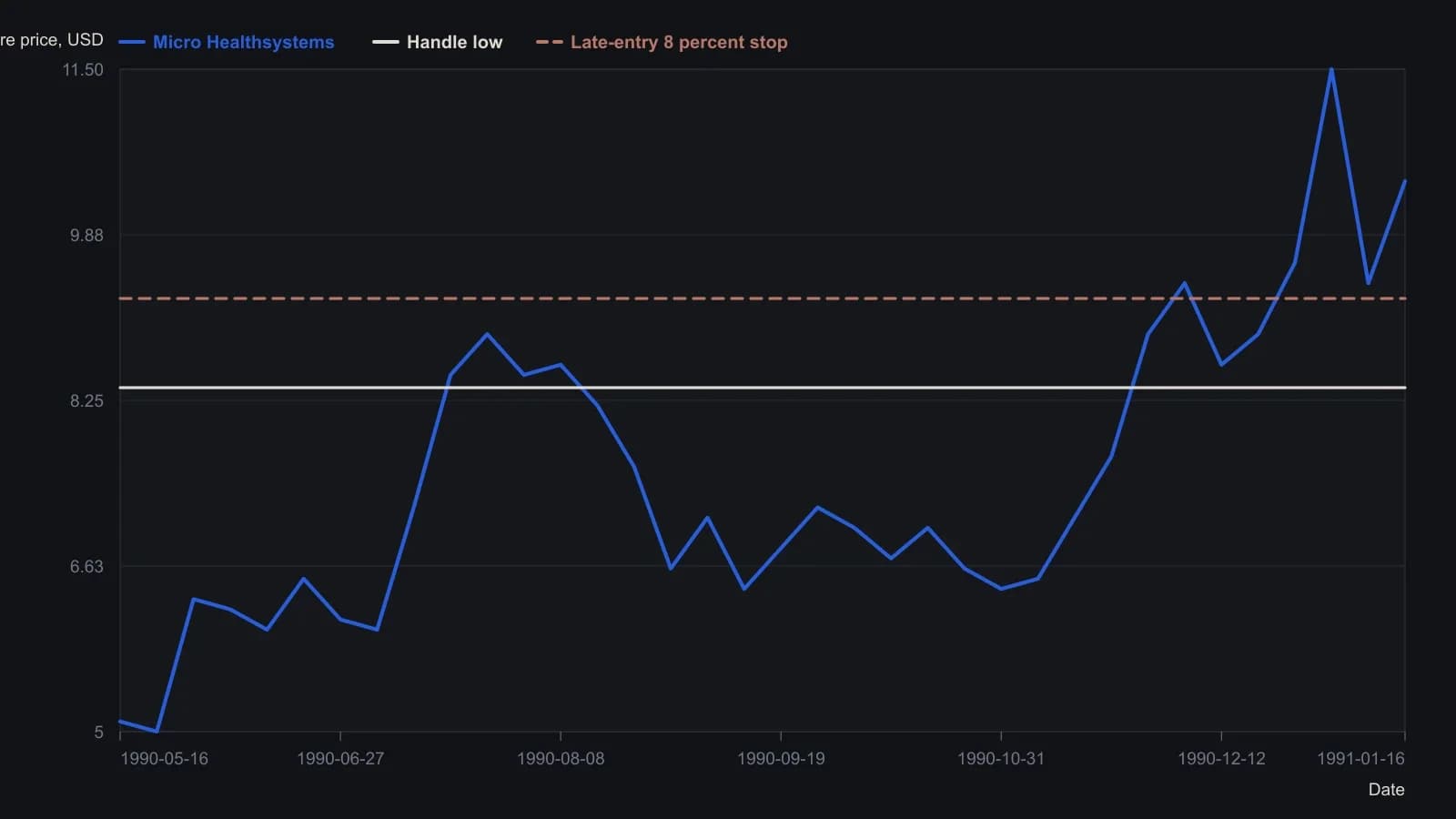
Daily high-low bars sampled at roughly weekly spacing; prices rounded to one decimal, which is as fine as the 0.5 grid will bear. Intra-bar wicks (the May flush near 4.5 and the mid-August air pocket near 6.1) are not weekly closes.
All readings on this track · 14 readings
- 1990Constructing falsifiable reversal patterns from price structure
- 1995Cup-with-handle construction: confirm the cup, the handle, then the breakout
- 1995Cup-completion cheat before the handle breakout
- 1998Constructing rounded-bottom cups as testable entries
- 1999Rounded bottom landmarks, invalidation, and breakout rules
- 2003Constructing rounded bottoms, triangles, and pennants
- 2006A five-by-five grid that accepts or rejects a cup
- 2006NTRI and the 2005 bowl breakout case
- 2006Rounded-bottom screens, first-try breakouts, and Fibonacci retracements
- 2007Constructing rounded bottoms as multi-year bases
- 2011Early semi-cup construction from the left rim and base
- 2011Early rounded bottom recognition on a locked log-price grid
- 2013Rounded turns as slope-first trade hypotheses
- 2017Evaluating a rounded bottom as a testable payoff structure