1999issue C011-3
Rounded bottom landmarks, invalidation, and breakout rules
After a landmarkSet is located, a horizontal reference stays at the rightRim until a volumeConfirmedBreak or an invalidationClose. Coded cup rules remain a compromise with what a visual reader would accept or reject.
- A recognizer must find the landmarkSet, including the rightRim and the cupLow, before any pattern flag can turn on.
- A horizontal reference is then held at the rightRim until an upside close through that level or an invalidationClose below 80 percent of it.
- An accepted upside break can require both a close above the rightRim and a volume reading above a moving average of volume.
- Companion ratio statistics from the same screen are specified as uninterpretable unless a binary cup flag already equals one.
Editorial reading
Editorial interpretation: treat a rounded bottom as three separately testable layers. The first layer is named rim-and-low construction. The second is an explicit cancel rule. The third is an entry that may stay silent until geometry and volume both pass. That reading is editorial and is not an archive claim.
The later high that finishes the bowl is the rightRim, and it later serves as the breakout reference. The cupLow is the lowest close located between the two rims of the rounded bowl. The landmarkSet is the named price-and-location pairs a recognizer must find before any pattern flag can turn on.
The held rightRim reference
After the left rim, the rightRim, and the cupLow are located, a horizontal reference is held at the rightRim price until either an upside close through that level or a close that drops below a stated fraction of it.
The same procedure can raise one alert when the formation is first accepted and a second alert when price later closes above the rightRim.
The stored formation can be cancelled if the close falls below 80 percent of the rightRim reference. That close is the invalidationClose.
Aeroflex daily close with cup-with-handle landmarks
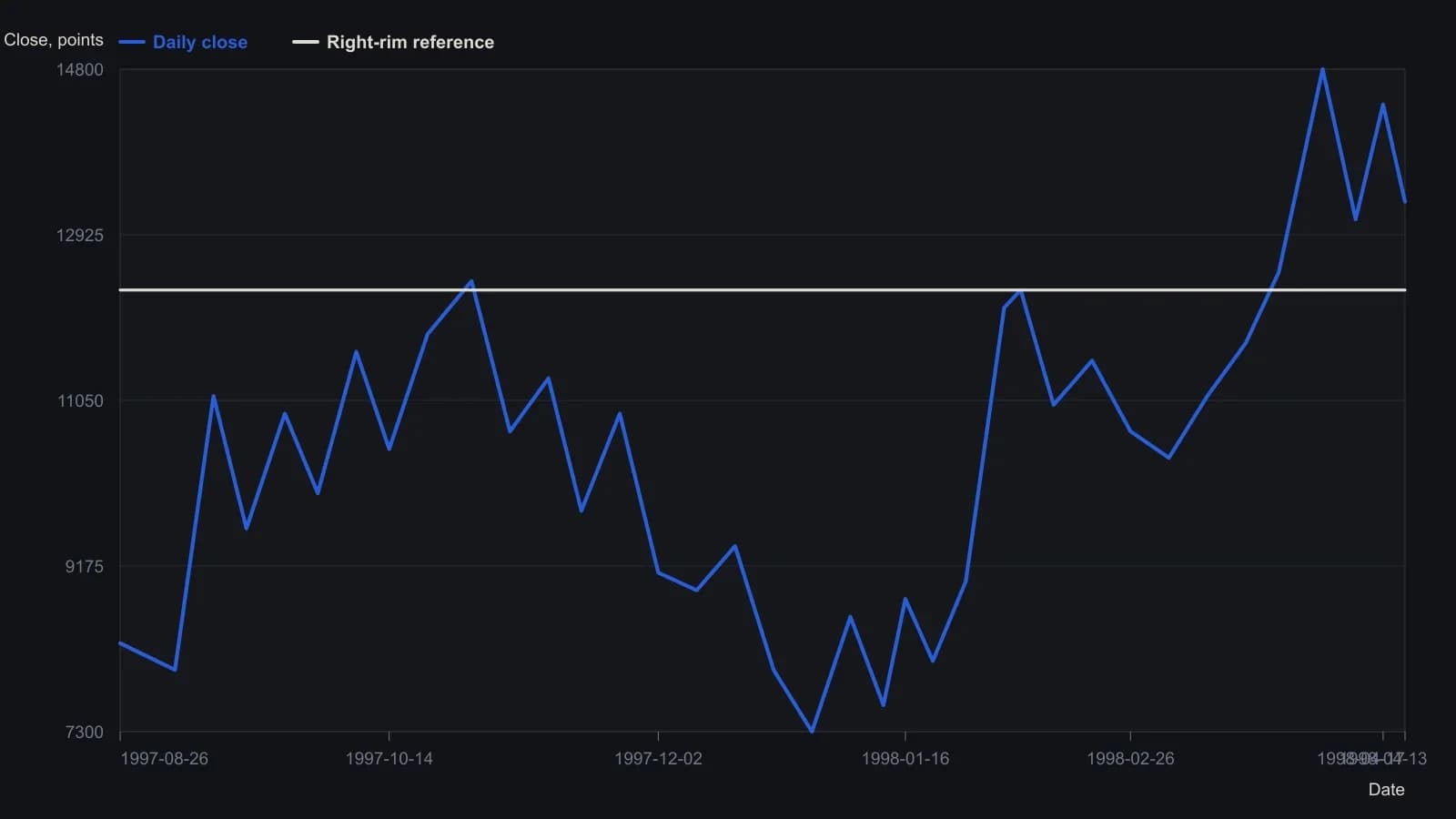
Raster reading of the published daily screenshot; axis ticks are 1,000 points, so closes are estimated to the nearest hundred. The Omega cup-and-handle indicator keeps the right-rim line until a close above the rim on volume above the 50-bar average, or cancels if the close falls below 80 percent of the rim. AlrtLen is 4 bars.
Joint gates for an accepted break
Editorial note: the third layer is an entry that can remain silent until both geometry and volume pass.
An accepted upside break can require both a close above the rightRim and a volume reading above a moving average of volume. That joint condition is a volumeConfirmedBreak.
A screen can locate five landmarks by both price and bar position, then apply joint constraints on those ten quantities before a binary cup flag is allowed to equal one. Companion ratio statistics computed in the same screen are specified as uninterpretable unless that binary cup flag equals one.
One geometric screen requires the later handle low to sit above a weighted blend of the cupLow and the rightRim high, and it also requires minimum bar gaps among the landmark locations.
A complete five-bar close sequence
A five-bar close sequence that places the lowest close two bars back, with neighboring closes stepping down then up, can be treated as a complete buy rule. The inverted sequence is the matching sell rule. Every comparison in the sequence must be true at once. That four-comparison close sequence inside a five-bar window is the fiveBarReversal.
All readings on this track · 14 readings
- 1990Constructing falsifiable reversal patterns from price structure
- 1995Cup-with-handle construction: confirm the cup, the handle, then the breakout
- 1995Cup-completion cheat before the handle breakout
- 1998Constructing rounded-bottom cups as testable entries
- 1999Rounded bottom landmarks, invalidation, and breakout rules
- 2003Constructing rounded bottoms, triangles, and pennants
- 2006A five-by-five grid that accepts or rejects a cup
- 2006NTRI and the 2005 bowl breakout case
- 2006Rounded-bottom screens, first-try breakouts, and Fibonacci retracements
- 2007Constructing rounded bottoms as multi-year bases
- 2011Early semi-cup construction from the left rim and base
- 2011Early rounded bottom recognition on a locked log-price grid
- 2013Rounded turns as slope-first trade hypotheses
- 2017Evaluating a rounded bottom as a testable payoff structure