2011issue C0466-71
Early semi-cup construction from the left rim and base
A mechanical-pattern-rule can flag a semi-cup by locating the left rim and base of a rounded-bottom cup before the right side completes. The same coded state can drive a cup-formation-alert, a watch-list-screen, and a chart overlay that still waits for later confirmation of a full cup.
- A semi-cup is the first half of a rounded-bottom cup, detected from the left rim and base rather than from a finished picture.
- A cup-formation-alert marks the bar where every coded cup condition is true, and a show-history-toggle can redraw earlier qualifying formations.
- A watch-list-screen can sort symbols that meet the semi-cup rules and open a linked chart with current price against the overlay.
- The overlay remains an early identification step and still requires later confirmation of a full cup before the pattern is treated as complete.
The left rim and base come first
The source presents a coded algorithm that flags a possible rounded-bottom cup by detecting roughly the first half of the formation rather than waiting for a completed cup.
That first half is a semi-cup: the left rim and base of a rounded-bottom cup, detected before the right side completes.
The method is described as mechanical recognition of possible cup patterns in time-series data by locating the left side and base as a precursor to a full cup.
A mechanical-pattern-rule sets a yes-or-no state
A mechanical-pattern-rule is a coded procedure that turns price-structure conditions into a yes-or-no cup state rather than a visual judgment.
One implementation plots an alert and a marker on the bar where every coded cup condition is met. That cup-formation-alert fires only when every coded cup condition is true on the current bar.
An input can also display historical formations. That show-history-toggle redraws prior qualifying formations instead of only the latest alert.
A watch-list-screen ranks current matches
A watch-list formula can label each symbol as meeting or not meeting the semi-cup criteria so a custom list can be sorted to the current matches.
That watch-list-screen flags which names currently meet the semi-cup rules so they can be inspected on a linked chart.
Linking that watch list to a chart lets a selected symbol show current price against a drawn semi-cup overlay.
Sample charts show failures and nesting
A sample daily chart is used to illustrate a large cup-and-handle that appears after earlier semi-cup failures, with the inset daily view showing two nested semi-cups inside the larger cup.
A nested-semi-cup is a smaller semi-cup that forms inside a larger unfinished or completed cup structure.
A weekly sample chart marks detected semi-cup formations with a parameter of 1.5 on a selected date of 07/24/2009.
A spreadsheet copy cannot scan history
A spreadsheet translation of the published basic code is presented as a static worksheet because it has no scan against an accessible price-history database.
Watch-list last prices for semi-cup and no-cup names
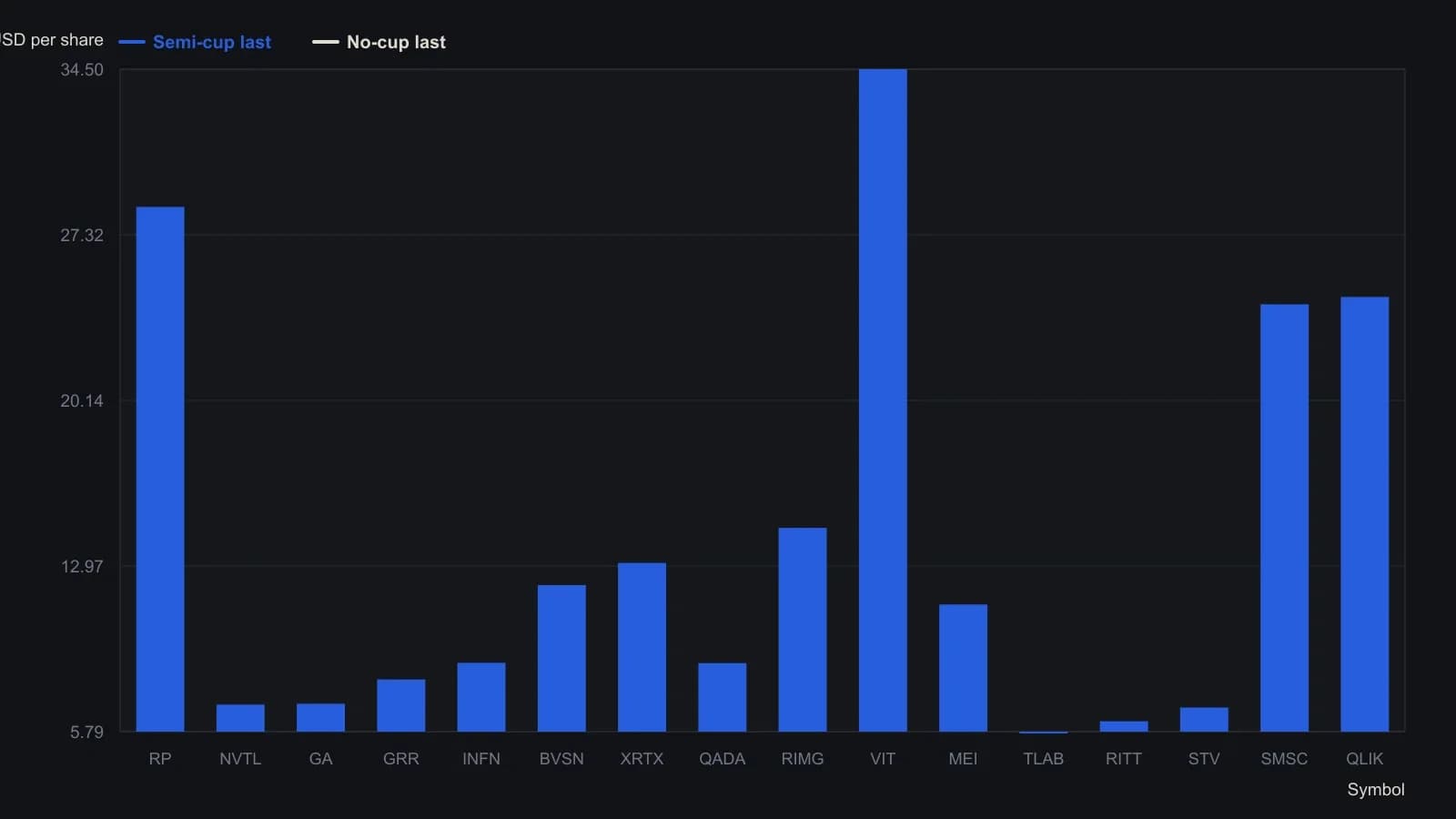
The list is sorted on the isSemiCup column, so current matches sit above the no-cup names. Bid, ask, high and low were printed beside each row but are not plotted. The bottom row (SRAY) was clipped and is omitted.
All readings on this track · 14 readings
- 1990Constructing falsifiable reversal patterns from price structure
- 1995Cup-with-handle construction: confirm the cup, the handle, then the breakout
- 1995Cup-completion cheat before the handle breakout
- 1998Constructing rounded-bottom cups as testable entries
- 1999Rounded bottom landmarks, invalidation, and breakout rules
- 2003Constructing rounded bottoms, triangles, and pennants
- 2006A five-by-five grid that accepts or rejects a cup
- 2006NTRI and the 2005 bowl breakout case
- 2006Rounded-bottom screens, first-try breakouts, and Fibonacci retracements
- 2007Constructing rounded bottoms as multi-year bases
- 2011Early semi-cup construction from the left rim and base
- 2011Early rounded bottom recognition on a locked log-price grid
- 2013Rounded turns as slope-first trade hypotheses
- 2017Evaluating a rounded bottom as a testable payoff structure