2005issue C031-4
Logic-first construction of a base-break system
Treat the first construction gate as a logic test that discards a coincidence-predictor, then encode a quiet base-period, range-tightness, a breakout-z-score, a follow-through-check, and a volume-supported-move as one mechanical procedure.
- A coincidence-predictor can post a long run of correct calls and still collapse, because the predicted result never followed from the observed event.
- Mechanical rules are framed as sound construction only when they encode a scientific, mathematical, or economic process, not when they are fitted to a coincidental winning run.
- A volume-supported-move is a continuation hypothesis later sessions can confirm or refute, and that single relationship is too thin to be an entire system.
- The sleeper-name construction needs a quiet, limited-range base-period and then accelerating movement that leaves that range, with empty scores when the windows or history are invalid.
Discard the coincidence-predictor first
A mapping between two unrelated events can post a long run of correct calls and still collapse, because the predicted result never followed from the observed event. A coincidence-predictor is that kind of mapping: one event is paired with another without a causal, mathematical, or economic link, so a long correct run can still be an accident.
Mechanical rules are framed as sound construction only when they encode a scientific, mathematical, or economic process, not when they are fitted to a coincidental winning run. A logical-premise is a stated market process that can be written as conditions and checked later, rather than inferred from a lucky historical sequence.
Keep volume as a stacked premise
A price change that occurs with strong volume is treated as a continuation hypothesis later sessions can confirm or refute. That single relationship is described as too thin to be an entire system.
A volume-supported-move is that continuation hypothesis: a price change accompanied by heavy participation can persist into a later session. It can be stacked on the same logical chain as the base-break checks, rather than asked to stand as the whole procedure.
Define the quiet base before the break
The sleeper-name construction requires a quiet, limited-range base and then accelerating movement that leaves that range. The base-period is the multi-session window used to define that quiet, limited-range trade before any break is considered.
The review window given is 25 sessions. The example base length is 20 sessions. Range-tightness is an integer that caps how much price may wander inside the base. It runs from 1 up to half the base length, with 1 to 3 described as the more selective settings. A larger value admits a wider quiet range and a larger candidate pool.
The routine returns empty scores when the short window is longer than the base or when available history is shorter than the base plus one session.
Rank the departure and test follow-through
After the latest close sits outside the base extremes, overlapping left and right ranges are checked for flatness, then a base-path expected close is used to compute a breakout-z-score. That score is the standardized gap between the latest close and the close implied by continuing the base path, used to rank how unusual the departure is.
A breakout-z-score above 2.00 is presented as a jump or drop beyond continuation of the base path. Readings above 4 are described as typically under 0.5% of names and as often forming an L-shaped lift or drop off a long base.
The post-break move is treated as potentially brief. A chart must show whether the range already broke several sessions earlier. A name that looked flat on one session is described as unlikely to still look flat on the next.
A follow-through-check is a construction test that detects the same emergence one or two sessions earlier and then measures what price did afterward. A volume-supported-move can be stacked on that same logical chain.
IEIB daily close: quiet base then L-shaped break
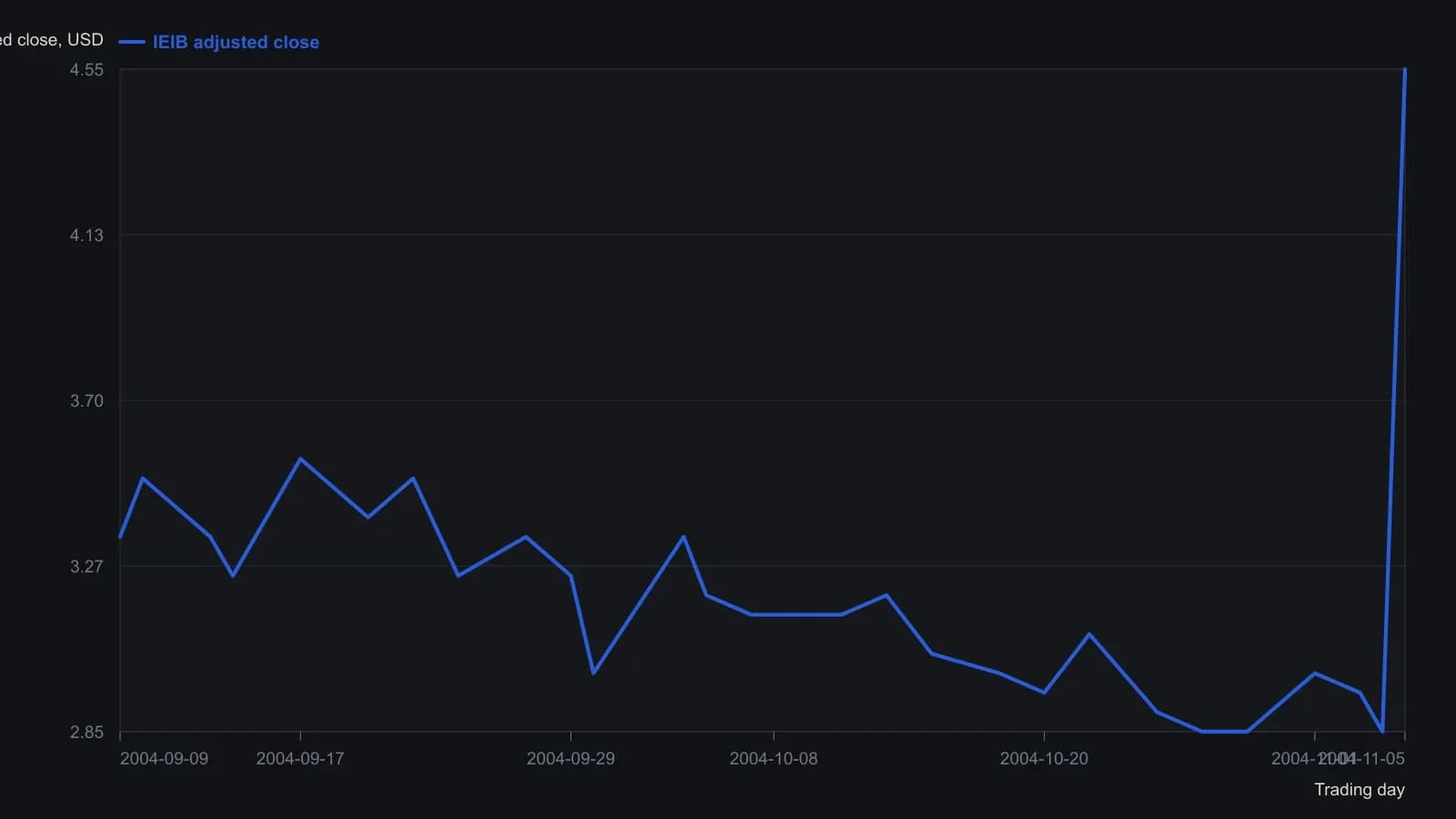
Closes estimated from the Unfair Advantage daily OHLC raster to about 0.05–0.10. The volume pane was not digitized. The figure illustrates EmergMkt(20,3): a 20-day flat base and a 3-day how-flat window.
All readings on this track · 17 readings
- 1994Cup-and-handle base construction and volume breakout
- 1996Constructing a mobility oscillator from price distributions
- 1996Float turnover as a construction rule for bases and breakouts
- 2001A historically derived growth checklist for entry, exit, and staying out
- 2003Base-building then breakout after a market bottom
- 2005Commodity group bases, breakouts and pennants
- 2005Logic-first construction of a base-break system
- 2005Quiet bases copied onto an intradacy clock
- 2005Failed cup-with-handle after earnings and float filters
- 2006Turning flat bases into breakout system rules
- 2007Base-building holds versus swing timing
- 2007Confirmed index highs, style-fit trend systems, and bases
- 2007Name the sideways regime before you test the breakout
- 2011A three-peaks-and-a-domed-house chart is not a complete timing model
- 2014Constructing a volume-capacity channel from a sideways base
- 2016Waves, bases, and the campaign log on a price chart
- 2020Ratio charts as regime context for relative strength and yield spreads