2014issue C0241
A defined-risk option case for the mid-February to mid-July energy window
The archive treats mid-February to mid-July as a recurring energy seasonal window and expresses that window as a purchased crude-oil option, so an early adverse swing limits loss to the premium rather than to an open futures path.
- Mid-February to mid-July is handled as one seasonal-window procedure, with summer fuel demand described as being priced before spring.
- A defined-risk option purchase is used so that an early adverse swing cannot force the exit that an open futures path might require.
- Commodities, exchange-traded funds, and energy stocks can list options on the same seasonal idea, but those contracts are not interchangeable.
- Supply, demand, and implied-volatility shocks are treated as regime shift, so the next window is unknown even when a historical review is used as background.
The seasonal window
Mid-February to mid-July is identified as a recurring energy-market seasonal window. It is described as bottoming near mid-February and topping around summer.
The window is attributed to summer fuel demand being priced before spring. The path is said to shift each year with supply, demand, and implied volatility, so the calendar is not treated as the whole regime.
A purchased option in place of the futures path
In the 2013 crude-oil illustration, the window opened near 98 and included an adverse swing of about 11 points off that entry before prices later moved into triple digits ahead of early July.
The case expresses the window as an August crude-oil option with a 97.50 strike purchased at 5.40, or 5,400 in premium, so that loss stays limited if the underlying keeps moving against the position.
A standalone long-option purchase is presented as an alternative to holding the futures path through a large adverse swing, because the premium paid is the defined loss.
Expiration payoff of the long August 2013 crude 97.50 call
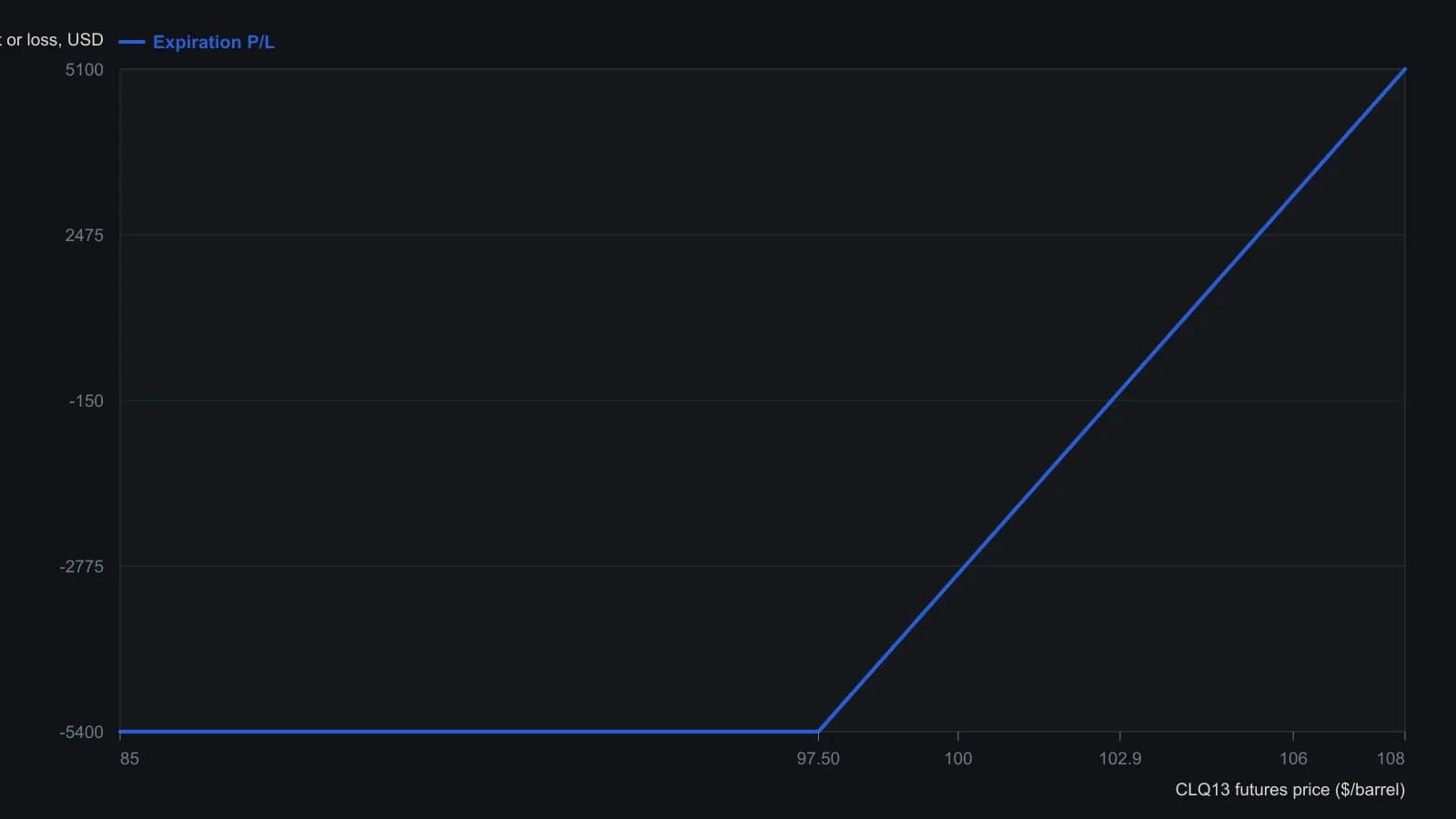
The $3,440 profit on the snapshot is the 15 July mark (option 8.84 with two days left), about $20 above this expiration value at the same 106.32 futures print.
Three venues, not one listed option
The same seasonal idea is mapped to three option venues: commodities, exchange-traded funds, and energy stocks. Listed options are not equivalent across those venues.
TradersWeek editorial: venue inequality is a reason to enter or stand aside, not a reason to copy one contract's terms onto another.
Background, not the next window
A 15-year historical review is used only as background for how often the mid-February to mid-July energy-market rise has appeared. The next year's occurrence is treated as unknown.
All readings on this track · 22 readings
- 1984A long silver put as a prepaid loss cap
- 1984Spectral window gates for index long puts
- 1990Breadth nonconfirmation as the gate for a volume fade and long-put case
- 2002Volatility-first construction for a bearish put or debit
- 2002Name the regime and the season before choosing a long put
- 2005Critique of put spreads versus outright long puts
- 2007Sector put hedges, automatic exercise, and pin risk
- 2008Margin shock, defined-debit options, and selective premium
- 2008Ranking in-the-money puts by breakeven rather than cheapest premium
- 2012Evaluating long-put moneyness when implied volatility shifts
- 2012Sizing a long butterfly for early assignment and a long option for gamma
- 2013Gold after the April break: option-spread vehicles and a long-put hedge
- 2014A defined-risk option case for the mid-February to mid-July energy window
- 2014Long put versus vertical debit spread on a Treasury ETF
- 2015Defined debit call spread on a health-insurer worksheet
- 2015Overbought technology index: a long put via an inverse proxy
- 2018Replace futures stops with short-dated long puts
- 2018Constructing short-dated long puts around weekly expiration
- 2018Four decisions before a portfolio protective put
- 2018Incremental producer hedging with puts and risk reversals
- 2019Put butterfly versus long put in a volatility spike
- 2020Scenario-first SPY put hedge: butterfly versus long put