2018issue C0735
Four decisions before a portfolio protective put
Hedging an existing stock book is a different job from betting on direction or collecting premium. The teaching frame is four bounded choices, index-match, hedge-horizon, insured-decline, and premium-budget, then a check of whether a long index put still covers that window after expiration and time decay.
- A protective put is a long put held against an existing stock book so a decline is offset without selling the shares.
- The four bounded choices are which index the book tracks, how long the cover must last, how deep a drop is insured, and what share of capital may be spent.
- A longer hedge-horizon usually costs more than a shorter one, and a short-dated put that expires without a decline may have to be replaced.
- Insuring a shallower drop typically costs more than insuring a deeper one, and unused premium is the upside given up if prices do not fall.
Hedging a book is a separate job
Using options to hedge an existing stock book is treated as a distinct job from betting on direction or collecting premium. A protective put is a long put held against that book so a decline is offset without selling the shares.
A long put is a purchased put that gains if the underlying falls and whose cost is the most that can be lost on the option itself. The historical case then chooses a contract month and strike and compares risk curves as expiration approaches.
Index, window, decline, and budget
Index-match maps the book to the equity index or ETF it tracks most closely before the put is selected. A large-cap book is mapped to the S&P 500, a technology-heavy book to the Nasdaq 100, and a small-cap book to the Russell 2000.
Hedge-horizon is the calendar span the put must cover. A longer hedge horizon usually costs more than a shorter one. A short-dated put that expires without a decline may have to be replaced with another purchase.
Insured-decline is how deep a drop the hedge is meant to offset. Insuring a 5% decline is described as typically costing more than insuring a 20% decline, because more of the move is being covered.
Premium-budget is the share of account equity set aside for the put. Whatever share of capital is spent on the hedge is lost if the market does not fall, and that spend is the upside given up while the hedge is on. If prices do not fall, that spend is given up as unused insurance.
The large-cap book in the archive case
The worked case is a $100,000 large-cap book that tracks the S&P 500, late April concern about as much as a 20% drop by the end of September, and a willingness to spend up to 3% of capital on a five-month hedge without selling the shares.
With the example ETF near $266, a 20% decline is mapped to about $213, and the illustrated contract is a September quarterly put at the $255 strike that expires on the last trading day of September.
Whether the put still covers the window
Option-expiration-analysis means choosing a contract month and strike so the hedge still covers the feared window after time premium erodes. Compared risk curves for that hedge are used to show time decay: as days pass, the long put loses time premium and the payoff profile changes before expiration.
The compared curves show that the payoff profile is not fixed on the purchase day. It changes as expiration approaches.
SPY 255 put hedge: P&L vs price as time decays
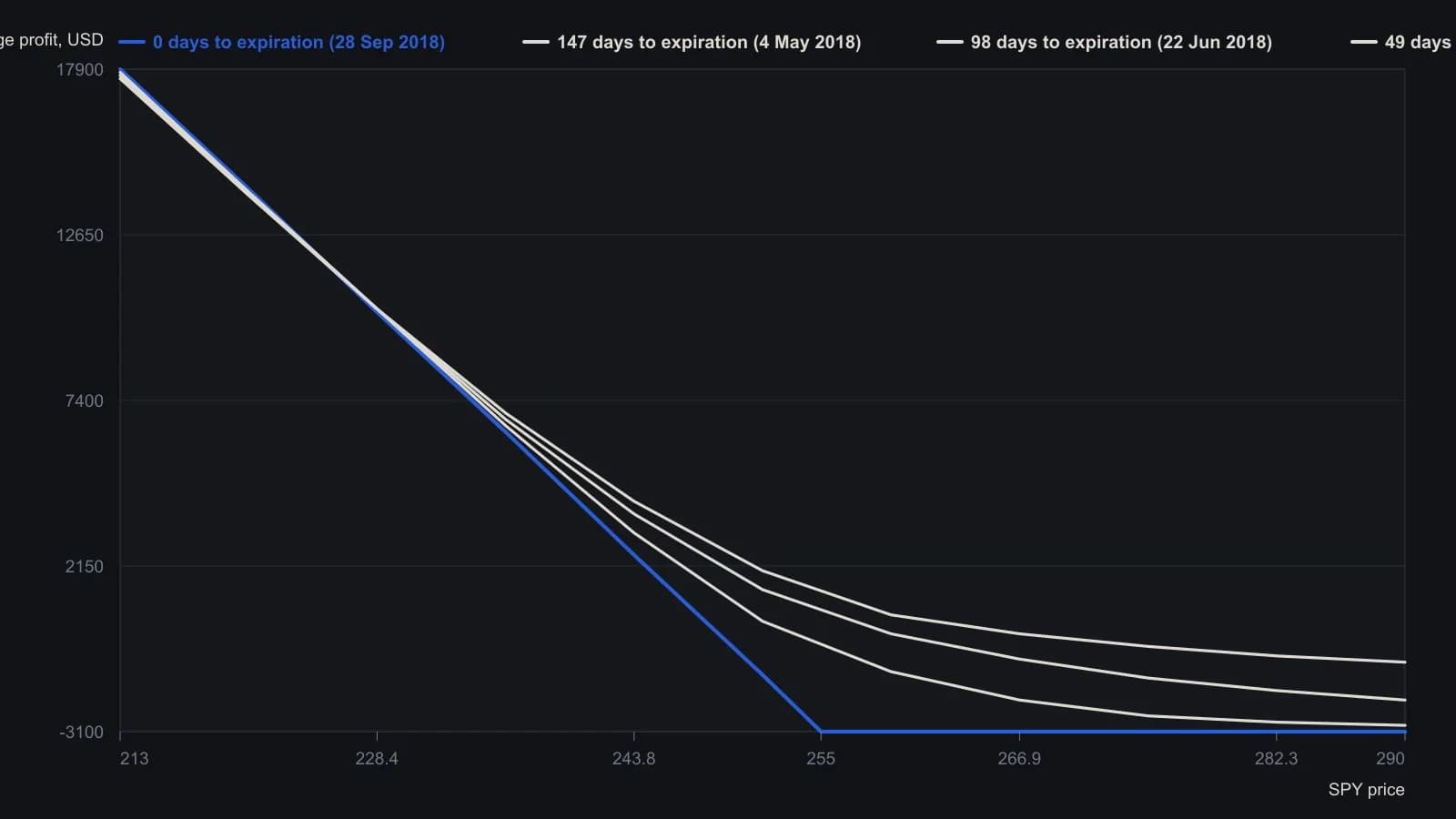
The source plots profit on the horizontal axis against SPY on the vertical axis to share a price scale with the candle chart; the series here are inverted so SPY price is the independent axis. P&L is the option hedge only, in dollars, for five contracts. Dates and day-counts are the figure legend (147d 4 May, 98d 22 Jun, 49d 10 Aug, 0d 28 Sep 2018). Raster reading is approximate to the nearest few hundred dollars.
All readings on this track · 22 readings
- 1984A long silver put as a prepaid loss cap
- 1984Spectral window gates for index long puts
- 1990Breadth nonconfirmation as the gate for a volume fade and long-put case
- 2002Volatility-first construction for a bearish put or debit
- 2002Name the regime and the season before choosing a long put
- 2005Critique of put spreads versus outright long puts
- 2007Sector put hedges, automatic exercise, and pin risk
- 2008Margin shock, defined-debit options, and selective premium
- 2008Ranking in-the-money puts by breakeven rather than cheapest premium
- 2012Evaluating long-put moneyness when implied volatility shifts
- 2012Sizing a long butterfly for early assignment and a long option for gamma
- 2013Gold after the April break: option-spread vehicles and a long-put hedge
- 2014A defined-risk option case for the mid-February to mid-July energy window
- 2014Long put versus vertical debit spread on a Treasury ETF
- 2015Defined debit call spread on a health-insurer worksheet
- 2015Overbought technology index: a long put via an inverse proxy
- 2018Replace futures stops with short-dated long puts
- 2018Constructing short-dated long puts around weekly expiration
- 2018Four decisions before a portfolio protective put
- 2018Incremental producer hedging with puts and risk reversals
- 2019Put butterfly versus long put in a volatility spike
- 2020Scenario-first SPY put hedge: butterfly versus long put