2008issue C061-2
Ranking in-the-money puts by breakeven rather than cheapest premium
In January 2008 a GBP/USD downside view still allowed an interim bounce, so the procedure specified a long put rather than selling a forward. In-the-money candidates were ranked by breakeven, the one-month 2.0050 put was selected, and the position was closed after about seven days as spot reached the 1.95 zone and implied volatility eased.
- An allowed bounce toward 1.98 to 1.99 ruled out selling a GBP/USD forward, so the directional vehicle was a long put whose maximum loss is the premium paid.
- In-the-money strikes 2.0050 and 1.9800 were quoted for one-month and two-month tenors and ranked by breakeven, treating option-premium as a budgeted input rather than a cost to minimize.
- The one-month 2.0050 put was chosen for the highest breakeven of 1.9584 even though the 1.9800 one-month and two-month premiums were lower.
- By 11 January 2008 spot was at 1.9520 and implied volatility had eased from 9.85% to 9.08%. The put was closed after about seven days, and the same dates were used to compare entry premium and exit receipt on neighboring strikes.
A bounce still on the table
On 4 January 2008 GBP/USD was near 1.9690. The working one-month downside zone was near 1.95, and a longer three-to-four-month zone was near 1.90. An interim bounce toward 1.98 to 1.99 was still allowed for.
Because that interim bounce could not be dismissed, the procedure specified a long put rather than selling a GBP/USD forward. A long put is a purchased put used as the directional vehicle so an adverse bounce cannot force a short-forward loss. Maximum loss is the premium paid.
How the candidates were scored
The candidates were in-the-money strikes 2.0050 and 1.9800, set against a one-month at-the-money-forward rate of 1.9674 with spot at 1.9690. In-the-money means a put strike above the prevailing spot or forward, so the contract already carries intrinsic value. The at-the-money-forward strike is the moneyness reference when scoring those alternatives. Each strike was quoted for a one-month and a two-month tenor, with tenor treated as a design choice.
Quoted option-premium amounts, the upfront price of each put, were 0.0466 for the 2.0050 one-month, 0.0300 for the 1.9800 one-month, 0.0544 for the 2.0050 two-month, and 0.0390 for the 1.9800 two-month. The matching breakevens were 1.9584, 1.9500, 1.9506 and 1.9410. Breakeven is the underlying level at which the put payoff offsets the premium paid. It was used here as the ranking metric across candidate contracts. Option-premium was compared across strikes and tenors as a budgeted input, not as a quantity to minimize by default.
The selected put and the seven-day close
The selected contract was the one-month 2.0050 put, chosen for the highest breakeven (1.9584) even though its premium exceeded the 1.9800 one-month and two-month alternatives.
By 11 January 2008 GBP/USD had declined to 1.9520 and implied volatility had eased from 9.85% to 9.08%. Implied volatility is the volatility priced into the option. A later decline can shrink remaining premium even while a favorable spot move helps the long put. After about seven days the original 1.95 zone was treated as largely reached with limited time-value erosion, and the put was closed. Time-value is the portion of premium above intrinsic value that decays as expiration approaches. A fast approach to the target reduces how much of it is lost.
Same-date comparison across strikes
The same review marked other strikes on identical dates, 1.9800, 2.0250 and 2.0300 alongside 2.0050, so entry premium and exit receipt could be compared across contracts instead of ranking solely by the lowest initial cost.
In-the-money GBP/USD put breakevens by strike and tenor
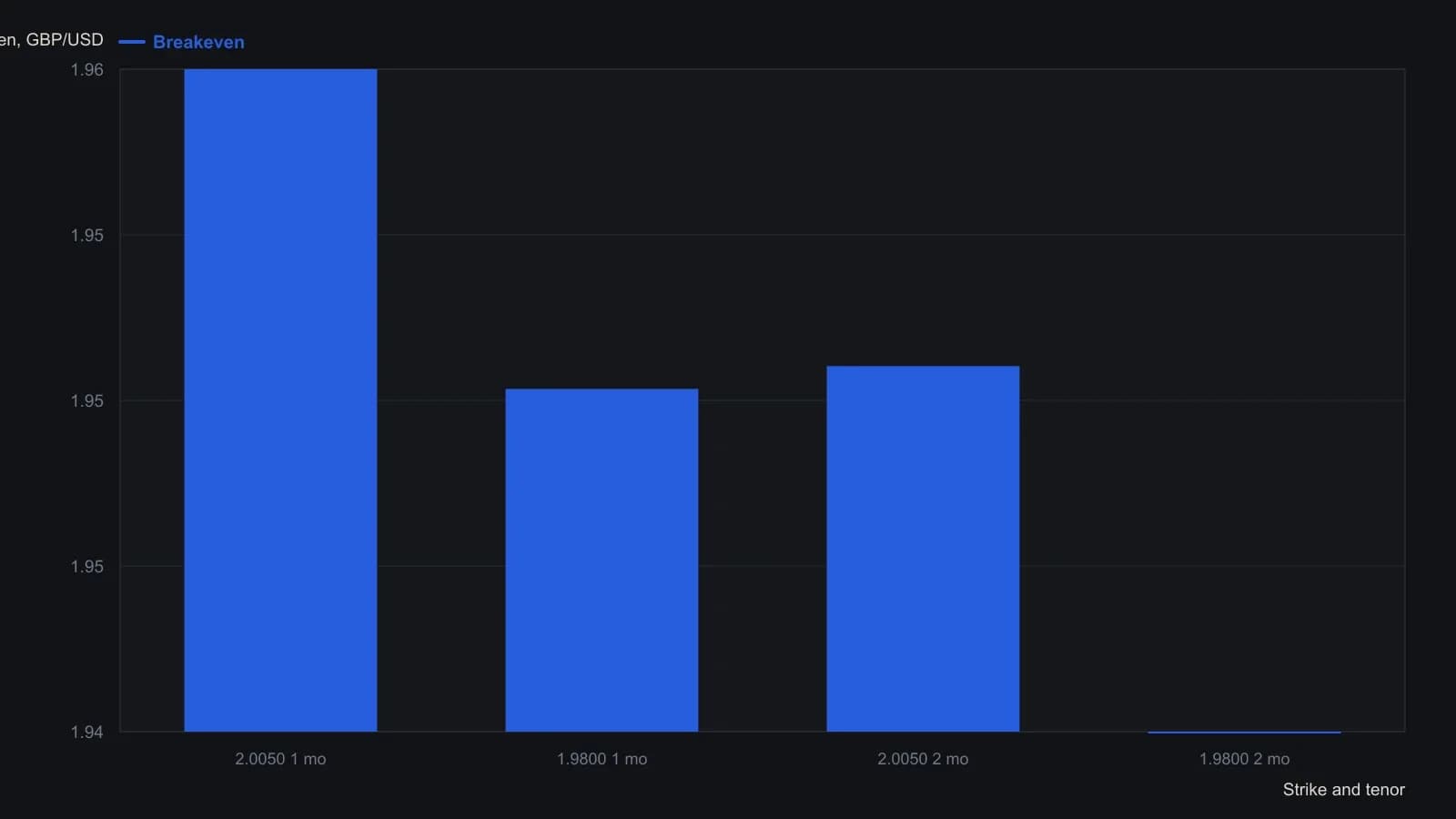
Both strikes were in-the-money versus the one-month at-the-money forward of 1.9674 (spot 1.9690). The selected 2.0050 one-month put cost 0.0466, more than either 1.9800 contract, but its 1.9584 breakeven was the highest of the set.
All readings on this track · 22 readings
- 1984A long silver put as a prepaid loss cap
- 1984Spectral window gates for index long puts
- 1990Breadth nonconfirmation as the gate for a volume fade and long-put case
- 2002Volatility-first construction for a bearish put or debit
- 2002Name the regime and the season before choosing a long put
- 2005Critique of put spreads versus outright long puts
- 2007Sector put hedges, automatic exercise, and pin risk
- 2008Margin shock, defined-debit options, and selective premium
- 2008Ranking in-the-money puts by breakeven rather than cheapest premium
- 2012Evaluating long-put moneyness when implied volatility shifts
- 2012Sizing a long butterfly for early assignment and a long option for gamma
- 2013Gold after the April break: option-spread vehicles and a long-put hedge
- 2014A defined-risk option case for the mid-February to mid-July energy window
- 2014Long put versus vertical debit spread on a Treasury ETF
- 2015Defined debit call spread on a health-insurer worksheet
- 2015Overbought technology index: a long put via an inverse proxy
- 2018Replace futures stops with short-dated long puts
- 2018Constructing short-dated long puts around weekly expiration
- 2018Four decisions before a portfolio protective put
- 2018Incremental producer hedging with puts and risk reversals
- 2019Put butterfly versus long put in a volatility spike
- 2020Scenario-first SPY put hedge: butterfly versus long put