1984issue C051-4
Spectral window gates for index long puts
A historical case fit a differenced moving-window-spectrum to 100 daily closes of an exchange stock index. A long-put was contemplated only after the forecasted decline cleared a minimum size and a minimum duration, and a later table let both strike structures be inspected on the same path.
- Editorial reading: the turning-point forecast is a permission rule, not an order. A long-put is eligible only after both forecast-gate tests clear.
- The moving window used 82 differenced daily closes, chosen to match a previously seen cycle of about 78 to 82 days, from a 100-day sample of an exchange stock index.
- Index options were chosen so that one-security misspecification risk was reduced, loss stayed limited to premium paid, and capital stayed leveraged to the forecasted index path.
- Two strike structures were defined in advance. The case bought far out-of-the-money February 210 puts at 1/8, and a later table let both structures be inspected on the same path.
A 100-day sample and an 82-day window
The case fed a spectral moving-window procedure the maximum allowed sample of 100 daily closes on an exchange stock index from 24 August 1983 through 16 January 1984. That moving-window-spectrum fitted overlapping wave components on a fixed-length recent sample rather than a single trend line. The window was set at 82 observations to match a previously seen cycle of about 78 to 82 days. Differencing was applied so that successive changes replaced levels and long-term trend did not dominate the spectrum.
AMEX Market Value Index, Aug 1983–Jan 1984
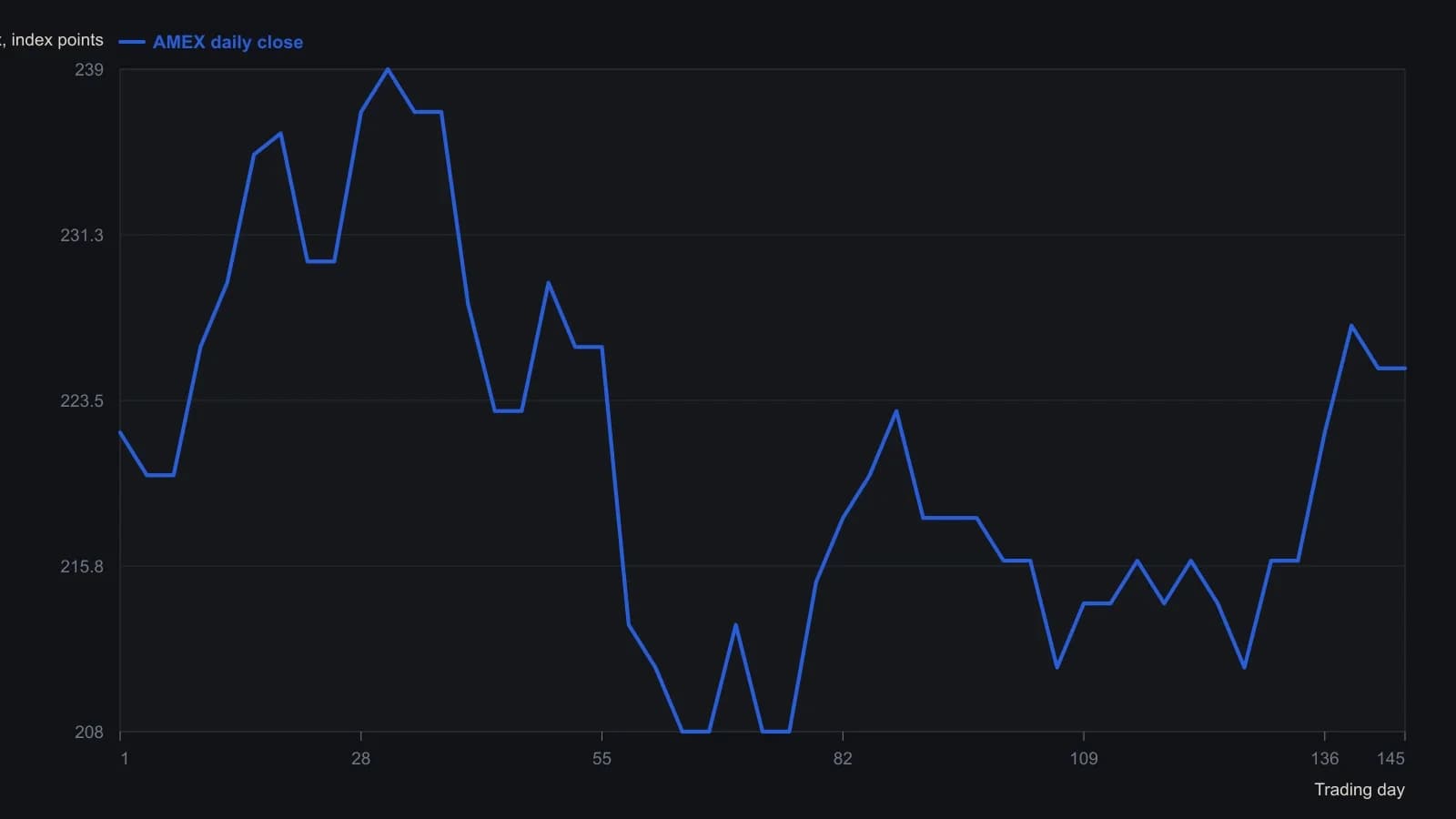
Y-scale is inverted on the source plate (lower index prints higher on the page). Points are approximate readings from the raster; the source printed no numeric table of these closes. Window length was 82 days on differenced data.
Forecast path and later comparison
The resulting forecast path was later plotted against realized index values that were unknown when the forecast was made. The forecast specified an 11.4 percent decline over about 30 trading days, from roughly 227 to 202, including a turning point against then-prevailing bullish sentiment.
The forecast-gate tests
A forecast-gate is a pair of precommitted tests, a minimum percent change and a minimum duration, that decide whether any option is bought. A position was contemplated only when the forecast showed a move of about 6 percent or more lasting about 20 trading days or longer. This run cleared both gates.
Index long-put structures
A long-put is a purchased put whose loss is limited to the premium and whose value rises if the underlying index falls. Index options were chosen over single-name options so that one-security misspecification risk was reduced, loss stayed limited to premium paid, and capital stayed leveraged to the forecasted index path.
Two purchase structures were defined. An in-the-money-put has a strike already on the profitable side of the index, so little of the premium is pure time value. The case allowed well in-the-money puts with little time premium. An out-of-the-money-put has a strike still beyond the current index, so the entire premium is time value unless the forecasted decline crosses that strike. The case also allowed far out-of-the-money puts whose strike was expected to be crossed if the forecasted decline occurred. The case used the far out-of-the-money structure, buying February 210 puts at a price of 1/8.
The later path and the inspection table
During the forecast horizon the index fell from a recent high of 227 to a low of 204. Half the puts were later closed at 1 and the rest at 4. A subsequent table of index closes and option prices was supplied so both purchase structures could be inspected against the same later path.
All readings on this track · 22 readings
- 1984A long silver put as a prepaid loss cap
- 1984Spectral window gates for index long puts
- 1990Breadth nonconfirmation as the gate for a volume fade and long-put case
- 2002Volatility-first construction for a bearish put or debit
- 2002Name the regime and the season before choosing a long put
- 2005Critique of put spreads versus outright long puts
- 2007Sector put hedges, automatic exercise, and pin risk
- 2008Margin shock, defined-debit options, and selective premium
- 2008Ranking in-the-money puts by breakeven rather than cheapest premium
- 2012Evaluating long-put moneyness when implied volatility shifts
- 2012Sizing a long butterfly for early assignment and a long option for gamma
- 2013Gold after the April break: option-spread vehicles and a long-put hedge
- 2014A defined-risk option case for the mid-February to mid-July energy window
- 2014Long put versus vertical debit spread on a Treasury ETF
- 2015Defined debit call spread on a health-insurer worksheet
- 2015Overbought technology index: a long put via an inverse proxy
- 2018Replace futures stops with short-dated long puts
- 2018Constructing short-dated long puts around weekly expiration
- 2018Four decisions before a portfolio protective put
- 2018Incremental producer hedging with puts and risk reversals
- 2019Put butterfly versus long put in a volatility spike
- 2020Scenario-first SPY put hedge: butterfly versus long put