2014issue C0418-19
Long put versus vertical debit spread on a Treasury ETF
Editorial framing treats a rate-policy thesis as a two-gate options lab. First lock a long-bond ETF target and holding window from the chart range. Then run one long put and one vertical debit put spread against that same target so debit, breakeven, and the short-strike cap become comparable signals.
- A 20-year Treasury bond ETF was used as a bond-etf-proxy so an equity-options process could express a Treasury view without futures.
- A directional option structure was considered only after a price-and-time-gate set a bearish outlook near 100 and a May expiration with 100 days remaining.
- The long-put bought May 106 puts for 287 per contract and needed the ETF at or below 103.13 to break even. The vertical-debit-spread sold a May 100 put against that long put, lowering the net debit to 217 and capping reward at 383.
- Relative to the standalone long put, the option-spread reduced net debit and defined risk while capping payoff if the ETF reached 100 by May expiration, then required an early-exit-monitor.
A bond-etf-proxy for the Treasury view
The archive presented a 20-year Treasury bond ETF as a bond-etf-proxy. A bond-etf-proxy is a long-maturity Treasury exchange-traded fund used as an options underlying so an equity-options process can express a fixed-income view without using futures. The fund was treated as an options-accessible proxy that tracks Treasury market moves.
In the last six months of 2013, the source context described Treasuries falling about 20% while interest rates rose, after policymakers began pulling back on bond purchases. From October 2013 the long-bond ETF was described as forming a widening cone of higher highs and lower lows, with both the 2013 lows and the recent highs expected to be tested.
Editorial reading: that cone supplies the first gate. A rate-policy thesis is not yet a structure. It becomes one only after a target price and a holding window are written down.
The price-and-time-gate
A directional option structure was considered only after a bearish price outlook near 100 was set for the ETF. The price-and-time-gate is the requirement to specify both a target price and an expiration window before choosing among directional option structures.
The archive then used May options with 100 days to expiration, so the same target and expiration window applied to both structures that followed.
Long put against the same target
The long-put case bought May 106 puts with 100 days to expiration for 287 per contract. A long-put is a single-leg purchase that pays premium for the right to sell the underlying at a stated strike before expiration. Breakeven is the strike minus the debit, and leftover time value can decay even if the directional view is later correct.
This case needed the ETF at or below 103.13 by expiration to break even.
Vertical debit spread against the same target
The vertical-debit-spread bought that May 106 put and sold the May 100 put. A vertical-debit-spread is a same-expiration put spread that buys a higher strike and sells a lower strike for a net debit, limiting loss to that debit and capping gain at the strike width minus the debit.
The short-leg credit lowered the net debit to 217 and capped reward at 383 because of the short-strike obligation at or below 100. An option-spread is a multi-leg options structure that pairs a long option with a short option so the credit from the short leg changes net debit, defined risk, and payoff relative to a single-leg trade.
Relative to the standalone long put, the option-spread case reduced net debit and defined risk while also capping the payoff if the ETF reached 100 by the May expiration.
Expiration P&L on the TLT May 106 put versus the 106/100 debit spread
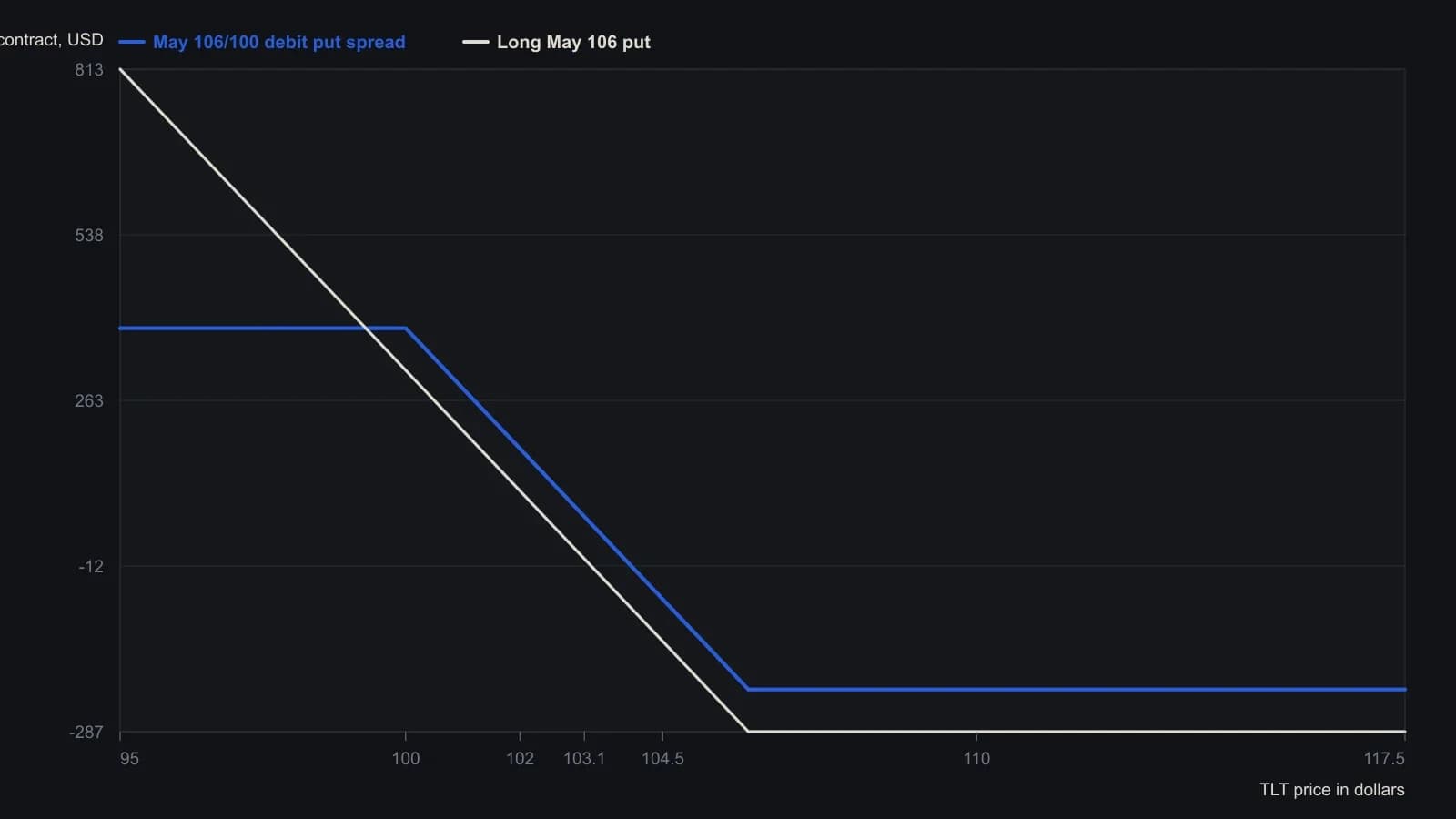
Only the May 14 expiration payoff implied by those fills is plotted. The colored marks-to-market before expiration on the platform screenshot are not used.
Compare first, then watch for an early exit
The comparison procedure required a price-and-time outlook first, then a risk-reward comparison of long-put and option-spread structures, then monitoring for possible exits before expiration.
That last step is the early-exit-monitor: review of an open options position before expiration, because the underlying can reach or fail the thesis while time premium is still changing.
Editorial note: TradersWeek treats debit, breakeven, and the short-strike cap as the comparable signals from the second gate. The archive does not rank the two structures.
All readings on this track · 22 readings
- 1984A long silver put as a prepaid loss cap
- 1984Spectral window gates for index long puts
- 1990Breadth nonconfirmation as the gate for a volume fade and long-put case
- 2002Volatility-first construction for a bearish put or debit
- 2002Name the regime and the season before choosing a long put
- 2005Critique of put spreads versus outright long puts
- 2007Sector put hedges, automatic exercise, and pin risk
- 2008Margin shock, defined-debit options, and selective premium
- 2008Ranking in-the-money puts by breakeven rather than cheapest premium
- 2012Evaluating long-put moneyness when implied volatility shifts
- 2012Sizing a long butterfly for early assignment and a long option for gamma
- 2013Gold after the April break: option-spread vehicles and a long-put hedge
- 2014A defined-risk option case for the mid-February to mid-July energy window
- 2014Long put versus vertical debit spread on a Treasury ETF
- 2015Defined debit call spread on a health-insurer worksheet
- 2015Overbought technology index: a long put via an inverse proxy
- 2018Replace futures stops with short-dated long puts
- 2018Constructing short-dated long puts around weekly expiration
- 2018Four decisions before a portfolio protective put
- 2018Incremental producer hedging with puts and risk reversals
- 2019Put butterfly versus long put in a volatility spike
- 2020Scenario-first SPY put hedge: butterfly versus long put