2008issue C061-2
Margin shock, defined-debit options, and selective premium
The archive used a grain-margin shock to compare a mini-contract with a long-put and an iron-butterfly when implied-volatility was elevated. A TradersWeek editorial reading is that an option-income-strategy is eligible only after range and standard-deviation extremes argue that volatility is more likely to compress than extend.
- A mini-contract cut the dollar change per one-cent move to 10 from 50, but daily-limit translations still left 1050 and 700 one-day swings on the mini bean and mini wheat.
- A long-option-only book, including an out-of-the-money countertrend long-put, limited loss to the premium paid, unlike futures or spreads that leave naked legs.
- A soybean iron-butterfly debit of about 25 cents prepaid a 1250 entry, limited risk to that debit, and was given 5750 of maximum potential before transaction costs.
- Higher implied-volatility was said to raise both premiums and the risk those richer prices embed, so an option-income-strategy was reserved for countertrend sales after range and standard-deviation extremes.
Instrument choice after a margin shock
Full-sized corn margin was described as having risen from near 400 to a 2025 account minimum to hold one contract. Exchange margins on many popular futures were said to have doubled, tripled, or more.
A TradersWeek editorial reading is that the shock is a classroom for instrument choice under elevated implied-volatility. First decide whether a smaller futures unit still leaves an uncapped path. Then compare a debit-only long-put and a defined-width iron-butterfly as prepaid capital caps. Treat an option-income-strategy as eligible only after range and standard-deviation extremes argue that volatility is more likely to compress than extend.
A mini-contract still left an uncapped path
Mini grain futures were sized as a mini-contract at one-fifth of the matching full contract, producing a 10 rather than 50 dollar change per one-cent move. Posted margins were 405 for mini corn, 1215 for mini wheat, and 2025 for mini soybeans, versus 4388 for soybean futures.
Session daily-limit moves were translated into mini-contract dollar swings. A 1.05 soybean daily-limit implied a 1050 one-day fluctuation on the mini bean. A 70-cent wheat daily-limit implied 700 on the mini wheat.
Posted grain-futures margins after the hike
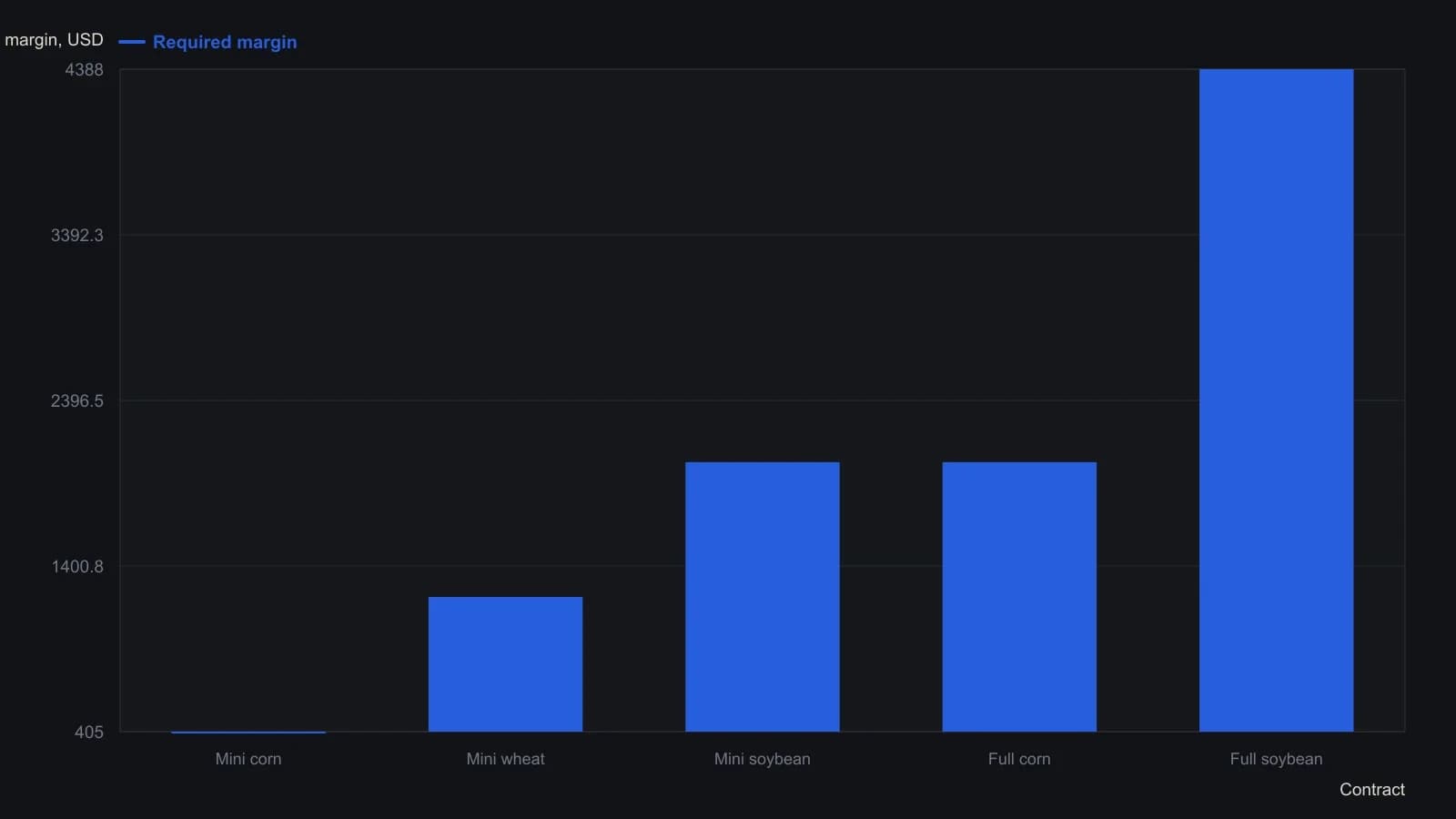
Margins are the exchange figures quoted at the time of writing in the June 2008 column. The earlier full-sized corn level described only as near $400 is omitted so the bars stay contemporaneous.
A long-put as a defined debit
A long-option-only book was presented as a way to enter highly volatile commodity markets with loss limited to the premium paid. That book was contrasted with futures or option spreads that leave naked legs.
After soybeans and wheat were cited at 16 and 13, out-of-the-money countertrend long-put positions were framed as a low-probability strike-breakthrough with a large payoff if it occurred. The same procedure was described as one that could absorb several worthless expirations first.
An iron-butterfly as a prepaid width
A soybean iron-butterfly debit was specified as buy the July 1260 call, sell two 1400 calls, and buy the 1540 call for about 25 cents. That construction was given a 1250 entry cost and a 5750 maximum potential before transaction costs, with risk limited to the debit paid.
Editorial note: both the long-put and the iron-butterfly were treated as prepaid capital caps. The long-put spent a single premium. The iron-butterfly spent a net debit that capped both cost and upside.
When an option-income-strategy was eligible
The rule of thumb that one sells premium after volatility expands and buys it when markets are quiet was treated as incomplete, because a short-option book is exposed if implied-volatility can still rise further.
Higher implied-volatility was said to raise option premiums and, correspondingly, the risk embedded in those richer prices rather than making short premium automatically cheaper to hold.
For Treasury and stock-index futures, short-premium income trades were reserved for countertrend sales after extremes defined by trading ranges and standard deviations, not for mid-range conditions. A TradersWeek editorial reading is that an option-income-strategy becomes eligible only after those range and standard-deviation extremes argue that volatility is more likely to compress than extend.
All readings on this track · 22 readings
- 1984A long silver put as a prepaid loss cap
- 1984Spectral window gates for index long puts
- 1990Breadth nonconfirmation as the gate for a volume fade and long-put case
- 2002Volatility-first construction for a bearish put or debit
- 2002Name the regime and the season before choosing a long put
- 2005Critique of put spreads versus outright long puts
- 2007Sector put hedges, automatic exercise, and pin risk
- 2008Margin shock, defined-debit options, and selective premium
- 2008Ranking in-the-money puts by breakeven rather than cheapest premium
- 2012Evaluating long-put moneyness when implied volatility shifts
- 2012Sizing a long butterfly for early assignment and a long option for gamma
- 2013Gold after the April break: option-spread vehicles and a long-put hedge
- 2014A defined-risk option case for the mid-February to mid-July energy window
- 2014Long put versus vertical debit spread on a Treasury ETF
- 2015Defined debit call spread on a health-insurer worksheet
- 2015Overbought technology index: a long put via an inverse proxy
- 2018Replace futures stops with short-dated long puts
- 2018Constructing short-dated long puts around weekly expiration
- 2018Four decisions before a portfolio protective put
- 2018Incremental producer hedging with puts and risk reversals
- 2019Put butterfly versus long put in a volatility spike
- 2020Scenario-first SPY put hedge: butterfly versus long put