2002issue C091-2
Volatility-first construction for a bearish put or debit
A bearish view can be built as a construction checklist. The implied-volatility regime decides whether an outright long put is admissible. That defined debit is then compared with short-stock margin and with a vertical debit that spends some upside to shrink the cost basis.
- When names already looked inexpensive and implied volatility was judged low, the construction chosen was simply to buy 60- to 90-day puts rather than a more complex structure.
- A long 100-strike put at a 10-point cost, or 1,000, was described as 80 percent less than a short-stock margin example of 5,000 to sell 100 shares at 100, while the put still loses its premium if the underlying is at or above the strike at expiration.
- A vertical debit that buys a 100 put and sells an 80 put lowers the net debit and caps profit potential, so the width between the long and short strikes is treated as a selectivity choice.
- Construction was framed as three concurrent inputs: strike selection versus risk and reward, enough calendar time for the directional view, and a volatility regime that favors buying options outright when volatility is low and spreading risk when it is higher.
A checklist rather than a single trade
Editorial reading: treat a bearish view as a construction checklist rather than as one automatic trade. The first decision is whether the implied-volatility regime makes an outright long put admissible. Only after that gate is the same view compared with short-stock margin and with a vertical debit spread.
Editorial teaching point: strike, holding window, and volatility are joint design inputs. Entry, exit, and standing aside then stay one testable procedure.
When an outright long put is admissible
When names already looked inexpensive and implied volatility was judged low, the construction chosen was simply to buy 60- to 90-day puts rather than a more complex structure. That 60- to 90-day expiration range is the holding window specified for the outright put construction.
A long put is a purchased put that creates a defined-debit bearish position. Loss is limited to the premium paid. The 100-share equivalent does not require short-stock margin.
Compare the debit with short-stock margin
A short-stock alternative was illustrated with 5,000 of margin to sell 100 shares at 100, equal to 50 percent of the stock price, and with theoretically unlimited risk if the stock rose. Short-stock margin is capital posted to sell shares short. In that illustration it is a large fraction of the stock price and is paired with theoretically unlimited upside risk.
In that short-stock illustration, the largest gain was 100 per share and only if the stock declined to zero.
A long 100-strike put was illustrated at a 10-point cost, or 1,000, described as 80 percent less than the short-stock margin example while still referencing a 100-share equivalent. The long-put construction remains exposed to loss of the premium if the underlying is at or above the strike at expiration.
Spend some upside to shrink the debit
When the implied-volatility regime does not favor buying the put outright, an option spread is the alternative construction. An option spread is a multi-leg construction that offsets part of a long-option debit by selling another option so risk and reward are jointly constrained.
The vertical debit construction buys a 100 put and sells an 80 put so premium collected on the short strike reduces the net debit of the position. Net debit is the remaining cash outlay after that collected premium is subtracted from the long-option cost.
That same vertical debit also caps profit potential, which is why the width between the long and short strikes is treated as a selectivity choice. A vertical debit spread is a same-side put pair that buys a higher strike and sells a lower strike, lowering the net debit while capping the maximum gain.
Capital to hold a 100-share IBM bearish view
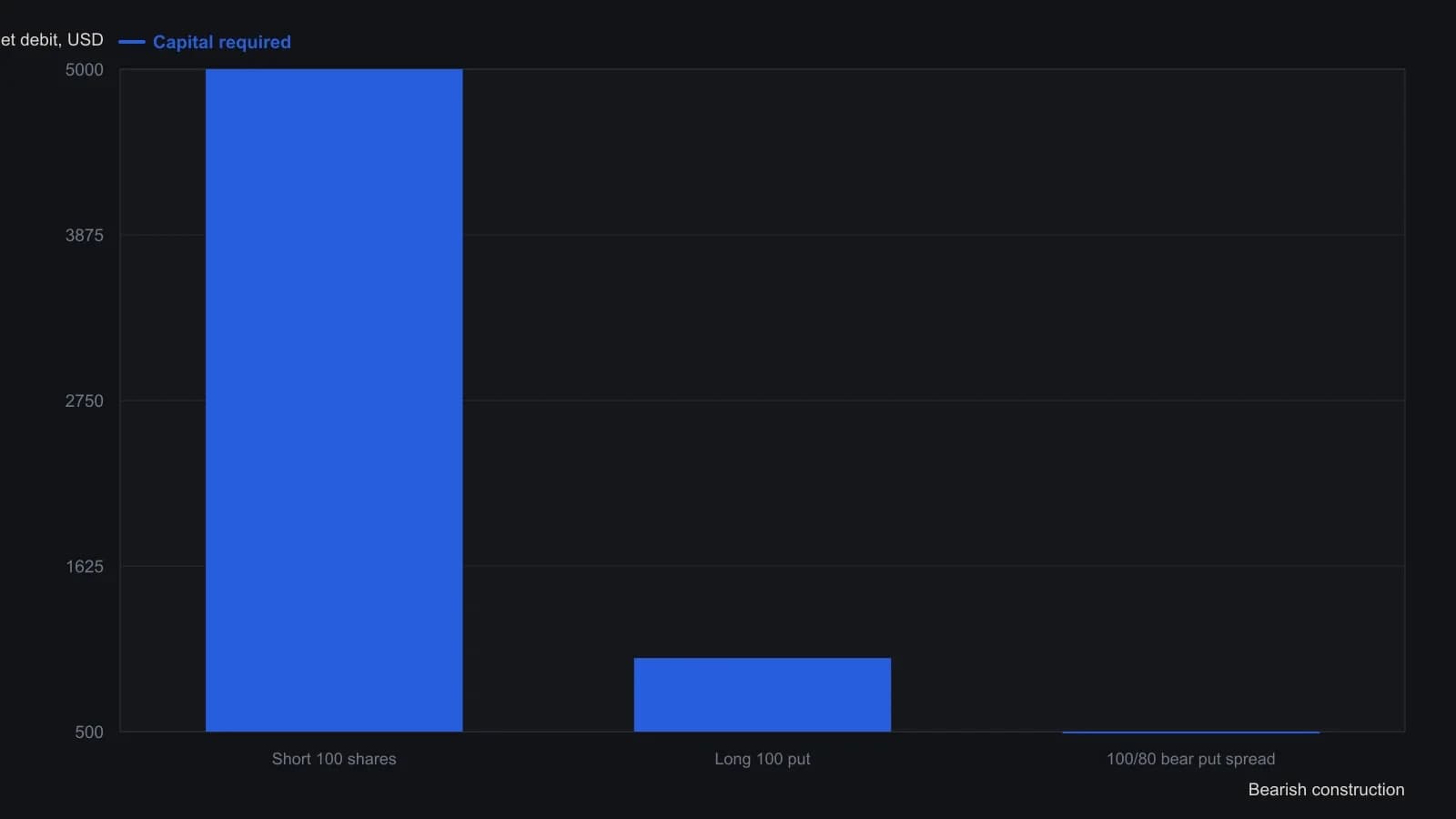
The $500 spread outlay is the Figure 3 maximum-loss label, which matches a $20-wide put debit whose maximum profit is printed as $1,500. Source payoff sketches are marked not to scale; this chart uses only the stated cash amounts, not digitized curves.
Three concurrent construction inputs
Construction was framed as three concurrent inputs: strike selection versus risk and reward, enough calendar time for the directional view, and a volatility regime that either favors buying options outright or spreading the risk.
Editorial reading: those three inputs belong in one procedure. The implied-volatility regime can admit the outright long put, move the same view into a vertical debit, or require standing aside.
All readings on this track · 22 readings
- 1984A long silver put as a prepaid loss cap
- 1984Spectral window gates for index long puts
- 1990Breadth nonconfirmation as the gate for a volume fade and long-put case
- 2002Volatility-first construction for a bearish put or debit
- 2002Name the regime and the season before choosing a long put
- 2005Critique of put spreads versus outright long puts
- 2007Sector put hedges, automatic exercise, and pin risk
- 2008Margin shock, defined-debit options, and selective premium
- 2008Ranking in-the-money puts by breakeven rather than cheapest premium
- 2012Evaluating long-put moneyness when implied volatility shifts
- 2012Sizing a long butterfly for early assignment and a long option for gamma
- 2013Gold after the April break: option-spread vehicles and a long-put hedge
- 2014A defined-risk option case for the mid-February to mid-July energy window
- 2014Long put versus vertical debit spread on a Treasury ETF
- 2015Defined debit call spread on a health-insurer worksheet
- 2015Overbought technology index: a long put via an inverse proxy
- 2018Replace futures stops with short-dated long puts
- 2018Constructing short-dated long puts around weekly expiration
- 2018Four decisions before a portfolio protective put
- 2018Incremental producer hedging with puts and risk reversals
- 2019Put butterfly versus long put in a volatility spike
- 2020Scenario-first SPY put hedge: butterfly versus long put