2012issue C0960-62
A two-pass reading of listed currency sleeves
A translation-sleeve tracks one exchange rate versus the US dollar and still changes a portfolio's currency mix. This article first places that rate in commodity, carry, and risk-appetite context, then uses a paired index-proxy so one trend rule can participate, flip, or wait.
- A translation-sleeve tracks one exchange rate versus the US dollar and still changes a portfolio's currency mix, even though it does not diversify across several currencies.
- The Australian-dollar sleeve was treated as a commodity-currency translation of gold, the broader commodity complex, Chinese demand, and domestic policy-rate cuts, with a daily 20-session average as the support reference for the 2012 advance.
- A daily-leverage-reset pair of euro sleeves let the same euro-dollar trend be expressed from either side, while persistent euro-area weakness and risk aversion explained why the leveraged long side sat near a June 2010 low.
- The case used trend-abstention: leave the leveraged long-euro sleeve on a watchlist until an optimism shift produced an early uptrend, and keep attention on the inverse sleeve while the weak-euro regime persisted.
One rate, not a currency basket
A translation-sleeve is a single-currency listed fund that converts one exchange rate versus the US dollar into a portfolio-usable instrument. In the archive case, those exchange-traded sleeves tracked one exchange rate versus the US dollar rather than a multi-currency basket.
Those sleeves still changed a portfolio's currency mix even though they did not diversify across several currencies.
In the mid-2012 snapshot, currency sleeves were described as carrying higher expense ratios than equity funds even when they held one currency. Their interest and price changes were taxed as ordinary income regardless of holding period.
The Australian dollar as a commodity-currency overlay
The Australian-dollar sleeve was treated as a commodity-currency translation of gold, the broader commodity complex, Chinese demand, and domestic policy-rate cuts. A commodity-currency is a currency whose medium-horizon path is read through metals, the broader commodity complex, and related demand conditions.
A daily 20-session average was used as the support reference for the Australian-dollar sleeve's 2012 advance. A nearby shelf near 103 was the test of whether the move could continue.
FXA daily closes versus the 20-day average
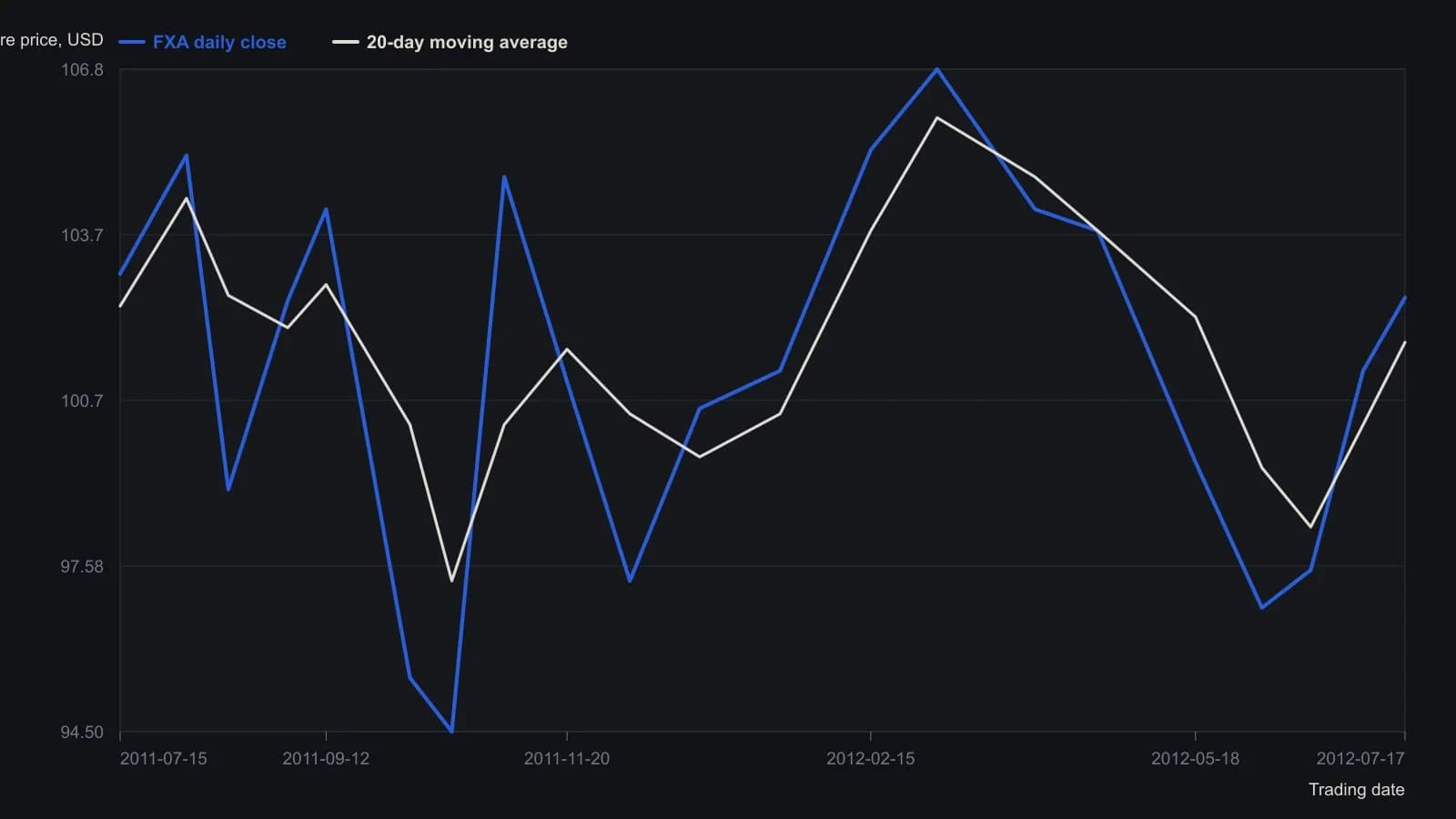
Digitized at swing and mid-month spacing from a daily raster, so values are approximate to about half a point. The long lower wick near 93.5 in early June is an intra-bar spike and is not in the close series.
A paired euro index-proxy
An index-proxy is a listed sleeve used as a stand-in for a currency or regional regime instead of trading the cash pair. One euro sleeve was specified to target twice the daily US-dollar price of the euro. A paired sleeve was specified to target twice the inverse of that daily move.
That pair follows a daily-leverage-reset design. The fund aims at a multiple of one day's currency move rather than a multi-day compounded path.
The inverse euro sleeve was read as the chart-level counterpart of the leveraged long-euro sleeve, so the same euro-dollar trend could be expressed from either side.
A regime-filter that chooses a side or a wait
Persistent euro-area weakness and risk aversion were the regime used to explain why the leveraged long-euro sleeve sat near a June 2010 low just under 21. A regime-filter is a cross-market backdrop, such as carry, risk appetite, or regional growth, that decides which proxy side is relevant.
The case framed a trend procedure as leaving the leveraged long-euro sleeve on a watchlist until an optimism shift produced an early uptrend, and keeping attention on the inverse sleeve while the weak-euro regime persisted. Trend-abstention is a rule that withholds entry until a moving-average or early-uptrend test is met, rather than forcing a side.
Editorial reading: once the regime-filter has chosen the relevant index-proxy side, the same trend rule can participate, flip to the counterpart sleeve, or wait. That two-pass sequence is a TradersWeek teaching overlay, not an extra archive claim.
All readings on this track · 25 readings
- 1989Constructing currency-translated commodity bars
- 1992Gold, the dollar, and a foreign-currency proxy
- 1993Overseas fund translation after the European currency break
- 1995Inflation-ratio overlays, peso breaks and election cycles
- 2002A liquidity filter and intermarket overlay for one currency setup
- 2002Classify a weak-dollar regime before overseas sales and index proxies
- 2003A currency pair as a regime spread with trend and leverage bounds
- 2005Score a currency position as a cross-market portfolio
- 2005CAD/JPY as an oil translation: correlation, carry, and portfolio role
- 2006Placing a currency trade inside a gold, oil, and yield regime
- 2006Classifying the yen regime after Japan's liquidity exit
- 2006Two horizons in the 2006 euro-dollar advance
- 2007Rolling-window tests for gold hedge slogans
- 2010Stacking commission and currency costs on international fills
- 2010A dollar-pivot intermarket regime for currency pairs
- 2010Constructing currency pairs from basket relative strength
- 2012Same-way versus opposite-way currency pair construction
- 2012Signed two-currency session spread construction
- 2012A two-pass reading of listed currency sleeves
- 2013Closed foreign futures still leave a leftover currency line
- 2014Forex pair ranks from seven cross-currency scores
- 2015Currency translation across rate and trade regimes
- 2015Ten-year policy phases and FX capital-flow regimes
- 2016A peaking dollar and the commodity as a two-market case
- 2017S&P 500 energy gauge as a short-horizon regime filter