2003issue C121-8
A currency pair as a regime spread with trend and leverage bounds
This archive case reads a spot ticket as currency-translation first. It locates the pair inside dollar-anchored volume, an overnight-differential, and a calmer daily-range regime than equities, then lets a same-pair trend-stack grant or withhold permission, and only then applies a leverage-ceiling so a signal cannot outrun the pip-spread.
- A spot ticket is currency-translation: one currency is bought as the other is sold, so return, overnight-differential, and regime are relative between two units.
- Four dollar-anchored pairs form the main map, with dollar/euro, dollar/yen, and dollar/sterling carrying most volume, and the euro sample sitting in a narrower daily-range regime than the equity-index sample.
- A trend-stack uses the daily view to identify the larger trend and block opposite entries, the four-hour view to choose the position, and the hourly view to time entry and exit.
- A 5-to-1 leverage-ceiling and a 2-to-4 percent of capital risk cap, with a target larger than the stop, bound exposure before the ticket is sent.
A pair is a two-legged ticket
A spot currency ticket is the simultaneous purchase of one currency and sale of another. In this archive case that reading is currency-translation: returns, carry, and regime are relative between two units rather than an outright on a single name.
The most-used set is five currencies forming four dollar-anchored pairs: the euro against the dollar, sterling against the dollar, the dollar against the yen, and the dollar against the Swiss franc.
Dollar-anchored volume sets the map
In the pair-volume breakdown, dollar/euro was 30 percent of activity, dollar/yen 19.6 percent, and dollar/sterling 10.7 percent, with other dollar crosses each under 5 percent.
Editorial note: those shares place a single ticket inside a dollar-centered regime rather than treating every cross as equally central.
A long dollar decline on the euro pair
On the euro/dollar weekly history through mid-2003, the dollar fell from 1.14 euros in December 2001 to 0.83 euros, a decline of more than 28 percent, after an October 2000 extreme near 1.21 euros.
Editorial note: that weekly path is regime context for the pair, not a signal on its own.
Weekly EURUSD from the 1998 launch window through the 2000 low
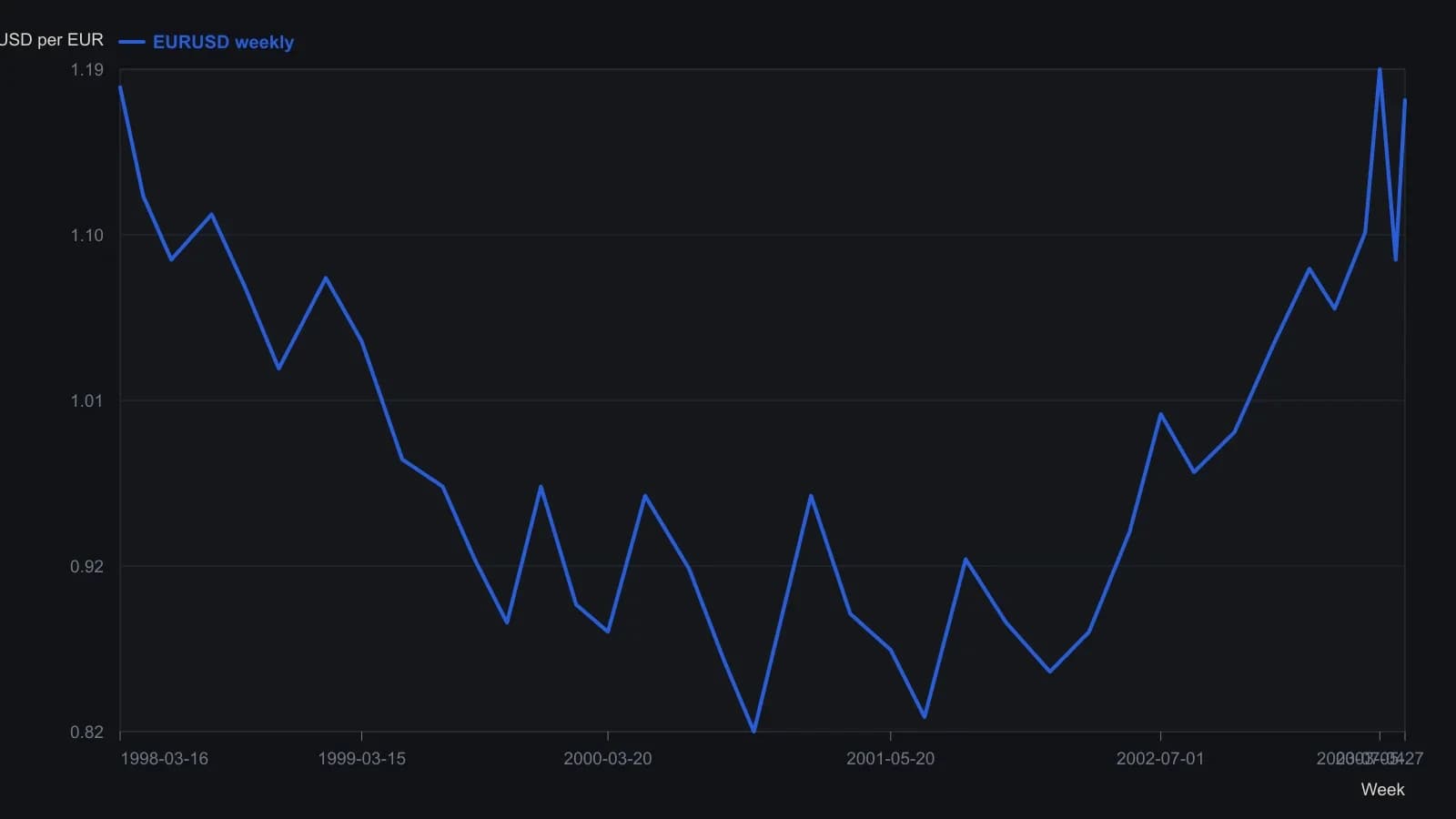
Printed weekly candles, not exchange prints. Readings are approximate mid-candle levels at about 10-pip resolution. The October 2000 low near 0.825 matches the article’s $1 = 1.21 euros waypoint.
A calmer daily-range regime than equities
In the 2001 daily-range comparison, the equity-index sample included moves greater than 4.5 percent while the euro sample clustered near 1 percent, remaining inside a 0.5 percent range on 142 of about 250 sessions.
Editorial note: the pair is located in that quieter volatility regime before a trend-stack is allowed to grant a position.
A same-pair trend-stack grants or withholds permission
The procedure stacks three charts of the same pair: a daily view to identify the larger trend and block opposite entries, a four-hour view to choose the position, and an hourly view to time entry and exit.
Editorial note: the daily view is permission. The four-hour and hourly views may act only in the direction the daily view allows.
Weekly, daily, and four-hour overlays
Weekly charts use 5-, 13-, and 40-period averages with 20-period, two-deviation bands and MACD 25-12-9. Daily charts shorten bands to five periods and add MACD 22-12-9 plus slow stochastic 5-3-3. Four-hour charts use 6-, 12-, 30-, and 132-period averages keyed to day, two-day, week, and month spans.
Round pip levels and deep retracements
The quoted transaction cost is a pip-spread, where one pip is 0.01 percent, replacing a commission on the spot ticket.
Round 20- and 80-pip levels are treated as recurring support and resistance, and 50 percent retracements against a 200-day average are treated as pause or profit-taking zones on large pair moves.
A leverage-ceiling before the ticket is sent
Exposure is bounded before entry by a 5-to-1 leverage-ceiling and a 2-to-4 percent of capital risk cap with a target larger than the stop. At that leverage the smallest listed spot ticket of 500,000 dollars would require 100,000 dollars of equity, in contrast to offerings as high as 200-to-1.
Editorial note: a granted trend-stack signal still sits under that leverage-ceiling so exposure cannot outrun the pip-spread.
All readings on this track · 25 readings
- 1989Constructing currency-translated commodity bars
- 1992Gold, the dollar, and a foreign-currency proxy
- 1993Overseas fund translation after the European currency break
- 1995Inflation-ratio overlays, peso breaks and election cycles
- 2002A liquidity filter and intermarket overlay for one currency setup
- 2002Classify a weak-dollar regime before overseas sales and index proxies
- 2003A currency pair as a regime spread with trend and leverage bounds
- 2005Score a currency position as a cross-market portfolio
- 2005CAD/JPY as an oil translation: correlation, carry, and portfolio role
- 2006Placing a currency trade inside a gold, oil, and yield regime
- 2006Classifying the yen regime after Japan's liquidity exit
- 2006Two horizons in the 2006 euro-dollar advance
- 2007Rolling-window tests for gold hedge slogans
- 2010Stacking commission and currency costs on international fills
- 2010A dollar-pivot intermarket regime for currency pairs
- 2010Constructing currency pairs from basket relative strength
- 2012Same-way versus opposite-way currency pair construction
- 2012Signed two-currency session spread construction
- 2012A two-pass reading of listed currency sleeves
- 2013Closed foreign futures still leave a leftover currency line
- 2014Forex pair ranks from seven cross-currency scores
- 2015Currency translation across rate and trade regimes
- 2015Ten-year policy phases and FX capital-flow regimes
- 2016A peaking dollar and the commodity as a two-market case
- 2017S&P 500 energy gauge as a short-horizon regime filter