2010issue C018-9
Stacking commission and currency costs on international fills
As of 5 November 2009, advertised international access, commissions, venue levies, and foreign-currency settlement differed across four compared retail broker-dealers. The editorial reading is to price those lines as one implementation-cost stack, then match order-type choice to the market's behavior before a fill is treated as executable.
- Implementation cost is the full stack: advertised commission, venue levies, settlement fees, and any currency-conversion markup.
- Only two of four compared platforms advertised online international trading with foreign-currency settlement, real-time local-currency quotes, and a longer list of markets and settlement currencies.
- Hong Kong tickets in the comparison added principal-based levies, stamp duty on both buys and sells, and on one platform a clearing-and-settlement fee with a floor and a cap.
- The accompanying historical editorial held that an executable exit still depends on order-type choice after the market is identified as volatile, trending, range-bound, strongly directional, or drifting.
Price the international ticket as one stack
As of 5 November 2009, two of four compared retail broker-dealers advertised online international trading with foreign-currency settlement. The other two did not. Among the two platforms that advertised the service, listed market access was 12 versus 6 and listed settlement currencies were 8 versus 6. Those two platforms advertised real-time international quotes in local currency. The two without the service did not.
The editorial reading is that access, quote currency, posted commission, venue levies, and the settlement path belong in one implementation-cost stack. A fill is not treated as executable until that stack is known and the instruction matches how the market is behaving.
What the advertised schedules showed
Advertised online commissions for a Hong Kong stock trade were HKD 250 versus HKD 299 before additional venue charges. Advertised local-market online commissions also differed in Canada at CAD 19 versus 19.99, in France and Germany at EUR 19 versus 19.99, in Japan at JPY 3000 versus 3399, and in the United Kingdom at GBP 9 versus 9.99.
The editorial reading is that a posted commission is only the first line of the stack. It is not, by itself, an executable price.
Venue levies on Hong Kong fills
Hong Kong trades also carried principal-based charges of 0.004 percent as a transaction levy, 0.005 percent as a trading fee, and 0.10 percent as stamp duty on both buys and sells. One compared platform added a 0.002 percent clearing-and-settlement fee with a HKD 2.00 floor and a HKD 100.00 cap.
A venue levy is a percentage-of-principal exchange or clearing charge added on top of the broker's posted commission. The editorial reading is to add those levies before treating the Hong Kong ticket as complete.
Advertised online international markets and settlement currencies
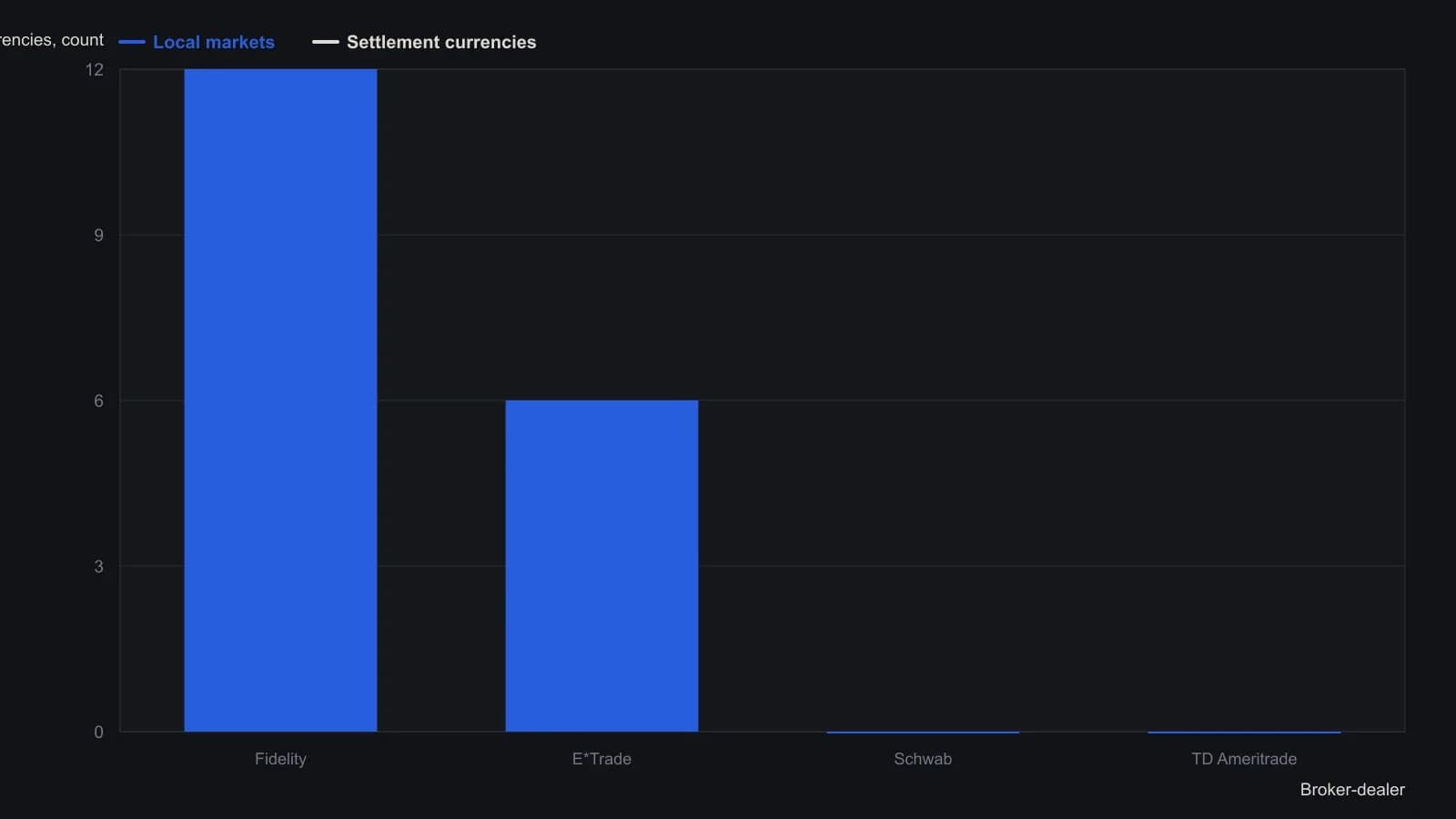
The advertisement verified the comparison as of 5 November 2009 and defined the basis as each broker-dealer’s online international offering, including the ability to settle in foreign currency. Entries marked NO are shown as zero offerings. Fidelity’s desk was limited to households with at least 120 stock, bond, or options trades in a rolling 12-month period and $25,000 in eligible assets. Posted Hong Kong commissions were HKD 250 at Fidelity and HKD 299 at E*Trade and are omitted here because only two brokers quoted a number.
Foreign-currency settlement and translation
Foreign-stock settlement could be in US dollars or local currency, and affiliate currency conversion could include a markup relative to unaffiliated third-party rates. Foreign-currency settlement means completing a non-domestic stock trade in the market's local currency instead of converting the ticket into US dollars at the broker.
Currency translation converts a fill, fee, or holding from one currency into another so the trade can be compared with the rest of a portfolio. The accompanying historical editorial linked a slumping US dollar and a desire to diversify assets to financially driven commodity-price rises that were not matched by industrial-production levels seen in 2008.
The editorial reading is that currency translation belongs in the same stack as commission and venue levies whenever the ticket can settle in more than one currency.
Order-type choice after the stack is known
The accompanying historical editorial argued that an executable exit depends on order-type choice and on first identifying whether a market is volatile, trending, range-bound, strongly directional, or drifting with little momentum. Order-type choice is selecting an executable instruction that matches whether the market is volatile, trending, range-bound, or drifting with little momentum.
The editorial reading is that the cost stack states what the ticket will cost if it fills. It does not, by itself, make the fill executable.
All readings on this track · 25 readings
- 1989Constructing currency-translated commodity bars
- 1992Gold, the dollar, and a foreign-currency proxy
- 1993Overseas fund translation after the European currency break
- 1995Inflation-ratio overlays, peso breaks and election cycles
- 2002A liquidity filter and intermarket overlay for one currency setup
- 2002Classify a weak-dollar regime before overseas sales and index proxies
- 2003A currency pair as a regime spread with trend and leverage bounds
- 2005Score a currency position as a cross-market portfolio
- 2005CAD/JPY as an oil translation: correlation, carry, and portfolio role
- 2006Placing a currency trade inside a gold, oil, and yield regime
- 2006Classifying the yen regime after Japan's liquidity exit
- 2006Two horizons in the 2006 euro-dollar advance
- 2007Rolling-window tests for gold hedge slogans
- 2010Stacking commission and currency costs on international fills
- 2010A dollar-pivot intermarket regime for currency pairs
- 2010Constructing currency pairs from basket relative strength
- 2012Same-way versus opposite-way currency pair construction
- 2012Signed two-currency session spread construction
- 2012A two-pass reading of listed currency sleeves
- 2013Closed foreign futures still leave a leftover currency line
- 2014Forex pair ranks from seven cross-currency scores
- 2015Currency translation across rate and trade regimes
- 2015Ten-year policy phases and FX capital-flow regimes
- 2016A peaking dollar and the commodity as a two-market case
- 2017S&P 500 energy gauge as a short-horizon regime filter