1992issue C111-5
Gold, the dollar, and a foreign-currency proxy
A historical case study of the dollar-gold-inverse: first translate the dollar with a foreign-currency proxy, then separate shared trend direction from shared turning points, and finally overlay official dollar support when the inverse loosens.
- Gold has historically tended to trend opposite the U.S. dollar, so dollar shifts have often been treated as an early inflation or disinflation clue that can appear first in gold.
- Currency-translation compares gold with a major foreign-currency futures contract as a visual stand-in for an inverted dollar when the usual inverse is intact.
- After an established gold-currency link weakens, correlation-analysis checks whether the markets still share direction or only still share peaks and troughs.
- When the inverse loosens, a policy-intervention-overlay treats official support for the dollar as a contemporaneous event that can coincide with a gold peak.
The dollar-gold inverse
Gold has historically tended to trend opposite the U.S. dollar, so shifts in the dollar have often been treated as an early inflation or disinflation clue that can appear first in gold. That historical tendency is the dollar-gold-inverse.
The 1970s inflation episode featured a falling dollar alongside a gold advance. The 1980-1985 dollar rally coincided with a multi-year gold decline that reversed in the same February 1985 month the dollar made its decade high.
Translate the dollar with a foreign-currency proxy
Comparing gold with a major foreign-currency futures contract is a currency-translation device equivalent to inverting the dollar. Gold and that currency should trend together when the gold-dollar inverse is intact.
From 1983 through 1989 gold and the German mark showed a close positive correlation. They turned up together in early 1985 as the dollar peaked, down together in late 1987 as the dollar rallied, and up together again in 1989 as the dollar weakened.
Separate shared direction from shared turning points
After 1990 the gold-mark trend relationship deteriorated, with the mark strengthening while gold weakened. That pattern is consistent with prolonged economic weakness, falling U.S. interest rates, a weak dollar, and low U.S. inflation.
Even after that 1990 trend break, gold and the mark still shared closely timed peaks and troughs, including a late-1990 rebound, early-1991 and early-1992 downturns, and late-1991 and spring-1992 rallies. Editorial reading: that later state is peak-trough-alignment, a looser but still useful state in which two markets no longer trend together and yet still turn near the same times.
Overlay official dollar support when the inverse loosens
In the first seven months of 1992 the inverse gold-Dollar Index link remained visible: an early-year dollar rebound aligned with a gold decline, and an April dollar downturn aligned with a gold advance that lasted into mid-July.
The mid-July 1992 gold peak coincided with the same week of aggressive official intervention to support the dollar. After that week gold also faced pressure from a six-year low in a broad commodity index and weakness in related precious metals.
Gold versus the U.S. Dollar Index, January–August 1992
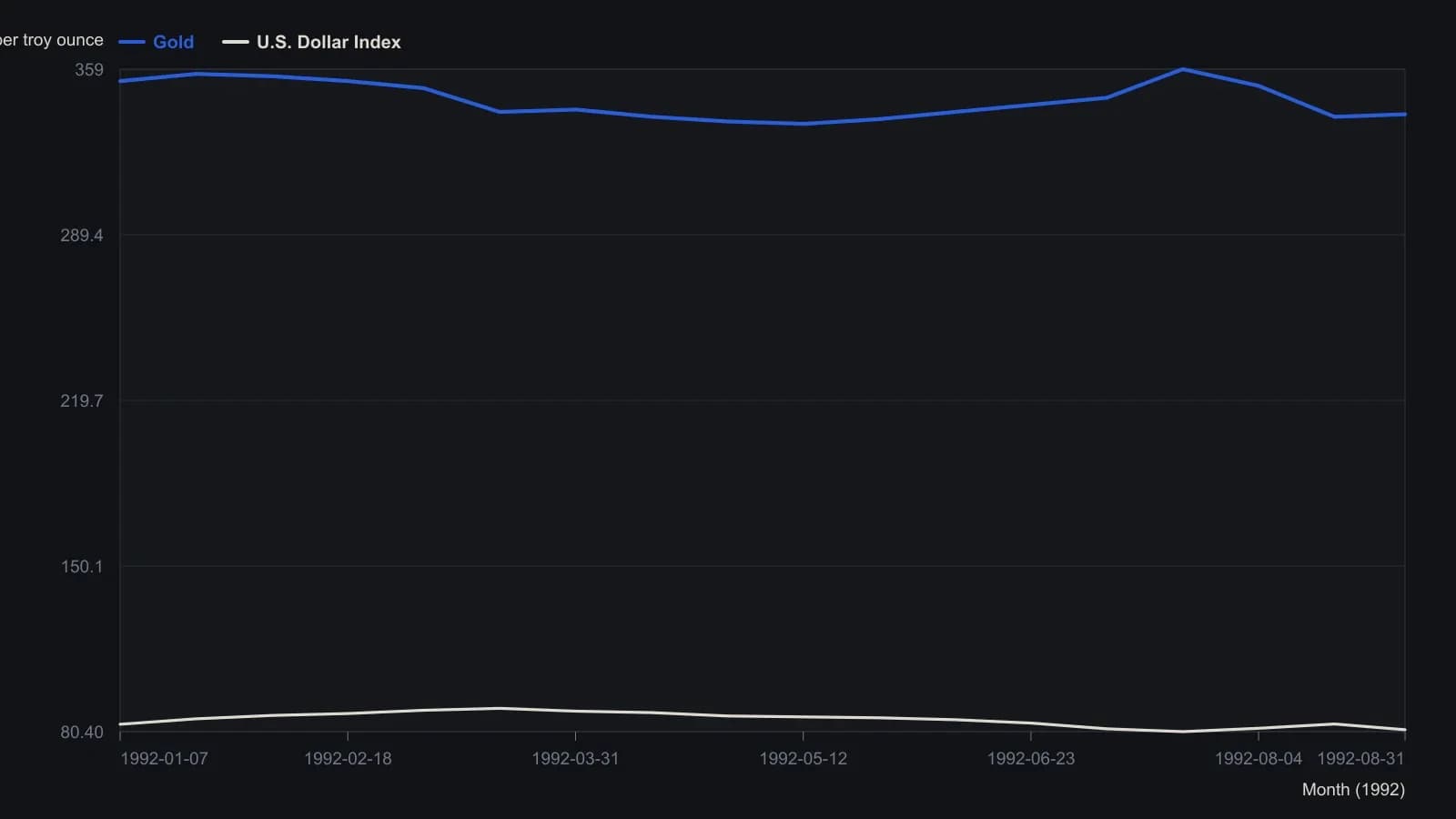
The source notes the mid-July gold peak coincided with aggressive central-bank dollar support; the August collapse also reflected a CRB six-year low and a plunge in platinum and silver. Dual-axis scan, so each series is in its own units.
All readings on this track · 25 readings
- 1989Constructing currency-translated commodity bars
- 1992Gold, the dollar, and a foreign-currency proxy
- 1993Overseas fund translation after the European currency break
- 1995Inflation-ratio overlays, peso breaks and election cycles
- 2002A liquidity filter and intermarket overlay for one currency setup
- 2002Classify a weak-dollar regime before overseas sales and index proxies
- 2003A currency pair as a regime spread with trend and leverage bounds
- 2005Score a currency position as a cross-market portfolio
- 2005CAD/JPY as an oil translation: correlation, carry, and portfolio role
- 2006Placing a currency trade inside a gold, oil, and yield regime
- 2006Classifying the yen regime after Japan's liquidity exit
- 2006Two horizons in the 2006 euro-dollar advance
- 2007Rolling-window tests for gold hedge slogans
- 2010Stacking commission and currency costs on international fills
- 2010A dollar-pivot intermarket regime for currency pairs
- 2010Constructing currency pairs from basket relative strength
- 2012Same-way versus opposite-way currency pair construction
- 2012Signed two-currency session spread construction
- 2012A two-pass reading of listed currency sleeves
- 2013Closed foreign futures still leave a leftover currency line
- 2014Forex pair ranks from seven cross-currency scores
- 2015Currency translation across rate and trade regimes
- 2015Ten-year policy phases and FX capital-flow regimes
- 2016A peaking dollar and the commodity as a two-market case
- 2017S&P 500 energy gauge as a short-horizon regime filter