2006issue C091-3
Two horizons in the 2006 euro-dollar advance
This TradersWeek editorial uses the 2006 euro-dollar advance to teach a two-horizon currency read: translate the pair through reserve allocation and relative policy rates, then classify whether the euro-area growth mix can sustain that translation.
- Currency translation converts a currency area's policy stance, reserve demand, and external accounts into a pair level rather than treating the quote as an isolated price.
- In 2006, reserve-diversification and the interest-rate differential sat in a weeks-to-months flow-and-confidence regime, while the advance was still framed as lacking euro-area growth support for a return to early-2005 highs.
- Intermarket analysis set the pair against cross-market rates, an export-led growth mix, and official reserve choices, not against the quote alone.
- Market-regime classification keeps that shorter horizon separate from unit labor costs and from whether a single monetary policy can serve members with diverging growth and inflation.
The 2006 higher swing
By spring 2006, the euro had advanced above 1.28 dollars from levels near 1.18 at the end of 2005. That move was framed as a higher swing that still lacked euro-area growth support for a return to early-2005 highs.
TradersWeek editorial reading: the episode is a case for not treating one pair as a standalone trade until the quote has been translated through reserve allocation and relative policy rates, and until the home-region growth mix has been tested against that translation.
EUR/USD cash through the 2006 advance
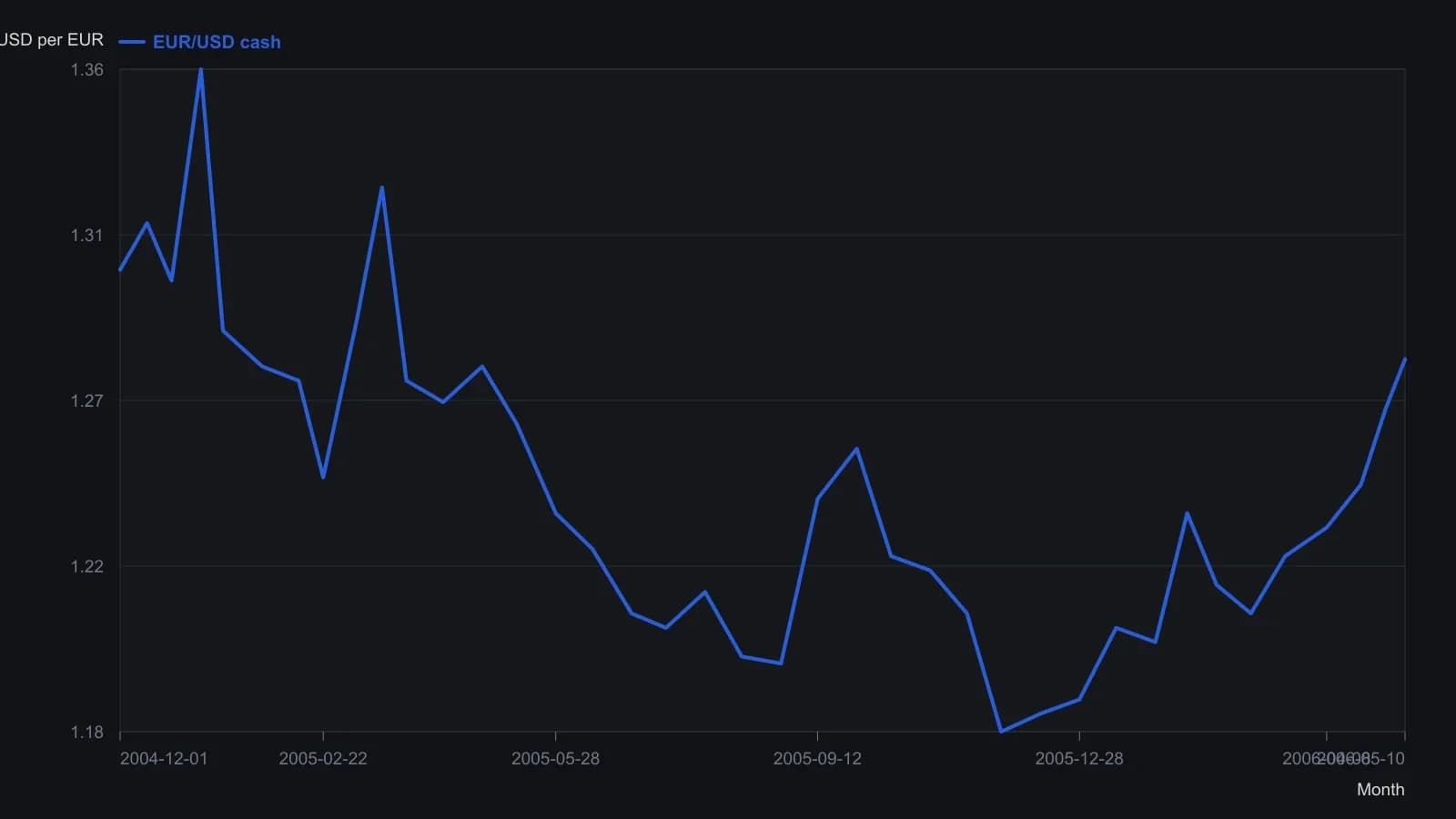
Digitized from the VantagePoint EUR/USD cash figure updated the night of 10 May 2006. Vertical scale taken from the published axis ticks; levels are approximate and are not pip-accurate.
Translate policy, reserves, and external accounts
Currency translation, as used here, means converting one currency area's policy stance, reserve demand, and external accounts into a pair level rather than treating the quote as an isolated price.
April 2006 euro-area consumer inflation was 2.4 percent, up from 2.2 percent and above a 2 percent policy reference, with money-supply growth at 8.6 percent in the year to March. Contemporaneous commentary treated euro-area policy rates as able to reach at least 3 percent later in 2006, while US rates were viewed as near the end of 25-point increases, with a debated peak at 5.25 percent or 25 points higher. That gap is the interest-rate differential: the difference between policy rates in two currency areas that can attract or repel cross-border balances over weeks to months.
Official reserve managers were reported to be raising the euro share of holdings at the dollar's expense, including notable shifts attributed to Middle Eastern and European official accounts. That is reserve-diversification: official shifts of foreign-exchange holdings away from one reserve currency toward another.
The US external deficit was placed above 7 percent of GDP, versus a euro-area current-account deficit below 1 percent of GDP, even as direct-investment outflows weakened the euro-area basic balance. Intermarket analysis, as used here, means reading a pair against cross-market rates, growth mixes, energy costs, and official reserve choices in other regions.
Test whether the growth mix can sustain the translation
Business surveys improved, with the German IFO at a 15-year April high and manufacturing PMI at its highest since 2000, while March retail sales fell 0.8 percent, leaving growth dependent on exports if global demand held. That pattern is export-led growth: expansion that depends on foreign demand because household spending at home is too uneven to carry the cycle.
Euro-area unemployment was 8.1 percent in March 2006, compared with rates below 5 percent in the United Kingdom and the United States, while governments still struggled to hold fiscal deficits below 3 percent of GDP.
Italian relative unit labor costs were described as having deteriorated by more than 20 percent over five years, with earlier euro softness masking that loss of competitiveness. Unit labor costs are the wage and productivity costs per unit of output that shape a member's trade competitiveness inside a shared currency.
Separate flow confidence from structural growth
Market-regime classification labels whether the backdrop is a short-horizon flow-and-confidence regime or a longer structural-growth regime that may not support the same direction.
TradersWeek editorial reading: reserve-diversification and the interest-rate differential belong to the weeks-to-months flow-and-confidence regime that can lift the pair. The export-led mix, unemployment well above rates in the United Kingdom and the United States, strained fiscal balances, and the deterioration in Italian unit labor costs belong to a longer structural-growth regime that was already framed as lacking support for a return to early-2005 highs.
Longer-horizon confidence in a shared currency was tied to whether one policy rate could serve members with diverging growth and inflation if domestic reforms stalled. That is the single-monetary-policy question: one policy rate applied across members whose growth and inflation paths may be diverging.
All readings on this track · 25 readings
- 1989Constructing currency-translated commodity bars
- 1992Gold, the dollar, and a foreign-currency proxy
- 1993Overseas fund translation after the European currency break
- 1995Inflation-ratio overlays, peso breaks and election cycles
- 2002A liquidity filter and intermarket overlay for one currency setup
- 2002Classify a weak-dollar regime before overseas sales and index proxies
- 2003A currency pair as a regime spread with trend and leverage bounds
- 2005Score a currency position as a cross-market portfolio
- 2005CAD/JPY as an oil translation: correlation, carry, and portfolio role
- 2006Placing a currency trade inside a gold, oil, and yield regime
- 2006Classifying the yen regime after Japan's liquidity exit
- 2006Two horizons in the 2006 euro-dollar advance
- 2007Rolling-window tests for gold hedge slogans
- 2010Stacking commission and currency costs on international fills
- 2010A dollar-pivot intermarket regime for currency pairs
- 2010Constructing currency pairs from basket relative strength
- 2012Same-way versus opposite-way currency pair construction
- 2012Signed two-currency session spread construction
- 2012A two-pass reading of listed currency sleeves
- 2013Closed foreign futures still leave a leftover currency line
- 2014Forex pair ranks from seven cross-currency scores
- 2015Currency translation across rate and trade regimes
- 2015Ten-year policy phases and FX capital-flow regimes
- 2016A peaking dollar and the commodity as a two-market case
- 2017S&P 500 energy gauge as a short-horizon regime filter