1995issue C061-4
Inflation-ratio overlays, peso breaks and election cycles
This archive case study teaches a three-layer regime read of one FX shock. An editorial frame uses the inflation-ratio overlay as the intermarket backdrop, translates the cumulative-inflation-differential into a home-currency valuation-gap, and checks whether a political-calendar-cycle is lining up with that stretch.
- Long-term exchange-rate direction is framed with an inflation-ratio overlay built from two countries' inflation rates, not from tick-by-tick FX noise.
- Currency-translation treats a persistent cumulative-inflation-differential as a loss of external purchasing power and a growing valuation-gap versus a lower-inflation partner.
- In the mid-1990s peso case, a valuation-gap near a 24-year extreme sat behind the break, and major peso adjustments had clustered on Mexico's six-year presidential transitions.
- Recursive-liquidation describes the follow-through: the first drop prompted sales of Mexican holdings, which pushed the peso lower until that process exhausted itself.
A three-layer read of one shock
An editorial reading of this archive treats one FX shock as a three-layer regime problem. The first layer is the partner inflation-ratio overlay as the intermarket backdrop. The second is currency-translation of the cumulative-inflation-differential into a home-currency valuation-gap. The third asks whether a political-calendar-cycle is lining up with that stretch.
Long-term exchange-rate direction is framed with an intermarket overlay built from the ratio of two countries' inflation rates rather than from tick-by-tick FX noise.
Build the inflation-ratio overlay
The working method is to form a consumer-price-index ratio for the two economies and shift that series so it sits as a best-fit overlay on the exchange rate. If one country has persistently higher domestic inflation than another, its currency is expected to weaken against the partner when other influences are held constant, because a unit that buys less at home should also buy less abroad.
For the United States and Britain from 1900 to 1994, both the CPI-ratio overlay and the pound-dollar rate rose by a factor of about three. The longest break after World War II is described as intentional recovery policy rather than a failure of the inflation link.
Translate the gap into a peso stretch
Currency-translation reads faster domestic price growth as a loss of external purchasing power versus a lower-inflation partner. Mexico's mid-1990s peso break is treated as a case in which a widening cumulative inflation gap versus the United States had already thinned the currency's support, with the valuation-gap near a 24-year extreme before surrounding events triggered the collapse.
Near the end of 1994 the peso was described as needing official buying to hold, while the current-account deficit had reached about 7.9 percent of GDP and more pesos were leaving than hard currency was arriving. The 1994 incoming government inherited a peso described as cumulatively overvalued by about 35 percent.
A slower managed move toward about 5.5 pesos per US dollar is presented as having been visible months before the December 1994 to January 1995 panic, while a later push back to 3.5 is judged unlikely under the inflation-differential frame.
Check the political-calendar-cycle
Major peso adjustments in the illustrated history clustered on Mexico's six-year presidential transitions, including 1976 and 1982. In editorial terms, the third layer is not a prediction of any election. It is a check on whether a recurring political-calendar-cycle is coinciding with an already stretched valuation-gap.
Mexican peso per dollar versus Mexico/US CPI-ratio overlay
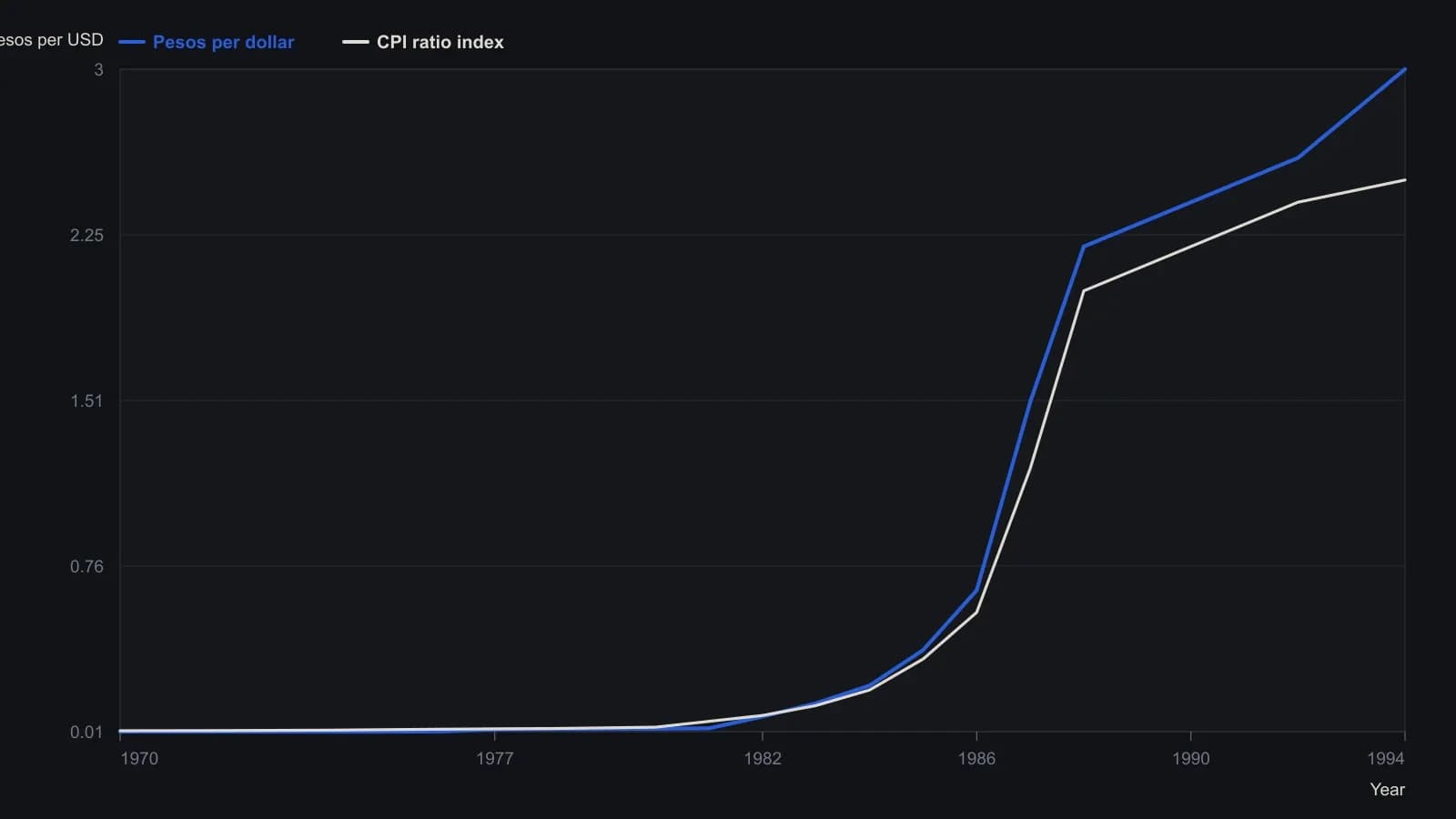
Y-axis is logarithmic, as printed (0.001–1 with headroom above 1). The peso series is in new-peso units (1 new peso = 1,000 old pesos), which is the only scaling that fits the labeled axis. The CPI-ratio series is the Mexico/US consumer-price ratio shifted to overlay the exchange rate. Readings are approximate; a small raster on three log decades cannot support more than about two significant figures. Large steps line up with the 1976 and 1982 government changes; the 1988–94 crawl is the slow devaluation the text calls too timid.
After the first break
The break is also used to illustrate recursive-liquidation. The first currency drop prompted sales of Mexican holdings, which pushed the peso lower and induced further exits until that process exhausted itself.
An editorial synthesis keeps the layers distinct. The inflation-ratio overlay is the intermarket backdrop. Currency-translation names the valuation-gap. The political-calendar-cycle asks whether a recurring six-year transition window is lining up with that stretch. Recursive-liquidation then describes how the first drop fed further exits until the selling exhausted itself.
All readings on this track · 25 readings
- 1989Constructing currency-translated commodity bars
- 1992Gold, the dollar, and a foreign-currency proxy
- 1993Overseas fund translation after the European currency break
- 1995Inflation-ratio overlays, peso breaks and election cycles
- 2002A liquidity filter and intermarket overlay for one currency setup
- 2002Classify a weak-dollar regime before overseas sales and index proxies
- 2003A currency pair as a regime spread with trend and leverage bounds
- 2005Score a currency position as a cross-market portfolio
- 2005CAD/JPY as an oil translation: correlation, carry, and portfolio role
- 2006Placing a currency trade inside a gold, oil, and yield regime
- 2006Classifying the yen regime after Japan's liquidity exit
- 2006Two horizons in the 2006 euro-dollar advance
- 2007Rolling-window tests for gold hedge slogans
- 2010Stacking commission and currency costs on international fills
- 2010A dollar-pivot intermarket regime for currency pairs
- 2010Constructing currency pairs from basket relative strength
- 2012Same-way versus opposite-way currency pair construction
- 2012Signed two-currency session spread construction
- 2012A two-pass reading of listed currency sleeves
- 2013Closed foreign futures still leave a leftover currency line
- 2014Forex pair ranks from seven cross-currency scores
- 2015Currency translation across rate and trade regimes
- 2015Ten-year policy phases and FX capital-flow regimes
- 2016A peaking dollar and the commodity as a two-market case
- 2017S&P 500 energy gauge as a short-horizon regime filter