1993issue C091-4
Overseas fund translation after the European currency break
Keep world equities in local currency and the dollar on a second series. In 1992 a dollar-priced overseas fund kept falling after the European currency crisis until translation stopped offsetting the equity rally.
- A local-currency world stock index can be read against a 10-week moving average while the dollar index stays on a second chart, so currency translation is not mixed into the equity trend.
- An overseas mutual fund can stand in for a foreign stock index when the fund is chosen because it tracks that index and avoids thin trading in individual foreign shares.
- After 14 September 1992, world stocks turned up and the dollar rose, but a dollar-priced overseas fund kept falling until the dollar broke down and the fund crossed its 10-week moving average.
- Editorial reading: the fund confirms only after translation stops fighting the equity rally, and the 10-week average dates that alignment rather than acting as a stand-alone timing rule.
Keep the equity trend and the dollar apart
A broad world stock index can be read in local currencies against a 10-week moving average, with the US dollar kept on a separate chart instead of using a dollar-converted equity series. A local-currency index leaves that world equity gauge in domestic units so currency conversion is not mixed into the equity reading. A dollar index is the separate US-dollar series used to isolate translation effects from local-currency equity action.
An overseas mutual fund can stand in for a foreign stock index when the fund is chosen because it tracks that index. That index-proxy fund avoids thin trading and sparse company-level information in individual foreign shares.
Intermarket analysis means reading equities, policy rates, and currencies together so a break in one market is treated as a regime shift for the others rather than as an isolated chart event.
World equities in local currency, 1992–93
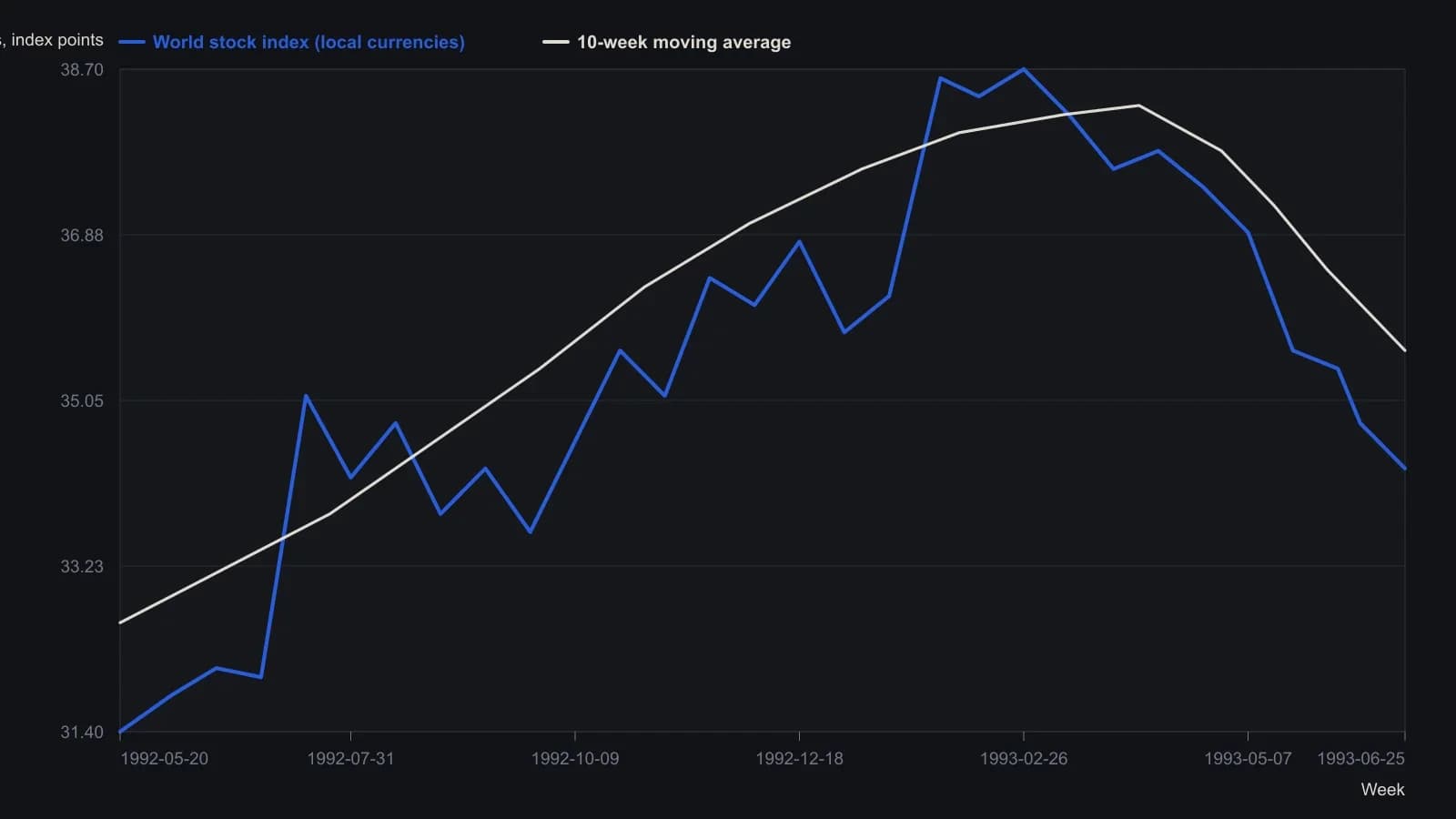
Weekly closes and the dashed 10-week average are digitized from the raster; expect about half an index point of reading error. The small v marks Duarte's signal, not a price.
Rates, parity, and the September break
High German interest rates after reunification, set to attract capital, weighed on global equities through most of 1992. Charts mark 14 September 1992 as the European currency-crisis date, linked to those German rates forcing other European Community members to hold rates and currencies at parity despite recessions.
The crisis produced a realignment of the European rate mechanism, the 1992 European currency-parity arrangement that required members to keep rates aligned with Germany until the September break. After the United Kingdom left that mechanism and cut rates, the S&P 500 turned up from a summer-to-early-autumn double bottom.
What the dollar and the fund did next
After 14 September 1992 the US dollar rose as capital left European currency disorder, and a world stock index turned up soon after the same date. A rising US dollar accompanied the S&P 500 lift from its lows. When the dollar stalled near 95, the S&P 500 slowed while other global markets continued to advance.
A dollar-priced overseas fund kept falling while global stocks rallied and the dollar appreciated, then bottomed as the dollar broke down and the fund crossed above its 10-week moving average. The moving average here is a fixed-lookback average of weekly prices used as a trend baseline, a 10-week line on the local-currency world index and on the overseas fund.
When translation offsets the asset path
Results in an international fund combine the path of the underlying assets with currency translation, so the two effects can add together or offset each other. Currency translation is the extra gain or loss a home-currency holder receives when overseas assets are converted through a changing exchange rate, separate from local-market price change.
All readings on this track · 25 readings
- 1989Constructing currency-translated commodity bars
- 1992Gold, the dollar, and a foreign-currency proxy
- 1993Overseas fund translation after the European currency break
- 1995Inflation-ratio overlays, peso breaks and election cycles
- 2002A liquidity filter and intermarket overlay for one currency setup
- 2002Classify a weak-dollar regime before overseas sales and index proxies
- 2003A currency pair as a regime spread with trend and leverage bounds
- 2005Score a currency position as a cross-market portfolio
- 2005CAD/JPY as an oil translation: correlation, carry, and portfolio role
- 2006Placing a currency trade inside a gold, oil, and yield regime
- 2006Classifying the yen regime after Japan's liquidity exit
- 2006Two horizons in the 2006 euro-dollar advance
- 2007Rolling-window tests for gold hedge slogans
- 2010Stacking commission and currency costs on international fills
- 2010A dollar-pivot intermarket regime for currency pairs
- 2010Constructing currency pairs from basket relative strength
- 2012Same-way versus opposite-way currency pair construction
- 2012Signed two-currency session spread construction
- 2012A two-pass reading of listed currency sleeves
- 2013Closed foreign futures still leave a leftover currency line
- 2014Forex pair ranks from seven cross-currency scores
- 2015Currency translation across rate and trade regimes
- 2015Ten-year policy phases and FX capital-flow regimes
- 2016A peaking dollar and the commodity as a two-market case
- 2017S&P 500 energy gauge as a short-horizon regime filter