2006issue C061-2
Classifying the yen regime after Japan's liquidity exit
In March 2006 the Bank of Japan suspended its quantitative liquidity policy. This archive article treats that exit as a market-regime-classification drill: map funding-currency status, translate the US-Japan yield-gap, and only then decide whether the dollar-yen range is a new regime or still a carry-funding market.
- In March 2006 Japan left a 30-35 trillion yen quantitative-liquidity-target for interest-rate targeting and a 0-2% inflation reference range, while short-term deposit rates were still expected to stay near zero at first.
- Carry trades had used the yen, with short rates at zero, to fund higher-yield currencies, commodities, and energy, so funding-currency status belongs in the first label, not after a pair view.
- A narrowing US-Japan yield-gap was treated as yen support after five-year yields near 1.2% and ten-year yields near 1.7%, which is a currency-translation step rather than a dollar-yen call.
- As of mid-March 2006 the pair held a range described as more comfortable for policymakers after the early-2005 low near 102.0. Editorial reading: that range does not by itself prove a new regime.
Start with the liquidity exit
In March 2006 the Bank of Japan suspended its quantitative liquidity policy and said it would switch to interest-rate targeting with a 0-2% inflation reference range. The earlier quantitative-liquidity-target had been 30-35 trillion yen of commercial-bank current-account deposits, after policy rates had already been cut to zero in 2001.
Editorial reading: the exit opens a market-regime-classification problem. The task is to label whether the yen is still a cheap funding source, a surplus-supported currency, or in transition after policy normalization, not to treat dollar-yen as a standalone call.
Map funding-currency status
Fourth-quarter 2005 annualized GDP rose more than 5.0%, bank lending turned positive for the first time in more than five years, and consumer prices rose 0.5% in the year ended January 2006, the third consecutive annual increase. Short-term Japanese deposit rates were expected to stay near zero at first, then rise gradually from the third quarter of 2006 toward about 0.75% by year-end, leaving nominal yields still low versus the rest of the world.
Over the prior six months, carry trades borrowed low-yield currencies, especially the yen while short rates remained at zero, to fund higher-yield currencies such as the Australian and New Zealand dollars, the Brazilian real, and the Mexican peso, as well as commodities and energy.
Editorial reading: firmer activity, a turn in bank lending, and a third year of consumer-price increases sit beside a path that still leaves Japanese nominal yields low. Market-regime-classification still has to record the yen as a working funding currency until carry-trade use is shown to have faded.
Translate the US-Japan yield-gap
Five-year Japanese yields had reached a five-year high near 1.2% and ten-year yields near 1.7%, and a narrowing US-Japan bond yield-gap was treated as a historical intermarket condition that would support the yen. The ten-year dollar-yen yield-gap bottomed in the third quarter of 2004 and the cash dollar-yen rate reached a low near 102.0 early in 2005.
Editorial reading: currency-translation converts that yield-gap change into support or pressure on the exchange rate. Intermarket analysis then sets the translation beside carry-trade funding, policy liquidity, and the later dollar-yen range, rather than treating the gap as a standalone pair signal.
Read the dollar-yen range last
After that late-2004 and early-2005 push to 102, the pair later held a range described as more comfortable for Japanese policymakers as of mid-March 2006.
Editorial reading: comfort for policymakers describes the market setting. It is not, on its own, evidence that a new regime has replaced a carry-funding market. The range is classified only after funding-currency status and yield-gap translation are already labelled.
Keep surplus and regional conditions in the same frame
Japan's current-account surplus fell 7.6% in the year ending January to 719 billion yen, while foreign-exchange reserves exceeded 800 billion dollars, still held mainly in US Treasury bonds, and rising income-account receipts were identified as background yen support.
A firmer Chinese yuan, amid expected US political pressure for stronger Asian currencies before the November congressional elections, was viewed as liable to lift other Asian currencies and thereby support the yen, though Japan's export dependence meant regional appreciation would not automatically produce yen gains.
Editorial reading: intermarket analysis keeps the smaller surplus, the Treasury-heavy reserve stock, income-account receipts, and a firmer yuan in the same frame as dollar-yen. Those items help label surplus support versus cheap funding. They do not complete a pair forecast.
US dollar versus yen, cash, October 2002–March 2006
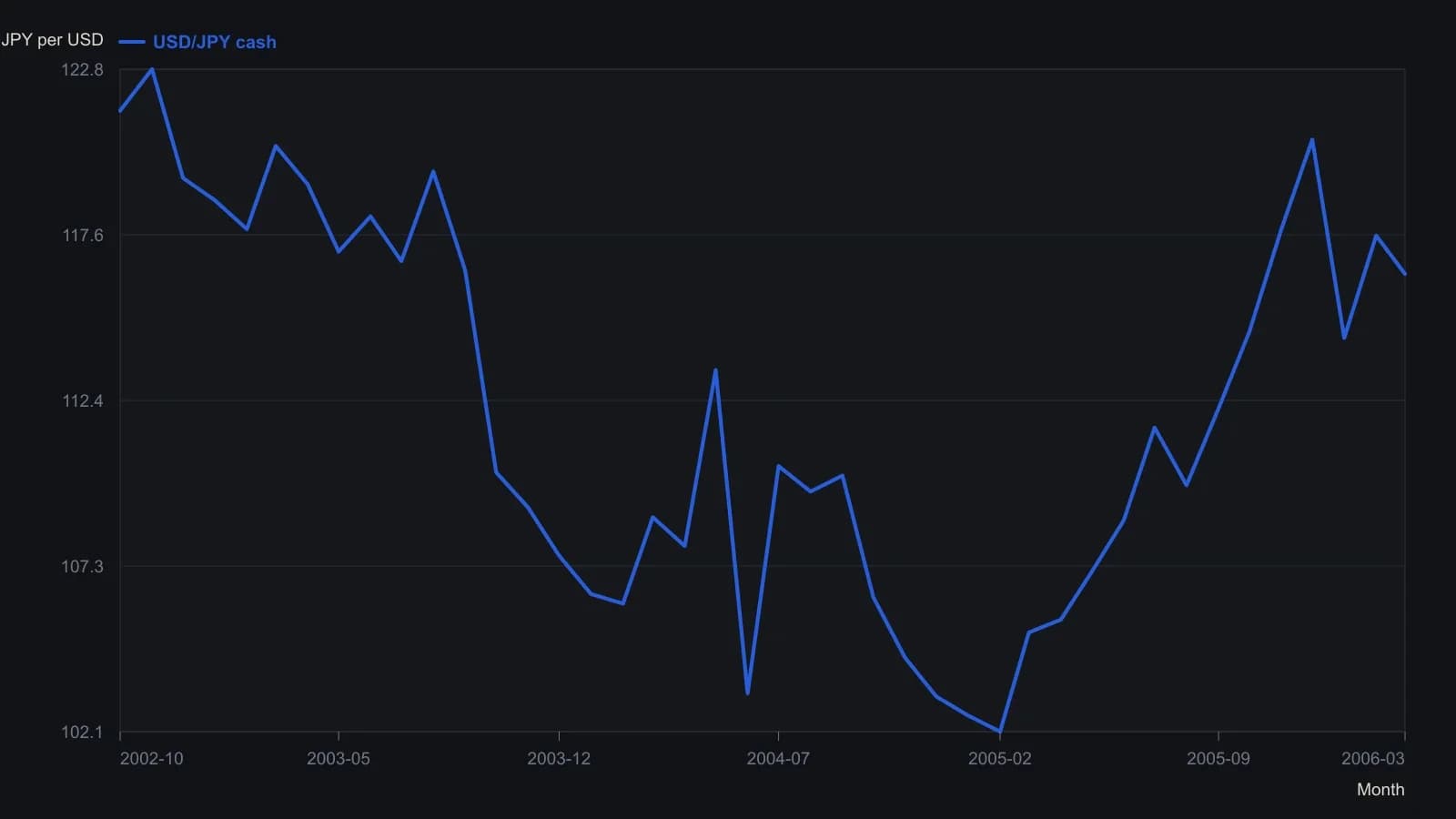
Digitized from the plotted cash series dated 17 March 2006. Intra-month wiggles are sampled, not every daily tick. Y values are approximate to about half a yen; the raster does not support the two-decimal axis labels as true precision.
All readings on this track · 25 readings
- 1989Constructing currency-translated commodity bars
- 1992Gold, the dollar, and a foreign-currency proxy
- 1993Overseas fund translation after the European currency break
- 1995Inflation-ratio overlays, peso breaks and election cycles
- 2002A liquidity filter and intermarket overlay for one currency setup
- 2002Classify a weak-dollar regime before overseas sales and index proxies
- 2003A currency pair as a regime spread with trend and leverage bounds
- 2005Score a currency position as a cross-market portfolio
- 2005CAD/JPY as an oil translation: correlation, carry, and portfolio role
- 2006Placing a currency trade inside a gold, oil, and yield regime
- 2006Classifying the yen regime after Japan's liquidity exit
- 2006Two horizons in the 2006 euro-dollar advance
- 2007Rolling-window tests for gold hedge slogans
- 2010Stacking commission and currency costs on international fills
- 2010A dollar-pivot intermarket regime for currency pairs
- 2010Constructing currency pairs from basket relative strength
- 2012Same-way versus opposite-way currency pair construction
- 2012Signed two-currency session spread construction
- 2012A two-pass reading of listed currency sleeves
- 2013Closed foreign futures still leave a leftover currency line
- 2014Forex pair ranks from seven cross-currency scores
- 2015Currency translation across rate and trade regimes
- 2015Ten-year policy phases and FX capital-flow regimes
- 2016A peaking dollar and the commodity as a two-market case
- 2017S&P 500 energy gauge as a short-horizon regime filter