1994issue C041-4
Bench-testing smoothers with cycle phase and power
Frequency is the reciprocal of cycle length, and phase in degrees records lead or lag. A five-period exponential moving average of a 64-period sine wave lags by about 11 to 12 degrees and keeps most of its power. The same smoother lags a 16-period cycle by about 33 degrees and retains about half the power.
- Cycle frequency is the reciprocal of cycle length, and angular advance is 360 degrees divided by that length.
- Phase, measured in degrees around a 360-degree cycle, shows whether a filtered series leads or lags the intended dominant cycle.
- A five-period exponential moving average lags a 64-period sine wave by about 11 to 12 degrees and keeps about 95% of its power, but lags a 16-period cycle by about 33 degrees and keeps about 0.52 of power.
- A moving-average filter attenuates some frequencies more than others, so the construction check is whether the intended dominant cycle keeps most of its amplitude while other components are reduced.
Cycle length, frequency, and phase
Cycle length is the number of ordered observations that complete one full oscillation. Frequency is how fast the cycle advances. It is the reciprocal of cycle length, and it can also be written as degrees per sampling interval. A 64-observation cycle has frequency 1/64, and a 16-observation cycle has frequency 1/16.
Angular advance equals 360 degrees divided by cycle length. A 64-period cycle therefore moves 5.625 degrees per sampling interval. Phase is measured in degrees, with 360 degrees completing one cycle, and it describes whether one series leads or lags another.
Exponential smoothing on two known cycles
Exponential smoothing is a recursive average of ordered observations that can delay turning points and reduce amplitude in a frequency-dependent way. The dominant cycle is the oscillation length a model is meant to retain when a filter is applied to price, volume, or breadth.
A five-period exponential moving average of a 64-period sine wave lags that wave by about 11 to 12 degrees and reduces its amplitude only slightly. The same five-period exponential moving average applied to a 16-period cycle at 22.5 degrees per interval lags by about 33 degrees and reduces amplitude more.
First difference advances phase
The first difference is the change between consecutive observations, which advances phase instead of delaying it. The first difference of a 64-period sine wave shifts the plot leftward, introducing phase lead rather than lag.
Residual power at each frequency
Power equals amplitude squared and is used to quantify how much of a cycle a filter still passes. Spectral analysis measures retained power and phase at each frequency so a filter's effect on a known cycle can be checked.
On a 5.625-degree-per-interval cycle a five-period exponential smoother retains about 95% of power, leaving amplitude near 0.97. On a 22.5-degree-per-interval cycle the same five-period exponential smoother retains about 0.52 of power, matching a peak amplitude near 0.72. A moving-average filter attenuates some frequencies more than others, so a construction check is whether the intended dominant cycle keeps most of its amplitude while other components are reduced.
64-period sine and five-period EMA
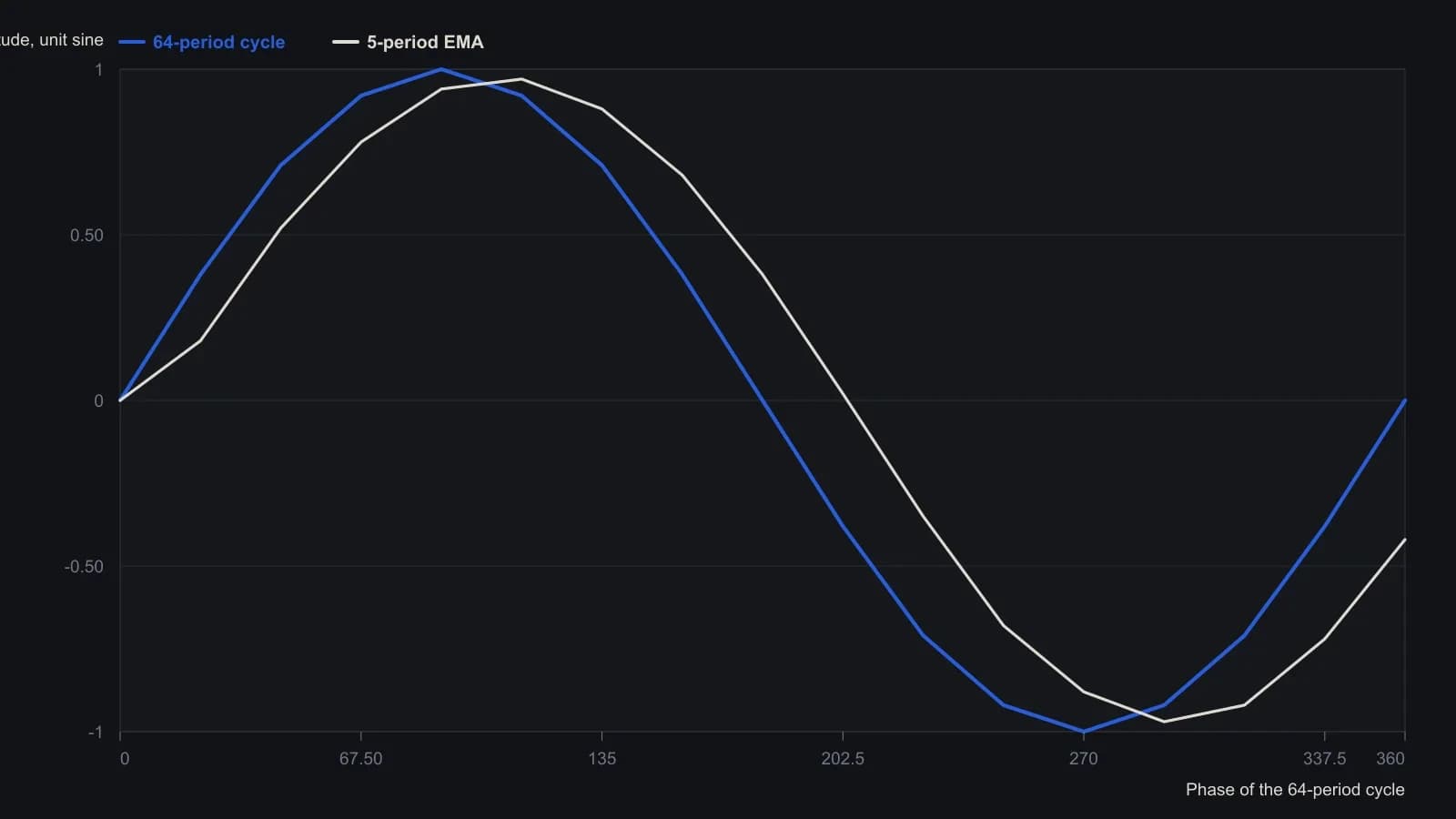
X is degrees of the injected 64-period cycle (5.625 degrees per bar). Amplitude 1 means power 1; the article states five-period EMA power near 95 percent at this frequency. The source scan is mirrored; series are recovered in the upright orientation.
All readings on this track · 21 readings
- 1982Spectrum-first construction of moving-average trend filters
- 1990Crowd questions that switch cycle regimes
- 1993Antithetic twins to cancel origin-linked forecast bias
- 1994Constructing frequency response from a three-stage filter cascade
- 1994Bench-testing smoothers with cycle phase and power
- 1995Constructing minimum tradable cycles from spectral noise
- 1995Spectral whipsaw limits for a price-crossing average
- 1996Constructing market phase from dominant-cycle components
- 2000Constructing a Hilbert squelch dominant-cycle gate
- 2007When cycle mode fails: regime gates for spectral trades
- 2008Constructing singular-spectrum forecast baselines
- 2008Stacking a midband cycle gate on a short-memory trend filter
- 2011Engineering spectral cycle detection and moving-average harmony
- 2011Evaluating fixed oscillators against a moving dominant cycle
- 2011A construction checklist for a dominant-cycle sinewave
- 2012Assembling a market-mode heatmap from successive band-pass filters
- 2012Adaptive trend detection from dominant-cycle spectra
- 2015Constructing price paths from cycles and support
- 2018Oscillator distribution shape for mean-reversion filters
- 2020Constructing a cosine-correlation cycle and phasor trend filter
- 2020Constructing a correlation-cycle market-state engine