2008issue C111-3
Stacking a midband cycle gate on a short-memory trend filter
A three-layer construction that lets a short-memory attractor nominate unstable turning points, a trend filter open or hold a position, and spectral analysis turn mid-length cycle extremes into an explicit stand-aside rule.
- The attractor-state treats price as an outcome of supply and demand, so volume and open interest are required inputs, with related futures open interest used when a centralized series is missing in over-the-counter currency trading.
- Unstable locations among five equilibrium points only nominate turning points. A decision-band bounded in [-1, 1] authorizes a buy in [0.6, 1] or a sell in [-0.6, -1], and the next-open-rule defers the action.
- Because the attractor is treated as short-memory, a trend-filter confirms, holds, or halts the trade, while a ten-day-volatility-stop covers a move the state layer cannot meet in time.
- Spectral-analysis discards cycles shorter than 10 days and longer than 40 days so dominant-cycle extremes, read on a Gaussian scale, become an explicit exit at the next open.
How the layers divide labor
The construction separates three jobs rather than folding them into one blended reading of price. A short-horizon attractor-state only nominates unstable turning points. A trend-filter may then open or hold a position, or stop trading. Spectral-analysis isolates a mid-length band so dominant-cycle extremes can be read as a halt-and-exit trigger.
The archive describes that historical workflow. The layering is the object of study here, not a claim that any single layer is complete on its own.
Supply, demand, and the attractor state
The constructed state treats price as an outcome of supply and demand, so volume and open-interest series are required inputs rather than a price-only specification. When centralized open interest is unavailable in over-the-counter currency trading, the construction substitutes open interest from the related futures contract.
The short-horizon layer is a coupled differential system in price, volume, and open interest. Its attractor is summarized by five equilibrium points. Unstable locations on that attractor are used as turning-point candidates. The attractor-state marks those candidate locations before the trend-filter acts.
Authorization, timing, and the protective stop
Initiation or rollover is gated by a decision-band, a normalized decision function bounded in [-1, 1]. A buy is authorized in [0.6, 1] and a sell in [-0.6, -1]. Under the next-open-rule, that action is taken at the next session open.
A ten-day-volatility-stop is calibrated from the last 10 days of volatility. It is intended for an unusually large move that the state layer cannot react to in time.
The trend filter after a short-memory state
Because the attractor layer is treated as short-memory, a digital trend-filter is added. The trend-filter confirms or maintains a position after the short-horizon state flags instability. It also decides when trading should stop.
In this stack the attractor-state does not keep the book on its own. Nomination of an unstable location, authorization inside the decision-band, and the later confirm-or-halt choice remain separate steps.
USD/CHF running profit across 42 Trend Determining trades
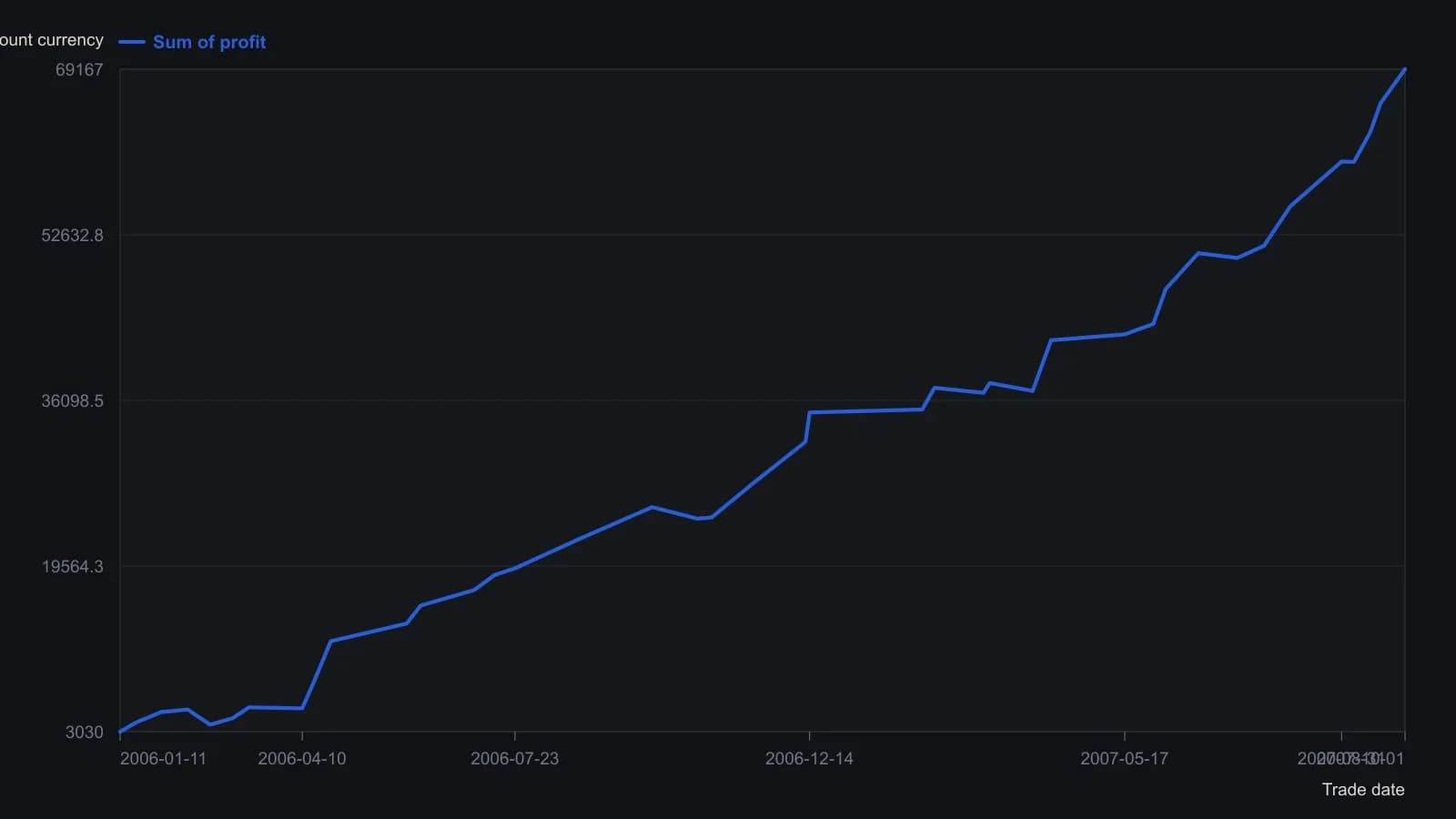
Position size in the blotter is not always exactly 100000 plus prior sum; the series uses the printed running profit, not a reconstructed equity from size. Dates are each trade’s first listed session.
Mid-length band and the cycle exit
Spectral-analysis is applied to the ordered price stream by discarding cycles longer than 40 days and shorter than 10 days. The specification uses stopband attenuation of -40 dB and passband ripple of 0.08, which leaves a mid-length active cycle.
Dominant-cycle detection reads extremes of that active cycle in a one-to-two standard-deviation Gaussian band. If the extreme occurs at the close, the position is exited at the next open. Those extremes, read on a Gaussian scale, are the halt-and-exit trigger, and the next-open-rule applies to that exit as well as to entry.
All readings on this track · 21 readings
- 1982Spectrum-first construction of moving-average trend filters
- 1990Crowd questions that switch cycle regimes
- 1993Antithetic twins to cancel origin-linked forecast bias
- 1994Constructing frequency response from a three-stage filter cascade
- 1994Bench-testing smoothers with cycle phase and power
- 1995Constructing minimum tradable cycles from spectral noise
- 1995Spectral whipsaw limits for a price-crossing average
- 1996Constructing market phase from dominant-cycle components
- 2000Constructing a Hilbert squelch dominant-cycle gate
- 2007When cycle mode fails: regime gates for spectral trades
- 2008Constructing singular-spectrum forecast baselines
- 2008Stacking a midband cycle gate on a short-memory trend filter
- 2011Engineering spectral cycle detection and moving-average harmony
- 2011Evaluating fixed oscillators against a moving dominant cycle
- 2011A construction checklist for a dominant-cycle sinewave
- 2012Assembling a market-mode heatmap from successive band-pass filters
- 2012Adaptive trend detection from dominant-cycle spectra
- 2015Constructing price paths from cycles and support
- 2018Oscillator distribution shape for mean-reversion filters
- 2020Constructing a cosine-correlation cycle and phasor trend filter
- 2020Constructing a correlation-cycle market-state engine