2007issue C041-3
When cycle mode fails: regime gates for spectral trades
A measured dominant cycle is only a candidate setup. Cycle mode waits until signal-to-noise, trend slope versus cycle amplitude, and half-cycle trendline persistence all stay inside their workable bands.
- A measured dominant cycle can change over time and is not treated as a single fixed period of the series.
- When bar-range noise equals cycle peak amplitude, a theoretically perfect valley-to-crest trade can still finish at breakeven if the entry fills at the bar high and the exit fills at the bar low.
- Cycle mode is intended only when measured trend slope stays inside the plus-and-minus cycle-amplitude band and measured signal-to-noise exceeds a 6 dB threshold.
- Knowing that a cycle exists, including its period and current phase, is not treated as sufficient if cycle amplitude is too small relative to noise or trend slope.
Cycle work as a permission problem
The historical workflow starts from a measured dominant cycle: the time-varying cycle period extracted from ordered market observations and treated as the signal a cycle-mode trade would try to ride.
Editorial: TradersWeek reads the same workflow as a permission problem, not a period-finding problem. The measured cycle remains a candidate setup until three independent regime gates stay inside their workable bands. Those gates are signal-to-noise, trend slope versus cycle amplitude, and half-cycle trendline persistence.
The period itself can move
Spectral analysis is used as a time-synchronized spectral display of how cycle energy shifts across periods. That display is there to show that a dominant cycle is not a fixed property of the series.
A measured dominant cycle in a market series can change over time rather than remaining a single fixed period.
Regime dependence of the same cycle
The trend filter is a set of regime checks that compare cycle amplitude with bar-range noise, trend slope, and how long price stays on one side of an instantaneous trendline, then flag cycle mode versus trend mode.
Regime dependence means the same measured cycle can be tradable or not depending on noise, trend strength, and trend persistence at that moment.
When noise matches cycle amplitude
Signal-to-noise ratio compares cycle peak amplitude with bar-range noise and expresses that comparison on a decibel scale so a threshold can mark when cycle-mode entries are theoretically workable.
When bar-range noise amplitude equals cycle peak amplitude, a theoretically perfect valley-to-crest trade can still finish at breakeven if the entry fills at the bar high and the exit fills at the bar low.
A 6 dB signal-to-noise case is defined as cycle peak amplitude twice the noise amplitude, and expected profit in that noisy case is half the profit of the noise-free case.
When trend slope swamps the cycle
If a cycle component and a linear trend are added, and the trend slope across one cycle period equals twice the cycle peak amplitude, a short-at-crest and cover-at-valley trade realizes about half the profit of the same trade with no trend.
Trend swamping is the additive case in which that slope is large enough to cancel most of the profit that a perfect crest-to-valley cycle trade would have shown without the trend. Trend swamping is treated as workable when the trend slope across the cycle period exceeds twice the cycle amplitude.
When price stays on one side of the trendline
An instantaneous trendline is a local trend component that a cycle is expected to cross about every half period. A long stay on one side is treated as a reason to avoid cycle mode.
Price is expected to cross that line about every half cycle, and cycle-mode trading is avoided when price has not crossed it within the last half cycle.
Cycle mode only inside the workable bands
Cycle mode is intended only when measured trend slope stays inside the plus-and-minus cycle-amplitude band and measured signal-to-noise exceeds a 6 dB threshold.
A trading mode indicator is a consolidated flag that is high when the trend-mode regime is favored and low when the cycle-mode regime is favored after the amplitude, noise, and persistence checks. A consolidated mode indicator can be high for trend mode and low for cycle mode after those amplitude and noise conditions are combined.
Knowing that a cycle exists, and even knowing its period and current phase, is not treated as sufficient for cycle-mode trading if cycle amplitude is too small relative to noise or trend slope.
T-bond signal-to-noise versus the 6 dB cycle-mode gate
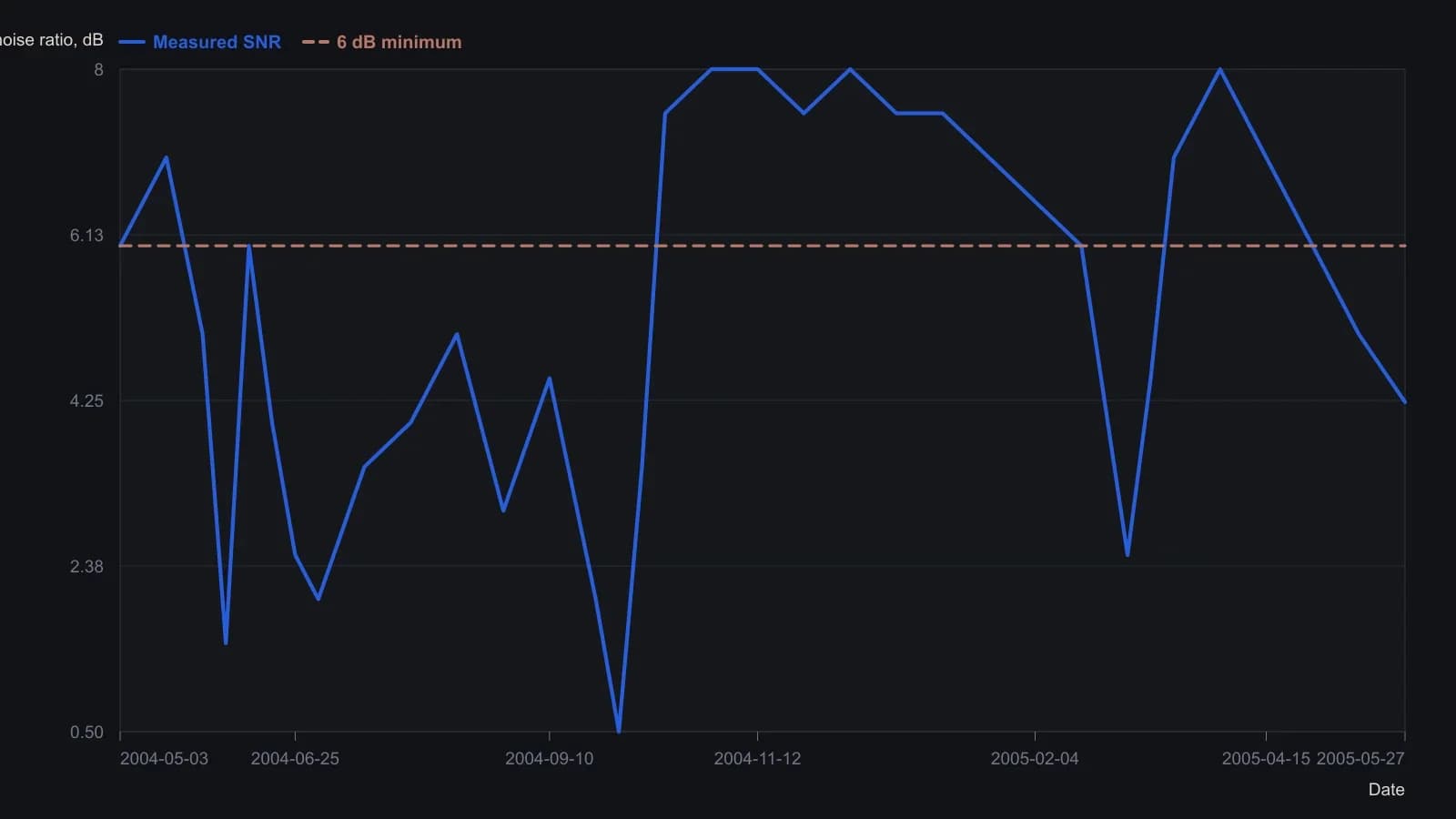
Digitized from the raster of the SNR pane. Vertical labels sit 4 dB apart, so intermediate values are good to about half a decibel except the closing print 4.23, which is taken from the on-chart readout. Dates follow the printed May 2004–May 2005 month axis.
All readings on this track · 21 readings
- 1982Spectrum-first construction of moving-average trend filters
- 1990Crowd questions that switch cycle regimes
- 1993Antithetic twins to cancel origin-linked forecast bias
- 1994Constructing frequency response from a three-stage filter cascade
- 1994Bench-testing smoothers with cycle phase and power
- 1995Constructing minimum tradable cycles from spectral noise
- 1995Spectral whipsaw limits for a price-crossing average
- 1996Constructing market phase from dominant-cycle components
- 2000Constructing a Hilbert squelch dominant-cycle gate
- 2007When cycle mode fails: regime gates for spectral trades
- 2008Constructing singular-spectrum forecast baselines
- 2008Stacking a midband cycle gate on a short-memory trend filter
- 2011Engineering spectral cycle detection and moving-average harmony
- 2011Evaluating fixed oscillators against a moving dominant cycle
- 2011A construction checklist for a dominant-cycle sinewave
- 2012Assembling a market-mode heatmap from successive band-pass filters
- 2012Adaptive trend detection from dominant-cycle spectra
- 2015Constructing price paths from cycles and support
- 2018Oscillator distribution shape for mean-reversion filters
- 2020Constructing a cosine-correlation cycle and phasor trend filter
- 2020Constructing a correlation-cycle market-state engine