2013issue C0718-24
Constructing a runs-test turn forecast
A runs-test turn forecast encodes ordered higher-risk and lower-risk returns as a two-state sequence, smooths that sequence over a fixed lookback, and treats the reading as a turn probability to check against a later dated sample.
- A turn forecast can be built from ordered risk-return observations rather than from volatility of daily returns, because volatility can miss priced risks that have not yet appeared as price variation.
- The runs-test input is a binary warning state set to 1 when the risk-return sequence is abnormal and to 0 when it matches the prevailing trend.
- An exponentially weighted forecast places one-third weight on the latest binary mark and two-thirds on the prior average, and the smoothed reading is interpreted as a turn probability.
- The warning mark is assigned on the same observation that shows the abnormal sequence, so the construction is assembled to avoid the lag of moving averages of prices or volatilities.
Build the forecast from ordered observations
A turn forecast can be built from ordered risk-return observations rather than from volatility of daily returns, because volatility can miss priced risks that have not yet appeared as price variation.
A runs-test encodes ordered market observations as a two-state sequence and treats clustered abnormal states as the input to that turn forecast.
Split names by market co-movement
The construction splits names by co-movement with the market: higher-risk series move more with the market, lower-risk series move less, and those two ordered return streams are compared under the prevailing trend.
The quantitative baseline is the normal risk-return pattern expected while a trend remains intact, against which later observations are compared.
Encode a binary warning state
An abnormal risk-return sequence is defined as higher-risk returns falling short of lower-risk returns in an advance, or exceeding them in a decline. That departure from the normal risk-return pattern is treated as the warning state.
The runs-test input is a binary series set to 1 in those two abnormal cases and to 0 in every other case. The binary warning state is a same-interval mark of 1 when risk-return sequencing is abnormal and 0 when it matches the prevailing trend.
Form an exponentially weighted forecast
The binary series is converted into a 0-to-1 forecast by an exponentially weighted average that places one-third weight on the latest observation and two-thirds on the prior average.
The smoothed reading is interpreted as a turn probability, with a rising count of ones in the ordered sample treated as higher turn potential.
AvD turn probability around the July 2007 top
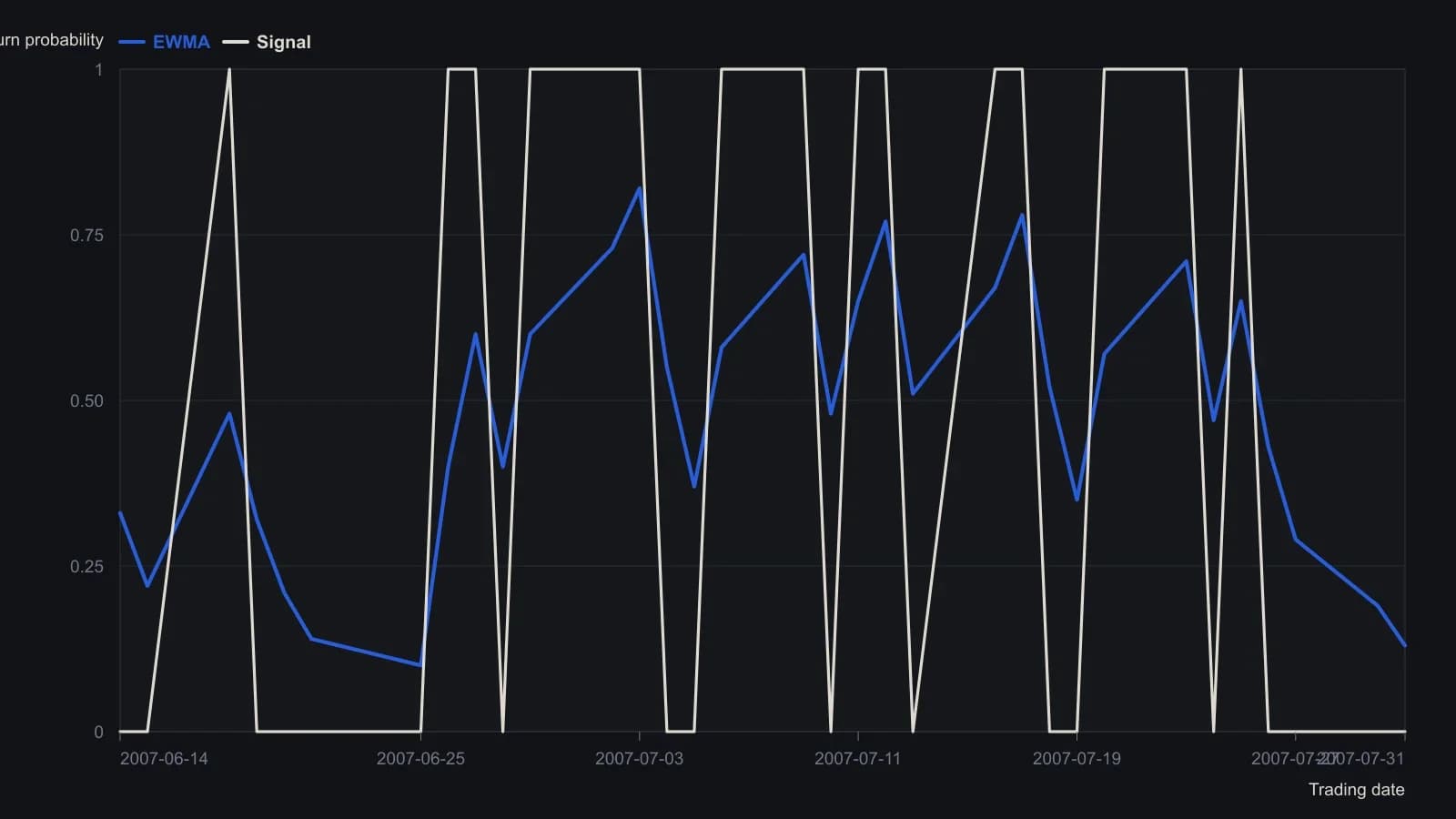
Each EWMA uses a one-third weight on the latest 0/1 observation and two-thirds on the prior average. The authors treat readings near 0.7 and higher as the relevant warning band.
Compare the reading with a later dated sample
The construction was applied on a daily sampling interval around a dated high of July 16, 2007 and a dated low of March 9, 2009. The sampling interval is the regular spacing of the ordered series, here a daily interval with a stated lookback.
In the 2007 window the binary mark was 1 on five of the six observations immediately before the dated high, and the smoothed reading reached 0.73 then 0.82 about two weeks earlier.
All readings on this track · 15 readings
- 1986Constructing runs and persistence tests from labeled prices
- 1986Evaluating daily price and volume serial independence windows
- 1986Evaluating advance-decline plus-day runs against chance baselines
- 1986Weekly resamples as a diagnostic filter for statistical windows
- 1988Runs test as a critique of price-series memory
- 1989Evaluating weekday close direction with a counted baseline
- 1989Statistical windows for indicator time parameters
- 1992Channel-height ratios for equity trend evaluation
- 2001A runs test before volatility and expected-value sizing
- 2005Constructing runs-test z-scores for signed return persistence
- 2005Evaluating persistence with runs and autocorrelation
- 2005Weekday FX turning points and close run tests
- 2013Constructing a runs-test turn forecast
- 2017Star rating from slope and swing runs
- 2018Regime-dependent odds after directional price runs