2013issue C0338-44
Volume-confirmed swing breaks with scale-in and trailing stops
This archive case walks one sector-supported name through three gates: volume-confirmation on the first swing-point break, first risk under a time-frame-matched anchor plus a fraction of range, and scale-in-position only while later tests stay quieter than the thrust that built the zone.
- A low is an actualized swing-point after it stays the lowest print for the next six bars, and a later break of that level marks a trend-transition.
- Volume-confirmation on the opening break requires the breaking bar to expand versus the swing-point bar; a later retest is judged against the higher of the breakout bar and the broken bar.
- Anchor-bars are ranked in a 60-bar window for high volume, wide range, and swing-point status, and timing waits on tests of the overlapping anchor-zone rather than on the qualified-trend label alone.
- First risk sits a stated fraction of the matching frame's average true range under the confirmed-breakout bar, the trailing-stop can move to a later tested zone, and scale-in-position stays open only while those later tests remain quieter than the thrust that built the zone.
A sector-and-name walkthrough
Editorial: TradersWeek presents this archive case as one three-gate procedure for a sector-supported name. Volume must confirm the first swing-point break. First risk must sit under a time-frame-matched anchor plus a fraction of range. Size may be added only while later tests stay quieter than the thrust that created the zone. The grouping is editorial. The facts below restate the historical workflow.
Swing-points and trend-transition
A low is treated as an actualized swing-point when it remains the lowest print for the next six bars. Later breaks of those swing-points are used to mark a trend-transition.
Weekly XLF swing path into the 16 November 2012 bar
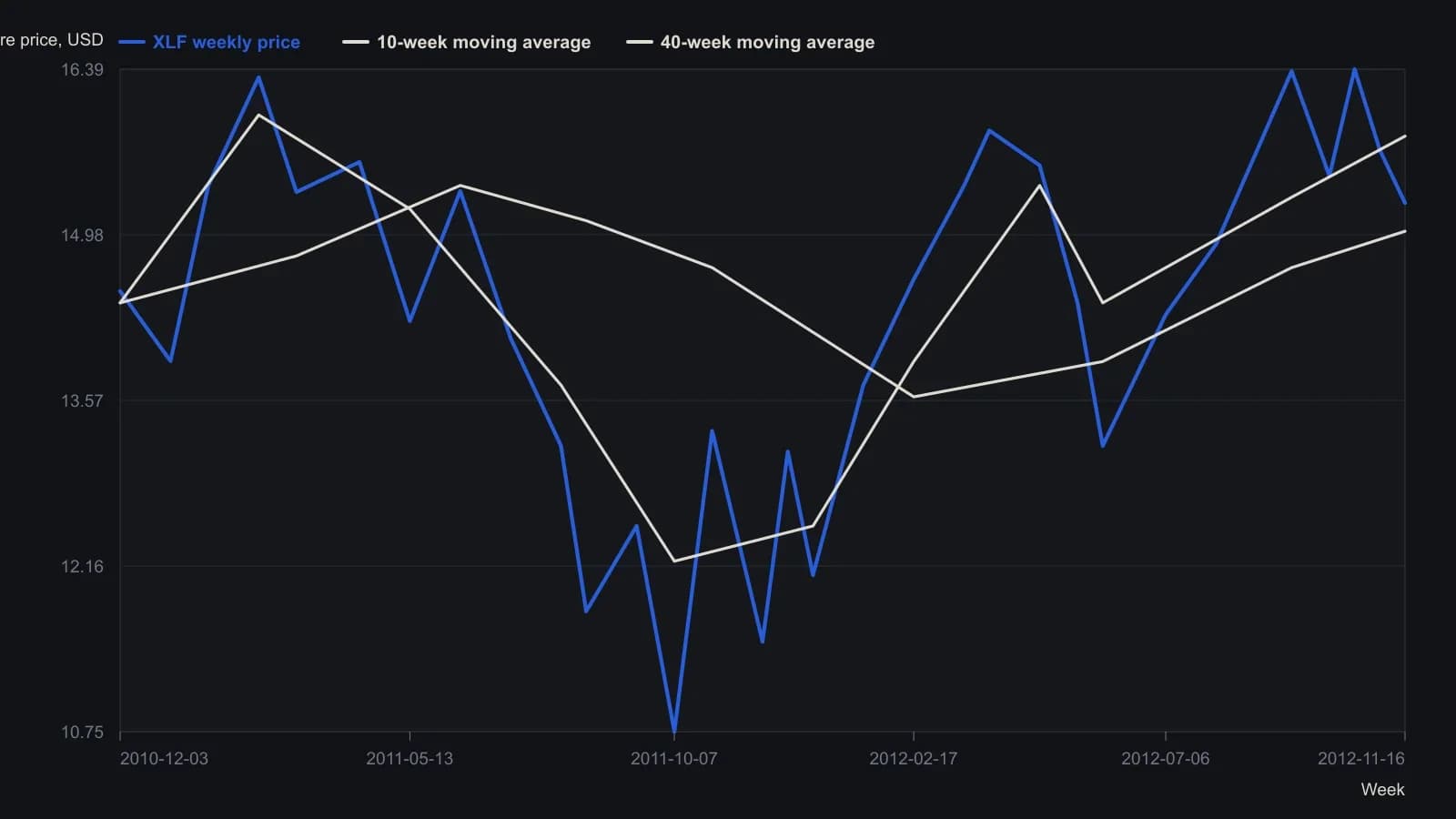
Print dated 16 November 2012, so the six later weekly bars needed to actualize that November low as a swing point are not on the chart. 10-week and 40-week average endpoints 15.82 and 15.01 are legend prints; the rest of those curves are digitized.
Volume-confirmation on the first break
Volume on the swing-point bar is compared with volume on the breaking bar. An expanding-volume break is labeled confirmation of the new direction.
Anchor-bars and the test map
High-volume anchor-bars are ranked inside a 60-bar window. If more than six bars qualify, only the six highest-volume bars are kept. A bar is also marked high-volume when its volume is 1.85 percent above the average of the comparison bars.
Qualified-trend direction is separated from timing. Entries and exits wait on how price behaves when it tests overlapping high-volume, wide-range, and swing-point zones. Those overlaps are the anchor-zone used for tests, entries, and stop placement.
First risk under the confirmed-breakout bar
In the illustrated intermediate-frame case, the first stop sits 20 percent of that frame's average true range beneath the confirmed-breakout bar low. The placement produces 17.82 under an 18.07 low when weekly average true range is 1.10.
Scale-in-position and the trailing-stop
When the same name is held for a larger sector-supported move, the case sets a farther final stop at 18.72 and treats adding size on the way up as part of the procedure rather than a one-lot entry. That add-on rule is scale-in-position.
The daily trailing-stop reference is the 19 December 2012 swing-point breakout that later retested and failed, so the trail is anchored to that tested zone rather than a fixed tick increment.
Quieter volume on the later test
Retest volume is judged against the higher of the breakout bar and the broken bar. The illustrated sequence printed almost 22 million shares on 19 December 2012, 29 million on the 2 January 2013 break, and 29.8 million on the retest. The retest failed the quieter-volume test.
Editorial reading
Editorial: TradersWeek reads the failed quieter-volume test as a closed gate for further scale-in-position, not as a separate trade idea. The archive describes only the historical workflow. It does not establish a present-day setup.
All readings on this track · 18 readings
- 1989Measured range, scale-in ladders, and spread replay as a cash-reserve design
- 1990When result pressure rewrites checklist and scale-in rules
- 1992Split-sample floors, ceilings, and standing aside
- 2006A swing operator's scale-in, structure, and cash-floor procedure
- 2011Scale in currency risk with tenth-size futures
- 2012Nested cycle scale-in with rewritten stops
- 2013Volume-confirmed swing breaks with scale-in and trailing stops
- 2014When volume thrusts still require a session procedure
- 2015Fusion entry and scale-in after broken levels
- 2015Volatility and volume gates for breakout entries
- 2015Scale-in and prior-range breakout management
- 2017A pair as a two-clock book
- 2017Pair-spread risk as a unit-by-unit capital sequence
- 2018Moving-average breakout with delayed scale-in
- 2018Steepening price-channel breakout with delayed confirmation and planned adds
- 2018A scale-in needs a gate or it is leverage
- 2020Two-stage longs: golden-cross starter, then cup-breakout add
- 2020Close-gated scale-in for swing breakouts