2020issue C037
Two-stage longs: golden-cross starter, then cup-breakout add
A golden-cross is used as an early long-entry signal. The starter long is placed on the session after that signal is observed, and a fixed-dollar-stop is set immediately two dollars below the fill. A later bullish-cup-breakout can open a new trade or add to an existing winning long, with adds preferred when a tall-breakout-candle forms on the right side of the cup.
- A golden-cross, a 50-period simple moving average crossing above a 200-period simple moving average, is used as an early long-entry signal. The starter long is placed on the session after that signal is observed.
- Once the starter order fills, a fixed-dollar-stop is placed immediately two dollars below the entry price.
- Additional shares are added only after a later bullish-cup-breakout, rather than taking full size on the first moving-average cross.
- Cup-breakout adds are described as preferable when a tall-breakout-candle forms on the right side of the cup.
A two-stage long procedure
The archive describes a long procedure that pairs a moving-average crossover with a later cup breakout. Two technical conditions, not one isolated indicator, govern when size is started and when size is increased.
A golden-cross is defined as a 50-period simple moving average crossing above a 200-period simple moving average. It is used as an early long-entry signal. Additional shares are added only after the cup-breakout signal appears, rather than taking full size on the first moving-average cross.
The golden-cross starter
The starter long is described as being placed on the session after the golden-cross signal is observed. That first order starts the long. It is not the point at which full size is taken.
A stop set at fill
Once the starter order fills, a stop-loss is placed immediately two dollars below the entry price. That fixed-dollar-stop is a protective exit placed a set two dollars below the filled starter-entry price.
Scale-in only on a bullish-cup-breakout
A later bullish-cup-breakout is a cup-shaped consolidation that later breaks higher. It is treated as a second long signal that can open a new trade or add to an existing winning long.
Scale-in means adding to an open long only after that later pattern appears, instead of taking the full size on the first signal. Cup-breakout adds are described as preferable when a tall-breakout-candle forms on the right side of the cup. A tall-breakout-candle is a large bullish bar on that right side, treated as the preferred add trigger.
Two conditions govern size
The procedure pairs a moving-average crossover with a later cup breakout so two technical conditions, not one isolated indicator, govern when size is started and when size is increased. The archive presents that pairing as a historical workflow.
Tesla daily closes with 50- and 200-day averages
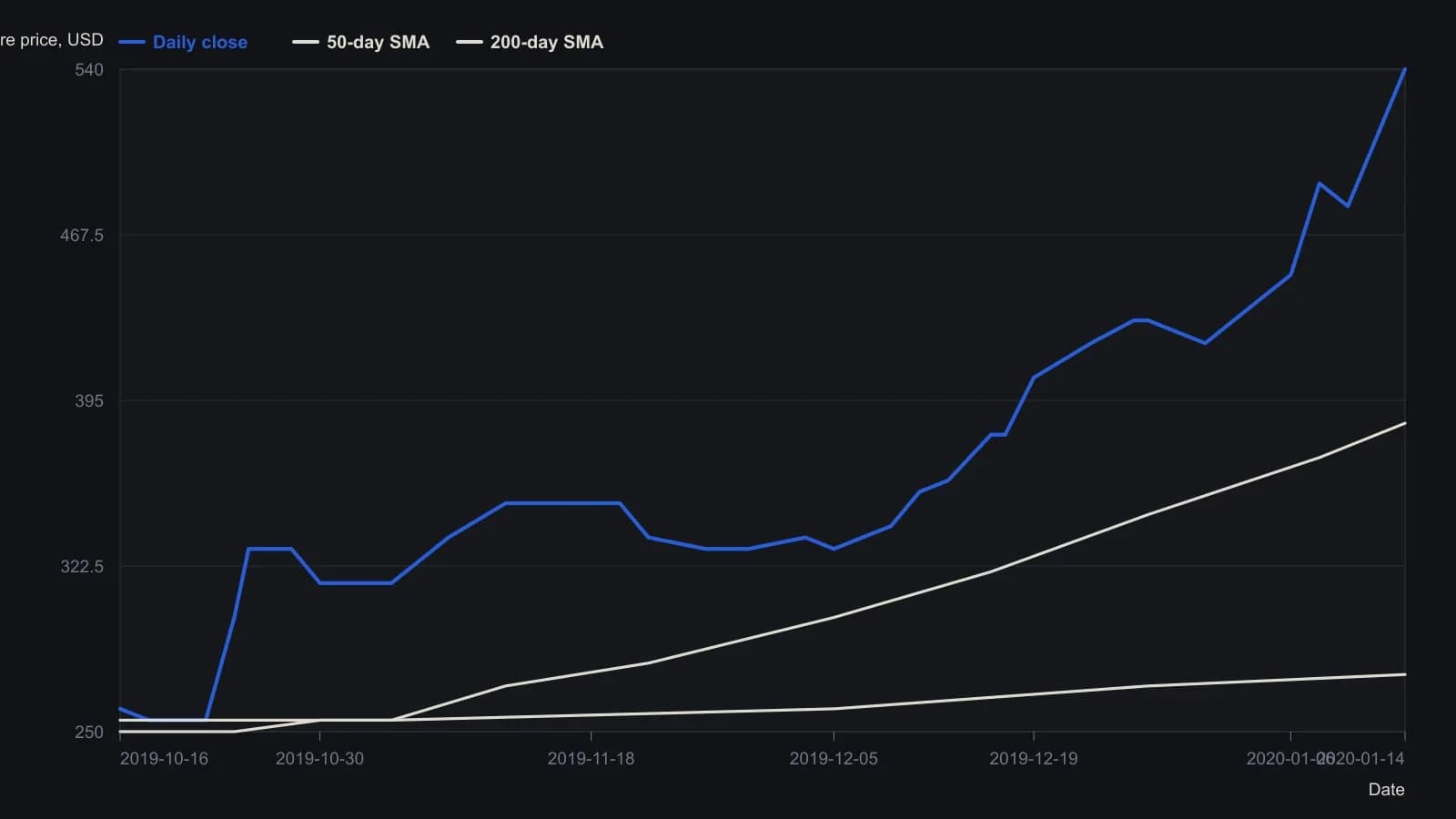
Approximate levels read from the raster; the source printed no numeric table. Tesla prices are pre-split. The 50- and 200-session simple moving averages are the pair used to mark the golden cross.
All readings on this track · 18 readings
- 1989Measured range, scale-in ladders, and spread replay as a cash-reserve design
- 1990When result pressure rewrites checklist and scale-in rules
- 1992Split-sample floors, ceilings, and standing aside
- 2006A swing operator's scale-in, structure, and cash-floor procedure
- 2011Scale in currency risk with tenth-size futures
- 2012Nested cycle scale-in with rewritten stops
- 2013Volume-confirmed swing breaks with scale-in and trailing stops
- 2014When volume thrusts still require a session procedure
- 2015Fusion entry and scale-in after broken levels
- 2015Volatility and volume gates for breakout entries
- 2015Scale-in and prior-range breakout management
- 2017A pair as a two-clock book
- 2017Pair-spread risk as a unit-by-unit capital sequence
- 2018Moving-average breakout with delayed scale-in
- 2018Steepening price-channel breakout with delayed confirmation and planned adds
- 2018A scale-in needs a gate or it is leverage
- 2020Two-stage longs: golden-cross starter, then cup-breakout add
- 2020Close-gated scale-in for swing breakouts