2012issue C0449-52
Nested cycle scale-in with rewritten stops
A 2012 case measured price cycles in a browser-only application and issued each setup with an entry, a stop-loss, and a profit target across six fixed intervals. Editorial reading treats the named interval as the dominant-cycle forecast, then asks whether shorter-interval turns justify a scale-in and whether the stop stays a written bound after every chart refresh.
- Each setup was tied to a named dominant-cycle interval and already carried an entry, a stop-loss, and a profit-target instruction.
- Selection favored the higher-interval trend, the top two-thirds of listed setups, a minimum 3-to-1 profit-to-risk-ratio, and a future-line-of-demarcation over a valid-trendline signal.
- When a longer-interval low was overdue, size was added only as successive shorter-interval buy-stops triggered.
- After a paper buy-stop filled, a sell-stop was placed at once, and later chart refreshes rewrote the stop and the target while keeping the loss bound explicit.
What the 2012 case recorded
The 2012 case examined a browser-only cycle application that measured multiple price cycles. Each setup was issued with an entry, a stop-loss, and a profit-target instruction.
Those measurements were applied to NQ, YM, and ES futures and to EUR/USD, EUR/GBP, GBP/USD, AUD/USD, USD/JPY, and EUR/JPY. The six fixed intervals were 40-day, 20-day, five-day, two-day, one-day, and five-hour.
How lows were stacked on the chart
Completed cycle lows were shown as stacked marks to the left of the live bar. Projected lows were shown as stacked marks to the right. More coincident marks were treated as stronger turning-point confirmation.
Tutorial filters and interval risk
Tutorial rules favored aligning with the higher-interval trend. Overlapping opposite cycle-target zones were treated as indecisive. The same tutorials warned that early-cycle entries can produce premature stop-outs.
Signal selection was limited to the top two-thirds of the listed setups and to a minimum 3-to-1 profit-to-risk-ratio. The underlying cycle literature was noted as using a 2-to-1 floor. Future-line-of-demarcation confirmations were ranked above valid-trendline signals.
Suggested maximum equity risk per trade declined with the interval: 2% on the 40-day, 1.2% on the 20-day, 0.8% on the five-day, 0.6% on the two-day, 0.4% on the one-day, and 0.3% on the five-hour.
A 40-day long with a rewritten stop
The 40-day equity-index long plan specified a least-aggressive buy at 1319.25, a stop at 1304.75, and a target at 1372.52. The plan listed 14.50 points of risk and a 3.7-to-1 profit-to-risk-ratio. Confirmation was a future-line-of-demarcation of a 10-day cycle. Futures prices were mapped to the related ETF by a factor of about 10.
After the paper buy-stop filled, a sell-stop was placed immediately. Later cycle-chart refreshes rewrote both the stop and the target, including a stop of 1295.25 and a target of 1349.35. The loss bound remained explicit through the hold.
Scale-in when the longer low is overdue
When a longer-interval low was overdue but shorter intervals had already turned, the described procedure was to add size as each shorter-interval buy-stop triggered, rather than committing full size on the first signal.
Editorial: that procedure is the scale-in. Cycle-nesting is the alignment of completed or overdue lows across shorter and longer intervals so an entry is staged only when more than one interval agrees.
40-day ES long: stop, entry and target after each daily refresh
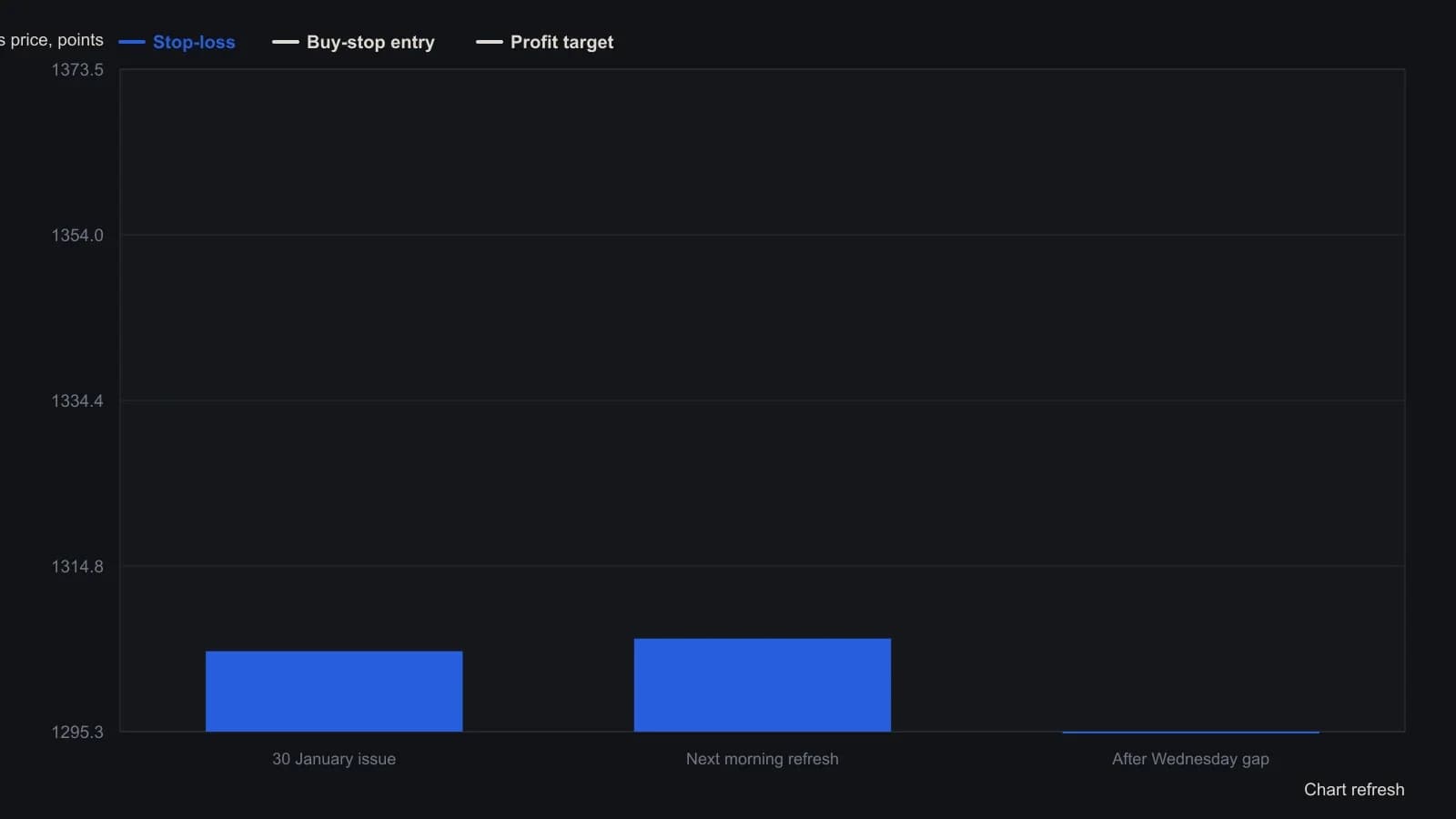
Hurst Trading Signals refreshed 40-day charts once a day. The review dates the first snapshot to Monday 30 January 2012, the second to the following morning, and the third to a recheck after Wednesday’s gap-up. The buy-stop is quoted again only on that third snapshot, where it was unchanged.
All readings on this track · 18 readings
- 1989Measured range, scale-in ladders, and spread replay as a cash-reserve design
- 1990When result pressure rewrites checklist and scale-in rules
- 1992Split-sample floors, ceilings, and standing aside
- 2006A swing operator's scale-in, structure, and cash-floor procedure
- 2011Scale in currency risk with tenth-size futures
- 2012Nested cycle scale-in with rewritten stops
- 2013Volume-confirmed swing breaks with scale-in and trailing stops
- 2014When volume thrusts still require a session procedure
- 2015Fusion entry and scale-in after broken levels
- 2015Volatility and volume gates for breakout entries
- 2015Scale-in and prior-range breakout management
- 2017A pair as a two-clock book
- 2017Pair-spread risk as a unit-by-unit capital sequence
- 2018Moving-average breakout with delayed scale-in
- 2018Steepening price-channel breakout with delayed confirmation and planned adds
- 2018A scale-in needs a gate or it is leverage
- 2020Two-stage longs: golden-cross starter, then cup-breakout add
- 2020Close-gated scale-in for swing breakouts