2018issue C1240-43
A scale-in needs a gate or it is leverage
A scale-in-position stays a sizing method only when the next unit faces the same yes-or-no test as the first. The archive workflow used a two-dollar initial-stop and a two-candle confirmation-gate on winning trades. Adding because a position is already red is averaging-down, not a cloned entry.
- Treat every add as a cloned entry: a confirmation-gate that can fail, an initial-stop that is already known, and an explicit right to stand aside.
- The archive scale-in-position added only to a winning trade after a two-dollar advance or a repeated two-candle pattern.
- A price that justified the first purchase did not justify being longer by five or ten lots after a further decline.
- Under-betting is more survivable than over-betting, and adding after a loss is a recurring size error.
A scale-in is a cloned entry
Editorial reading: a scale-in-position remains a position-sizing method only when the next unit must pass the same yes-or-no test as the first. If the only reason for more size is that the open trade is already red, the trader has not scaled in. They have raised leverage to argue with the tape.
The archive described a different procedure. Extra units waited for a confirmation-gate on a trade that was already winning, and an initial-stop was fixed at the first entry before any add was considered.
How the archive added size
The described scale-in-position placed a two-dollar initial-stop at the first entry. It added to a winning position after every two-dollar advance or after each new occurrence of the same two-candle pattern.
The add rule was limited to charts already in consistent uptrends with prices between 20 and 70 dollars a share. A stated exclusion was to skip buys when the share price contained the digit nine.
The confirmation-gate
The two-candle pattern served as a confirmation-gate. Extra units waited until that pattern was seen on a trade that was already winning.
In the four dual-candle pairs discussed, three of the second candles printed with higher volume. That higher volume was offered as confirmation of demand.
Adding after a loss is not a scale-in
A paired critique said a price that justified an initial purchase did not justify being longer by five or ten lots after a further decline. That move is averaging-down: increasing size after an adverse move in order to lower the average price of a losing position.
The same critique held that remaining too small is more survivable than remaining too large. Under-betting stays inside the original risk budget. Over-betting carries more shares or contracts than the first-entry thesis supports.
Adding after a loss was treated as a recurring decision error because recent losses continue to shape the next size choice. Editorial reading: that error turns a planned scale-in-position into extra leverage rather than a confirmation that can still fail.
Named price-pattern hits in the 8 September 2018 CPS scan
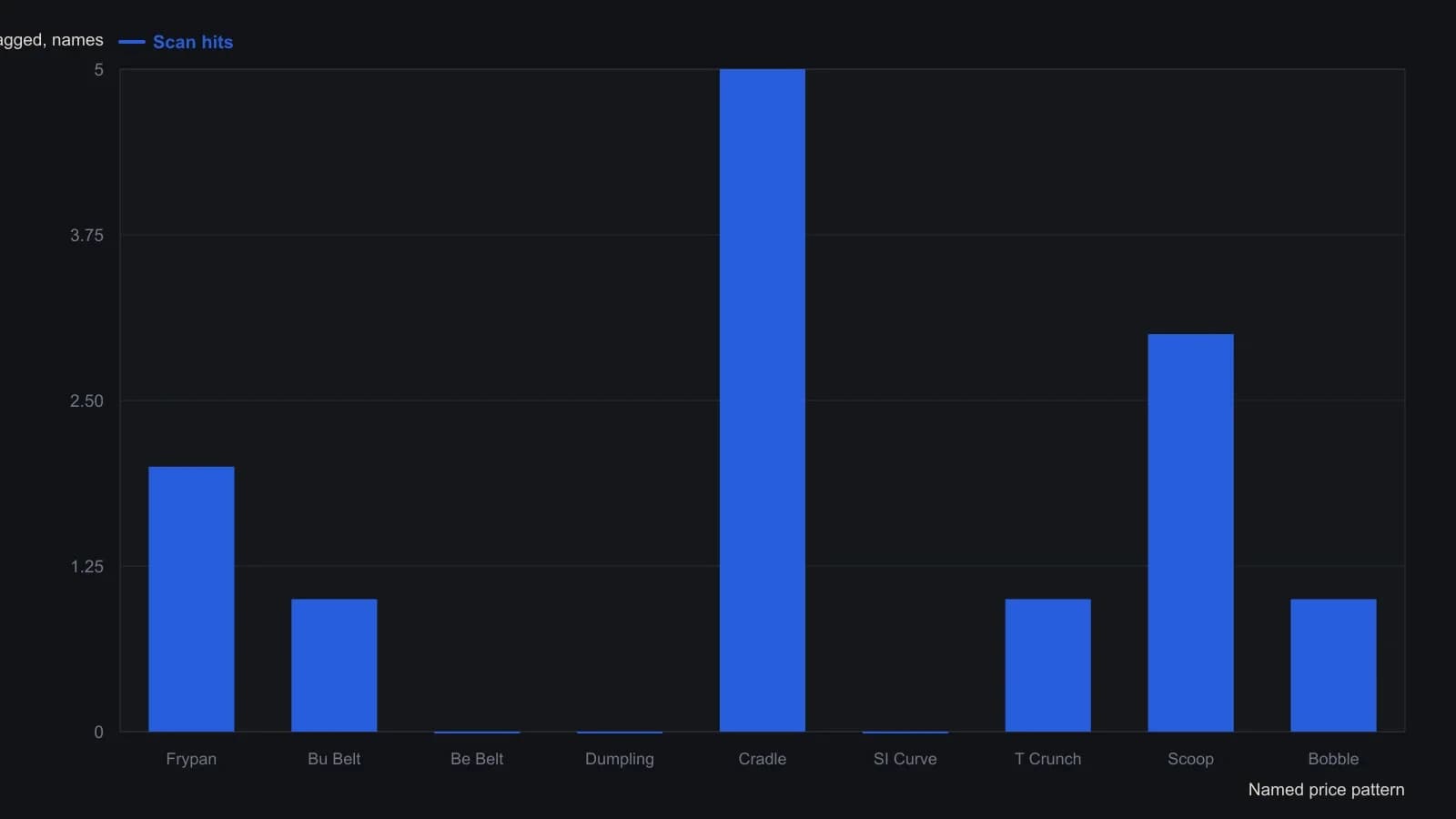
Counts are exact tallies of 1.0000 cells in the 23-row results grid. Eleven rows show 0.0000 in every visible pattern column. Scan: CPS – Price Patterns, daily, filter enabled, 265 periods loaded, run 8 September 2018 10:01:31.
All readings on this track · 18 readings
- 1989Measured range, scale-in ladders, and spread replay as a cash-reserve design
- 1990When result pressure rewrites checklist and scale-in rules
- 1992Split-sample floors, ceilings, and standing aside
- 2006A swing operator's scale-in, structure, and cash-floor procedure
- 2011Scale in currency risk with tenth-size futures
- 2012Nested cycle scale-in with rewritten stops
- 2013Volume-confirmed swing breaks with scale-in and trailing stops
- 2014When volume thrusts still require a session procedure
- 2015Fusion entry and scale-in after broken levels
- 2015Volatility and volume gates for breakout entries
- 2015Scale-in and prior-range breakout management
- 2017A pair as a two-clock book
- 2017Pair-spread risk as a unit-by-unit capital sequence
- 2018Moving-average breakout with delayed scale-in
- 2018Steepening price-channel breakout with delayed confirmation and planned adds
- 2018A scale-in needs a gate or it is leverage
- 2020Two-stage longs: golden-cross starter, then cup-breakout add
- 2020Close-gated scale-in for swing breakouts