1992issue C061-5
Split-sample floors, ceilings, and standing aside
This commodity procedure waits for a historic extreme, adds only on the scale-in path the rules allow, and accepts a floor, target, or ceiling only after that level has been taken from the unused half of the series.
- Abstention is the coded choice to hold no position until a historic price extreme, at which producers and consumers are forced to change future output and use.
- Mean-reversion here means buying near a historic floor or selling near a historic ceiling on the premise that extreme cheapness or richness eventually forces supply and demand to adjust.
- Walk-forward-analysis selects floors, profit targets, and ceilings on one half of a series and generates the buy, sell, and stand-aside signals only on the other half, then reverses the halves.
- The same rule set is framed as an aid for scale-in-position, adding in increments rather than taking a single full-size entry at the first floor or ceiling touch.
Wait for a historic extreme
The procedure waits for historic price extremes at which producers and consumers are forced to change future output and use. Each new extreme is treated as raising the chance of a later reversal.
Until such an extreme is reached, the coded choice is abstention: hold no position. Standing aside is part of the rule set, not an informal pause.
How cheapness and richness are expected to adjust
Very low prices are described as shrinking later supply when marginal producers shut down and as lifting demand when buyers switch to cheaper substitutes.
Very high prices are described as inviting more supply and less demand, including the chance that output in other regions can offset a local crop failure.
Mean-reversion, in this usage, is buying near a historic floor or selling near a historic ceiling on that supply-and-demand premise.
Floors, ceilings, and profit targets
A floor-price is a long-entry threshold read from a multi-decade monthly futures chart of a tangible commodity. A ceiling-price is the matching short-entry threshold from the same long-term monthly chart family. A profit-target is the predetermined exit at which a floor long is liquidated or a ceiling short is covered.
A long is opened at the floor and closed at its profit target. A short is opened at the ceiling and covered at its profit target.
Unused-half floors, targets, and ceilings
Two floor-and-ceiling sets were read from the first half and the second half of each series. Each half was traded with floors, profit targets, and ceilings taken from the unused half.
That transfer is walk-forward-analysis: select the levels on one half of a series, generate the buy, sell, and stand-aside signals only on the other half, then reverse the halves.
Long-lived holdings and actual contract prices
Because holdings were typically long-lived, actual contract prices were used so rollovers included real spread differences and carrying charges. Slippage and commission were included as a round-turn charge.
Where the combined rules were applied
The combined rules were applied to corn, wheat, soybeans, soybean oil, soybean meal, copper, pork bellies, hogs, cotton, and heating oil. Some series, including heating oil, begin later than the others.
The closing note frames the same rule set as an aid for a scale trader who adds to a position rather than taking a single full-size entry. Scale-in-position, in this usage, is adding to a commodity position in increments rather than taking the full size at the first floor or ceiling touch.
Yearly gain and drawdown on 3.33× margin, 1975–1991
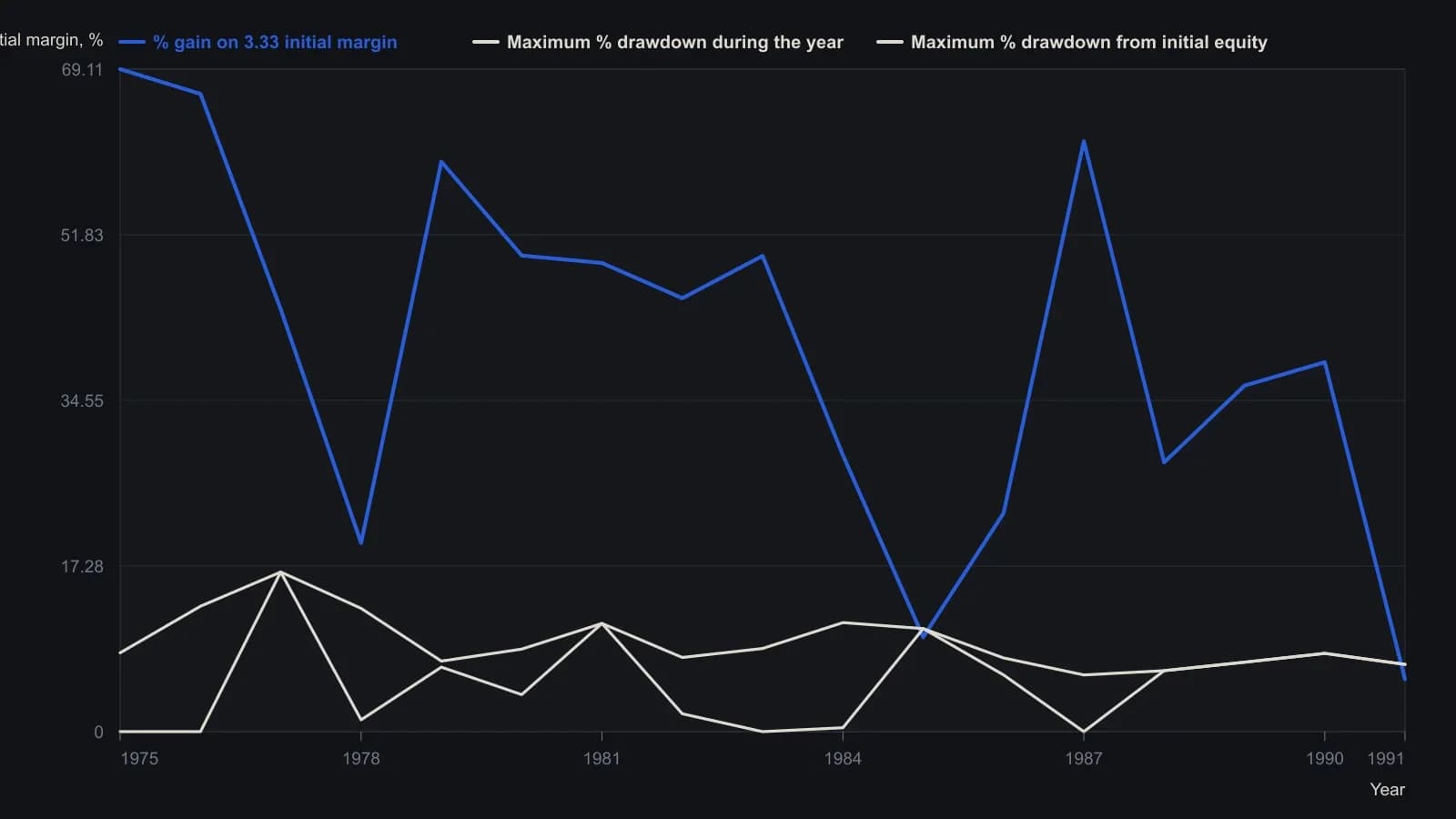
1991 covers only the first 10 months. Not every series begins in 1974; heating oil starts in 1980. Slippage and commission were set at $68 per round turn. Floors, targets, and ceilings applied to each half of the sample were taken from the unused half.
Editorial reading
Editorial: TradersWeek treats the archive workflow as three jointly testable decisions, not as separate hunches about bottoms and tops. Wait until a historic extreme. Add only on the scale-in path the rules allow. Accept a floor, target, or ceiling only after it has been transferred onto the unused half of the series.
Editorial: entry, exit, add-on, and abstention are read as one procedure so that a floor or ceiling taken from the unused half can be checked together with the choice to stand aside until price reaches that extreme.
All readings on this track · 18 readings
- 1989Measured range, scale-in ladders, and spread replay as a cash-reserve design
- 1990When result pressure rewrites checklist and scale-in rules
- 1992Split-sample floors, ceilings, and standing aside
- 2006A swing operator's scale-in, structure, and cash-floor procedure
- 2011Scale in currency risk with tenth-size futures
- 2012Nested cycle scale-in with rewritten stops
- 2013Volume-confirmed swing breaks with scale-in and trailing stops
- 2014When volume thrusts still require a session procedure
- 2015Fusion entry and scale-in after broken levels
- 2015Volatility and volume gates for breakout entries
- 2015Scale-in and prior-range breakout management
- 2017A pair as a two-clock book
- 2017Pair-spread risk as a unit-by-unit capital sequence
- 2018Moving-average breakout with delayed scale-in
- 2018Steepening price-channel breakout with delayed confirmation and planned adds
- 2018A scale-in needs a gate or it is leverage
- 2020Two-stage longs: golden-cross starter, then cup-breakout add
- 2020Close-gated scale-in for swing breakouts