2018issue C0825
Steepening price-channel breakout with delayed confirmation and planned adds
A slowly rising multi-week price channel is the starting condition, not the trade. Confirmation waits for a later breakout that stays steeper for at least one week, then uses a defined high-break trigger, a trailing stop, and planned adds.
- Begin with a slowly rising price channel that has already persisted for several weeks.
- Treat later steepening as a slope-change filter: the breakout must hold a steeper path, preferably near a 45-degree visual slope, for at least one week.
- The stated trigger is 0.50 above the 90-day high, with a 2-point initial stop that then trails and adds about every 2 points while the same upward path remains intact.
- Narrow, orderly channels inside a wide overall trading range are the preferred condition. The write-up says breakouts from sideways boxes more often fail to continue.
The starting channel
The setup begins with a slowly rising price channel that has already persisted for several weeks. A price-channel is a bounded rising price path whose width and slope can be read on an OHLC chart over weeks. The first slow climb is the background condition. It is not yet the signal.
WLL daily price, February–May 2018
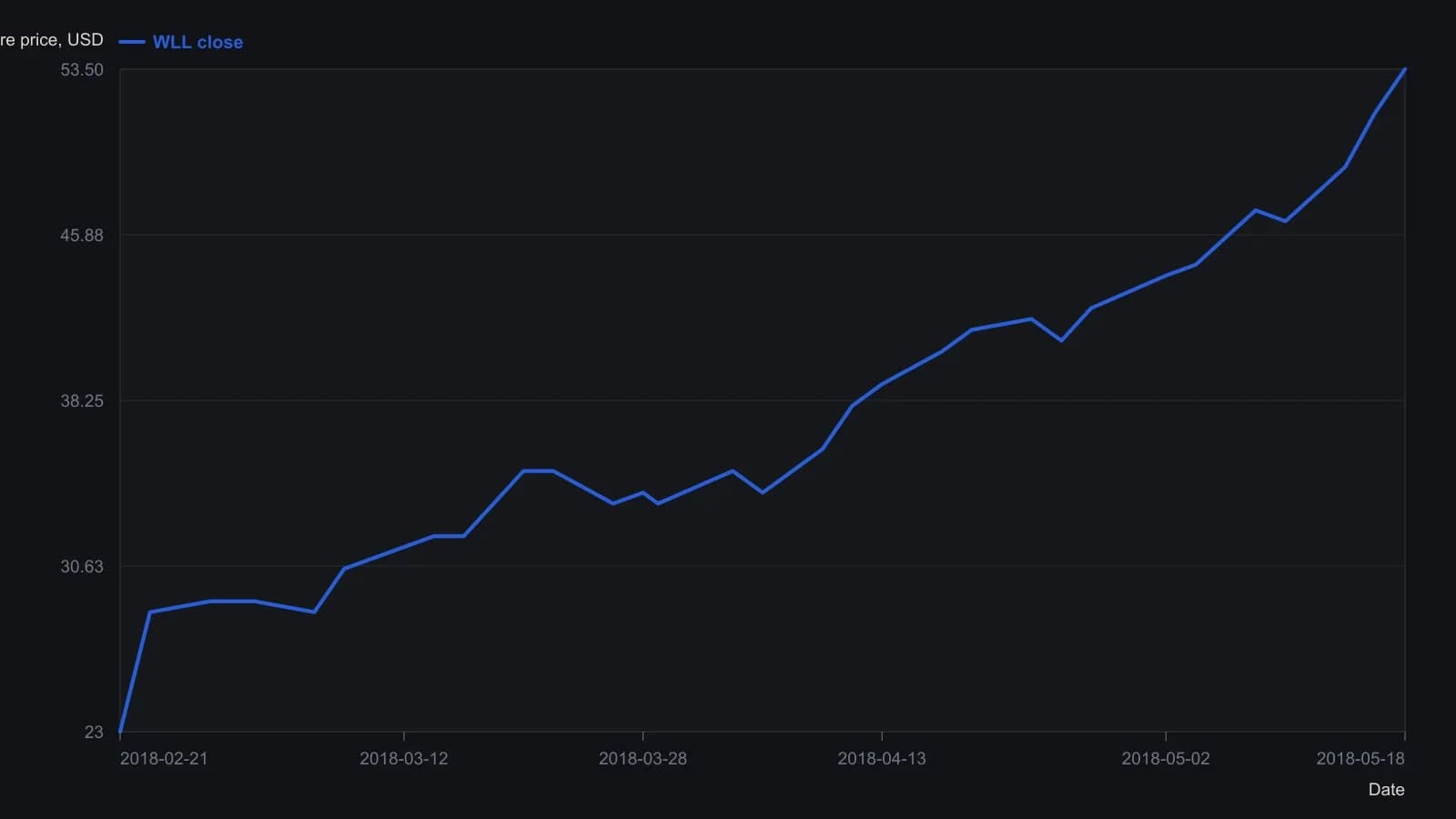
Closes are digitized from candlesticks to the nearest half-dollar and sampled on the chart’s dated ticks, not every session. The printed blue channel and May ramp are annotations, not a data table. The source wants that steeper ramp to hold for at least a week and prefers a narrow channel with a wide range.
How confirmation is defined
Confirmation is a later breakout whose slope increases and remains steeper for at least one week. A slope-change-filter is a waiting rule that requires the channel angle to increase and persist before a breakout is treated as a signal. A roughly 45-degree visual slope is specified as the preferred steepness for that second-stage move.
In this workflow, a breakout is a move that leaves the prior channel path and holds a steeper trajectory long enough to count as confirmation.
Entry, trailing stop, and planned adds
The stated entry trigger is 0.50 above the 90-day high. The stated protective rule is a 2-point initial stop that then trails. A trailing-stop is a protective offset that starts at a fixed distance from entry and then follows price if the move continues.
If price keeps rising, additional size is added about every 2 points. Scale-in-position means adding size in fixed increments only while the same upward path remains intact.
Preferred chart condition
Narrow, orderly channels combined with a wide overall trading range are presented as the preferred chart condition. The write-up contrasts this continuing-channel breakout with breakouts from sideways boxes, which it describes as more often failing to continue.
All readings on this track · 18 readings
- 1989Measured range, scale-in ladders, and spread replay as a cash-reserve design
- 1990When result pressure rewrites checklist and scale-in rules
- 1992Split-sample floors, ceilings, and standing aside
- 2006A swing operator's scale-in, structure, and cash-floor procedure
- 2011Scale in currency risk with tenth-size futures
- 2012Nested cycle scale-in with rewritten stops
- 2013Volume-confirmed swing breaks with scale-in and trailing stops
- 2014When volume thrusts still require a session procedure
- 2015Fusion entry and scale-in after broken levels
- 2015Volatility and volume gates for breakout entries
- 2015Scale-in and prior-range breakout management
- 2017A pair as a two-clock book
- 2017Pair-spread risk as a unit-by-unit capital sequence
- 2018Moving-average breakout with delayed scale-in
- 2018Steepening price-channel breakout with delayed confirmation and planned adds
- 2018A scale-in needs a gate or it is leverage
- 2020Two-stage longs: golden-cross starter, then cup-breakout add
- 2020Close-gated scale-in for swing breakouts