1990issue C111-8
Volume-confirmed facilitation as an execution gate for half-hour breakouts
Range-per-tick facilitation and a rise in tick volume define plus-plus confirmation on 30-minute index-futures bars. Editorial reading: the pair is an execution gate for a one-bar straddle, and an inside-bar cancel treats an unfilled order as a completed no-trade.
- Range-per-tick facilitation is the bar high-low range divided by tick volume, then labelled plus or minus only against the immediately preceding bar.
- Plus-plus confirmation requires both a higher facilitation reading and higher tick volume than the prior bar before a breakout order may be armed.
- The one-bar straddle rests one tick beyond the signal-bar high and low, and an inside-bar cancel pulls both stops if the next bar fills neither side.
- The 2:00 Central Standard Time procedure compares the 1:00-1:30 bar with the 1:30-2:00 bar, then uses a same-session close rather than an overnight hold.
The historical workflow computes range-per-tick facilitation on successive 30-minute index-futures bars and withholds a breakout order unless plus-plus confirmation is present. TradersWeek editorial reading: that sequence is a permission gate for execution, not a prediction of which side will trade.
How range-per-tick facilitation is labelled
On a 30-minute index-futures bar, range-per-tick facilitation is the bar's high-low range divided by its tick volume, read as points moved per tick. A 200-point range with 100 ticks equals 0.5 points moved per tick.
The reading is a sequential label only. The current value is plus when it exceeds the prior bar and minus when it is lower. In uncombined form the filter has no fixed numeric threshold, so it adjusts across volatility regimes by comparing consecutive bars rather than an absolute cutoff.
When a bar is treated as tradeable
A bar is treated as tradeable only when it is facilitating and also has greater tick volume than the previous bar. That joint state is plus-plus confirmation, and both conditions are required before a breakout order is armed.
One-bar straddle and inside-bar cancel
The evaluated entry is a one-bar straddle: a buy-stop one tick above the signal-bar high and a sell-stop one tick below its low. Both working orders are canceled if the next bar fills neither side. When that following bar stays inside the signal range, the inside-bar cancel pulls the pending stops because no breakout occurred.
The isolated 2:00 same-session close
Each unique half-hour breakout was tabulated separately, after which the 1:30 and 2:00 Central Standard Time bars were isolated for same-session close exits. That isolation stands in contrast to taking every plus-plus bar and holding overnight.
The 2:00 procedure compares the 1:00-1:30 bar with the 1:30-2:00 bar and arms the straddle only if both facilitation and tick volume rose. The orders cancel at 2:30 on no fill. After a fill, the unfilled side is replaced with a $1,500 money-management stop before a 3:15 close exit.
Profit per trade on S&P ++ 30-minute breakouts, 1989–March 1990
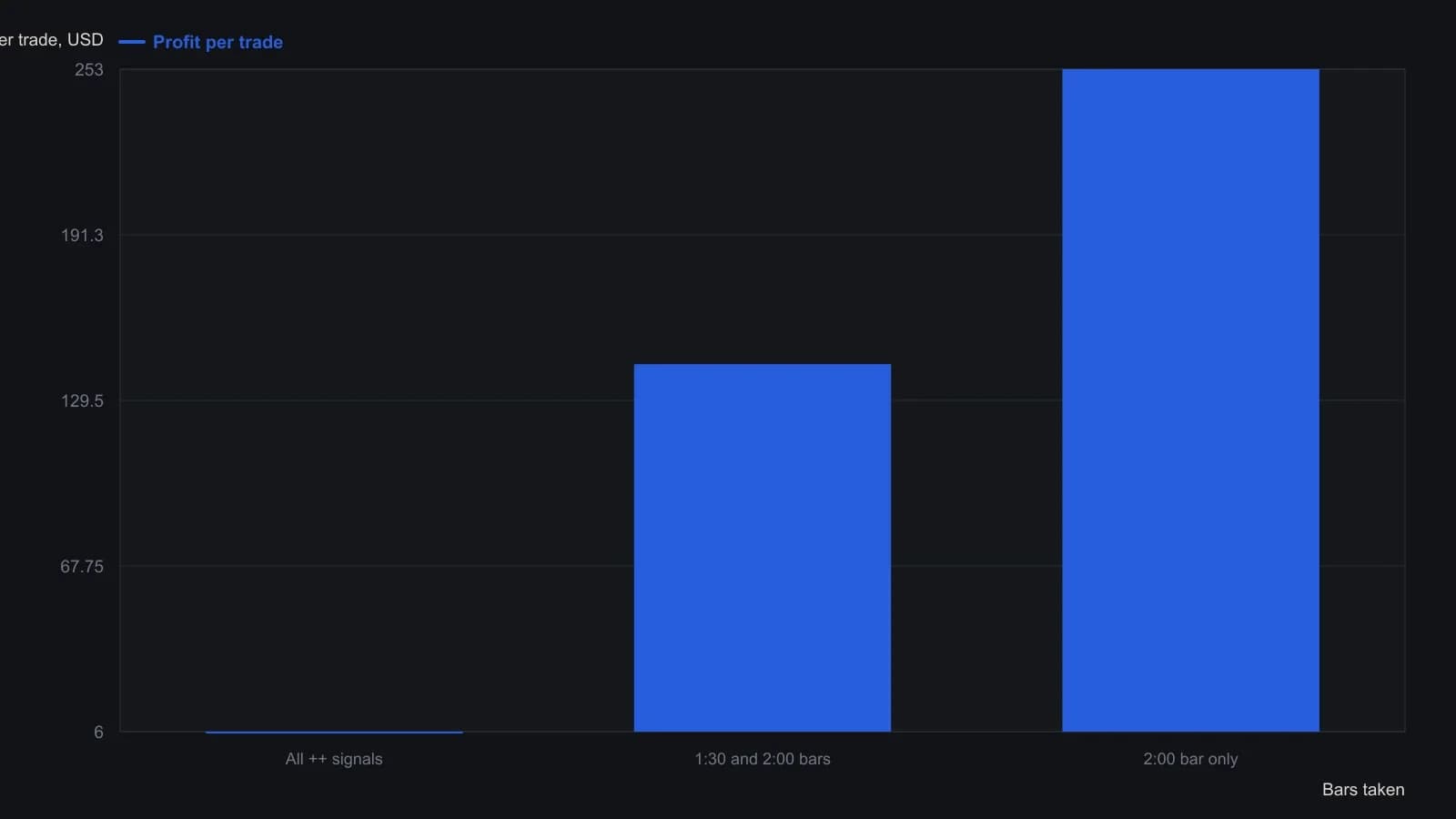
Each test charges $25 commission and nothing for slippage. The All row holds overnight; the 1:30 and 2:00 rows exit on that day’s close. Matching net profits were $1,750, $18,200 and $18,700.
How the historical evaluation was scored
The tests charged $25 commission, assumed no slippage, and used return on intradrawdown instead of return on account so changing margin and idle margin balances would not enter the ratio.
The later evaluation extended the sample through 1989 and most of first-quarter 1990. One long-window check of the 2:00 plus-plus breakout ran from first-quarter 1986 through first-quarter 1990.
All readings on this track · 20 readings
- 1987Intraday Value Area construction from TPO counts
- 1987Constructing session market profiles from half-hour auctions
- 1988Volume value area versus time-print filters
- 1988Auction control from a price, volume, and time ledger
- 1988Constructing intraday trade-facilitation percentile tables
- 1988Constructing session decisions from auction age and volume
- 1989Range extension after the opening auction
- 1989Constructing value maps from auction volume overlays
- 1989The bull hook as a next-session opening-range breakout filter
- 1990Incomplete volume-at-price samples and auction reads
- 1990Constructing overlay profiles to map auction value
- 1990Constructing daily overlay profiles for auction brackets and breaks
- 1990Volume-confirmed facilitation as an execution gate for half-hour breakouts
- 1992Volume-box construction with named spreadsheet macros
- 1993Commercial volume caps outside the value area
- 1993Hourly participant volume as a live filter for day trades
- 1999Assembling the daily auction from time-price opportunities
- 2000Who accepted price first in the auction
- 2002Treat the session as an auction: find value, then judge the breakout
- 2002Auction structure, trader constraints, and the opening range