1990issue C031-7
Incomplete volume-at-price samples and auction reads
A public volume-at-price file let non-members see the per-price activity floor observers had watched in the pit. The published extract was built from an early clearing cut, so Market Profile, volume-profile, and volume-confirmation reads were taken from a sample that later reconciliations still had to complete.
- The published volume-at-price file is built from the second reconciliation, an early cut that leaves a large share of the day without a price assignment.
- A three-out-of-four sample is still not a census if excluded trades cluster by price, clock period, or participant type.
- Side-by-side cuts understated CTI4 institutional volume, and missing prints clustered in the last two hours rather than in prior-evening activity.
- Market Profile, the volume profile, and volume confirmation all inherit those unassigned prices, including a late-session gap that can dominate the close.
A public file for the third auction dimension
Market Profile treats volume at each price as the third auction dimension that locates acceptance or value. Related price-time-volume work does the same, so the daily volume-at-price file is the required input.
In 1984 an exchange published a public volume-at-each-price file so non-members could see the per-price activity that floor observers had previously watched in the pit.
The published file comes from the second reconciliation
The published file is built from the second clearing reconciliation submitted around 17:00 Central. That cut contains only about 70 percent of that day's volume.
The rest of the session arrives in a third reconciliation around 21:00 and a fourth the next morning around 10:00 after out-trades are settled.
Typical published files show only about 75 percent of final cleared volume. About 25 percent of trades therefore have no assigned price in the file many users treat as complete.
A large sample is still not a census
An informal user survey found that more than 80 percent believed they were reviewing the entire prior session rather than a sample.
A three-out-of-four sample is still not a census. The publisher has not shown that the included prints are random, or that excluded trades do not systematically omit certain prices or clock periods.
Published LDB file versus the later third clearing rec
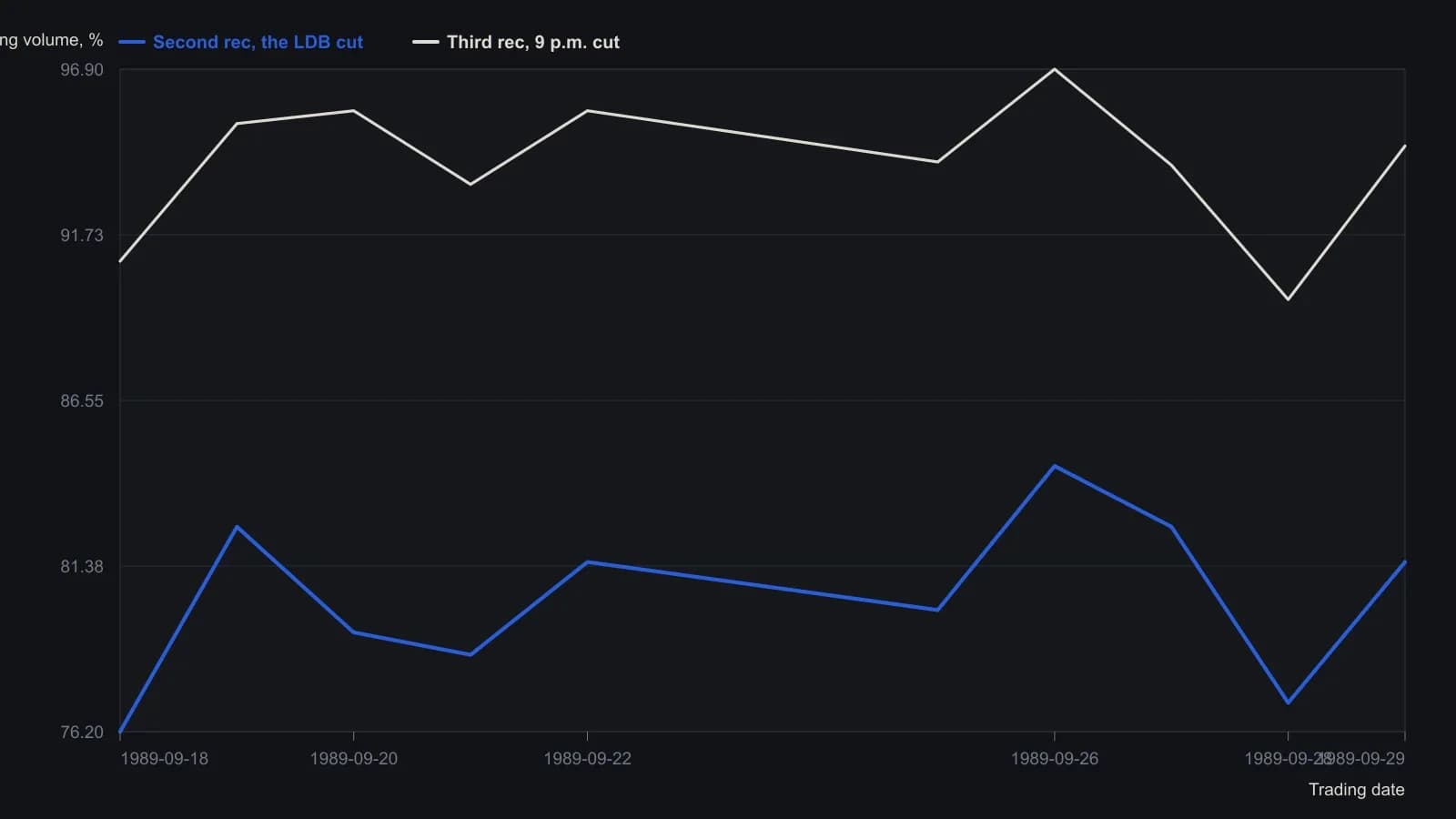
The article text cites a typical second-rec share of about 70 percent of the day. This ten-day extract prints higher, from 76.2 to 84.5 percent of final.
What the missing prints left out
Side-by-side second and third reconciliations consistently understated institutional CTI4 volume. Market Profile and volume-confirmation users therefore likely understated longer-horizon participation in bonds.
Missing prints appeared tied to the last two hours of the day rather than to prior-evening activity. That window can dominate the close and the volume profile.
How the file counts volume
Volume in the file is reported as paired buys and sells. That total must be halved to recover traded volume.
Editorial interpretation: Market Profile is a price-time-volume auction map of acceptance or value from how much traded at each price, not from price and time alone. The volume profile is the distribution of that size across prices. Volume confirmation uses per-price and per-period volume to qualify who participated and whether the close was a thin or heavy print. Each of those reads can only use the size the early file assigned.
Editorial interpretation: a late-session gap in the final hours can dominate close location and the shape of the volume profile, while an understated CTI4 slice changes how volume confirmation reads the lasting participant.
All readings on this track · 20 readings
- 1987Intraday Value Area construction from TPO counts
- 1987Constructing session market profiles from half-hour auctions
- 1988Volume value area versus time-print filters
- 1988Auction control from a price, volume, and time ledger
- 1988Constructing intraday trade-facilitation percentile tables
- 1988Constructing session decisions from auction age and volume
- 1989Range extension after the opening auction
- 1989Constructing value maps from auction volume overlays
- 1989The bull hook as a next-session opening-range breakout filter
- 1990Incomplete volume-at-price samples and auction reads
- 1990Constructing overlay profiles to map auction value
- 1990Constructing daily overlay profiles for auction brackets and breaks
- 1990Volume-confirmed facilitation as an execution gate for half-hour breakouts
- 1992Volume-box construction with named spreadsheet macros
- 1993Commercial volume caps outside the value area
- 1993Hourly participant volume as a live filter for day trades
- 1999Assembling the daily auction from time-price opportunities
- 2000Who accepted price first in the auction
- 2002Treat the session as an auction: find value, then judge the breakout
- 2002Auction structure, trader constraints, and the opening range