2008issue C071-4
Audit an out-of-the-money covered-call overlay against a Sharpe control
This archive article teaches a desk-style audit of one overlay. Freeze the market-regime assumptions, score the short call only against an explicit buy-and-hold Sharpe control, and inventory the live breaks a Monte Carlo trial left out.
- An out-of-the-money covered call pairs a held stock or fund with a short call struck above spot. This workflow froze a plus-one-standard-deviation strike, treated as theoretically exercised about 16 percent of the time.
- Sharpe ratio compared a plain buy-and-hold book with the same book plus the overlay. A Monte Carlo design ran 31 paired 24-month trials under frozen range, trend, implied-volatility, and rate assumptions.
- Sample-mean Sharpe scores were -0.27 for the control book and 0.16 for the overlay book. The difference test rejected the stated null at the 95 percent critical value and did not reject it at the 99 percent critical value.
- Editorial: inventory trend, volatility drift, and regime-flexible spread choices the simulation left out before treating premium as a free buffer.
Freeze the overlay before you score it
An out-of-the-money covered call is opened by selling a call whose strike sits above the current price of a stock or exchange-traded fund already held. In this archive workflow that short call is a plus-one-standard-deviation strike: a gap of one monthly standard deviation above spot, treated as theoretically exercised about 16 percent of the time.
Editorial: the desk audit starts by freezing that market-regime package. Do not widen, narrow, or repair the short call while the score is being taken. The comparison is one overlay against one control, not a flexible options book.
How the 30-day width was read
A 30-day width was estimated by dividing annual implied volatility by the square root of 12, given as 3.4641. The same gap could be read from the board by using a nearby call whose delta is near 16 percent as a delta-as-exercise-proxy for that plus-one-standard-deviation strike.
Implied volatility is the annualized input used both to price the short calls and to set that monthly standard-deviation width.
Score the overlay only against a buy-and-hold Sharpe control
Sharpe ratio was defined as excess return over the risk-free rate per unit of risk. In this workflow it is the risk-efficiency score that compares a plain buy-and-hold book with the same book plus out-of-the-money covered calls.
Editorial: score the short call only against that explicit buy-and-hold Sharpe control. Do not introduce a second overlay, a different risk metric, or a live repair path into the same comparison.
What each Monte Carlo trial assumed
A Monte Carlo design ran 31 paired 24-month trials. Each Monte Carlo trial is a simulated 24-month path of both books under fixed range, trend, volatility, and rate assumptions. The test asked whether traditional buy-and-hold Sharpe was greater than or equal to Sharpe with the overlay.
Simulation assumptions included a monthly range capped at plus or minus 2 standard deviations, a neutral trend, constant 10 percent annual implied volatility, a constant 5 percent risk-free rate, Black-Scholes prices, a 0.04 friction charge, one-dollar strikes, penny pricing, immediate monthly reestablishment at plus 1 standard deviation, and no dividends.
What the paired sample reported
Across the 31 paired trials the sample-mean Sharpe scores were -0.27 for the control book and 0.16 for the overlay book.
The difference test reported a t-statistic of -1.7930 with 60 degrees of freedom and pooled variance 0.8935. That statistic rejected the null at the 95 percent critical value of -1.6710 and did not reject it at the 99 percent critical value of -2.3900.
Paired Sharpe ratios from the 31-trial Monte Carlo
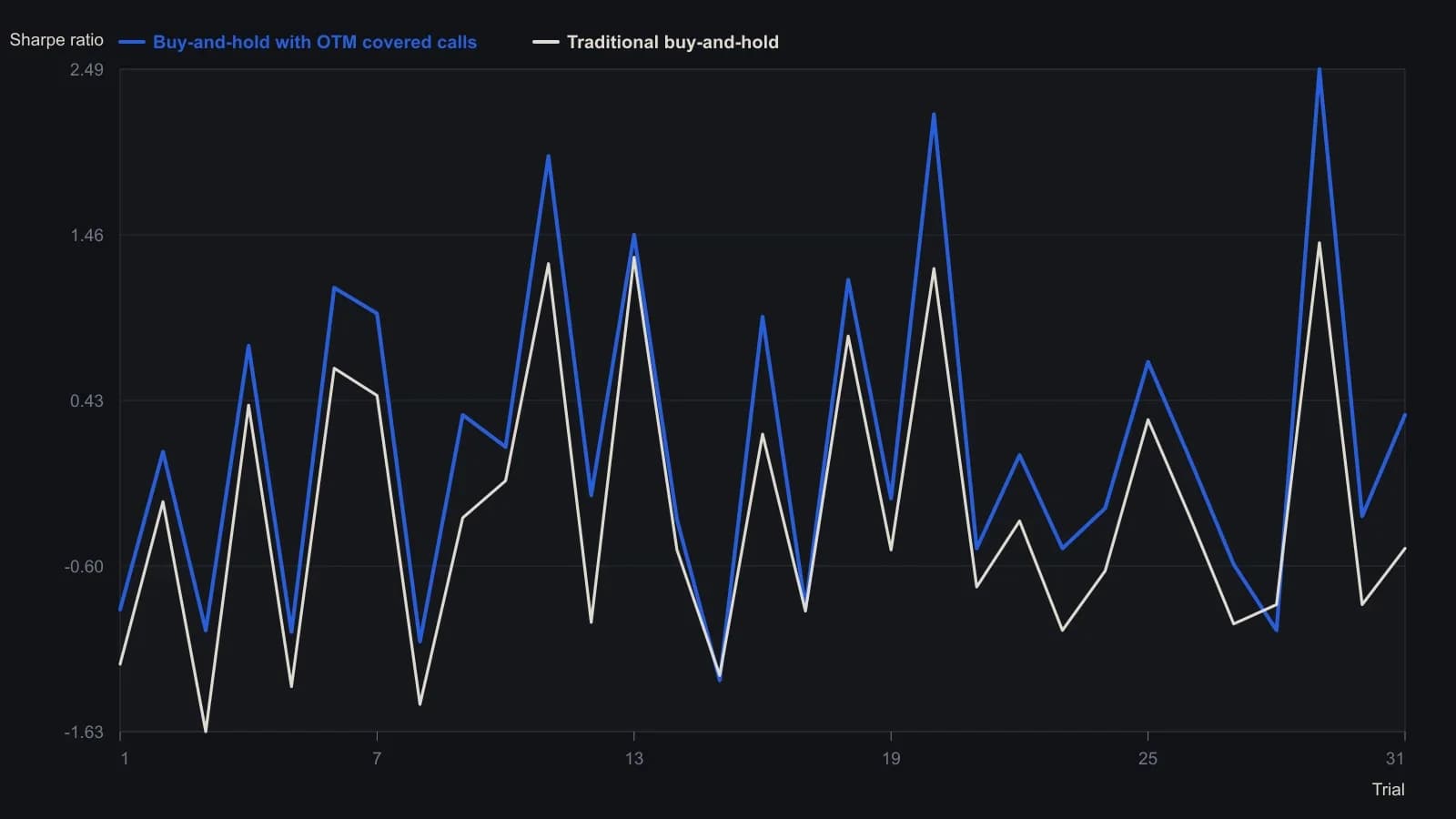
Each trial held implied volatility at 10 percent, a 5 percent risk-free rate, a trendless path, monthly re-strikes at plus one standard deviation, and a monthly range of plus or minus two standard deviations.
Inventory the breaks the model left out
The model was described as truncating moves beyond 2 standard deviations, imposing a trendless path, holding implied volatility flat, and using a semi-fixed strike gap.
Outside the model, strike distance was described as something that could be widened in a recognized advance and narrowed in a recognized decline. That regime-flexible spread is a live choice, not part of the frozen trial. Discretionary repairs included rolling the short call higher, selling a second lower strike, waiting for an intraday high, or averaging sales when several contracts were required.
Editorial: list those breaks, trend, volatility drift, and strike flexibility, before anyone treats collected premium as a free buffer. The archive scores a frozen overlay. A live book that changes the gap is a different object.
All readings on this track · 12 readings
- 1986Auditing stochastic crossovers with moving-average baselines
- 1994Evaluating system changes with chi-square, Sharpe, and leverage
- 1995Evaluating mechanical switch rules with a stop-loss order and Sharpe ratio
- 1995Intermediate-term allocation with drawdown filters
- 1996Evaluating a multi-market book without picking winners
- 1996Regime-aware allocation beyond a single equity trend
- 1997Evaluating managed futures as portfolio diversifiers
- 2008Audit an out-of-the-money covered-call overlay against a Sharpe control
- 2013Constructing the Sharpe ratio as return over variability
- 2014Expected value and bet size are separate controls
- 2015Constructing a Sharpe-style score from profit and loss variability
- 2019Continuous futures series and long-horizon allocation evaluation