2008issue C111-2
Flipped support and resistance as target zones
Prior support and resistance bands can locate later price targets through role reversal. A cleared resistance is treated as later support, a broken support as later resistance, and each flipped shelf becomes the next target zone rather than a spent level.
- Prior support and resistance bands are one method for locating later price targets after those bands are broken or cleared.
- Role reversal treats a cleared resistance as later support and a downside break of support as later resistance.
- A later return to the same horizontal band is a level extension of the same crowd boundary, not a new level.
- Nearby support is associated with long initiation or short covering; nearby resistance is associated with long covering or short initiation.
Support and resistance as later targets
Resistance is framed as a zone where selling pressure exceeds buying pressure. Support is framed as a zone where buying pressure exceeds selling pressure. Prior support and resistance bands are presented as one method for locating later price targets.
A cleared resistance is treated as later support, and a downside break of support is treated as later resistance. That working rule is role reversal: a broken support can later cap rallies, and a cleared resistance can later floor declines. The flipped band is then a target zone, a previously contested place used to reassess a position rather than a promised turning print.
The illustrated sequence of role changes
On the illustrated chart, zone A capped two advances and zone B held two declines before the later sequence of breaks.
After zone B broke, price printed a low at label 1, and the next advance was expected to meet that former support as resistance. The subsequent rally stalled at labels 3 and 4, with 4 treated as a level extension of 3, then found support again at label 2, treated as a level extension of 1.
Once the 3-4 band was crossed it was treated as potential support. Zone B later capped the rise at C. After price held the 3-4 band and crossed C, C was treated as support and the next watch band was A, where price turned down from D.
Infosys price versus flipped 800 and 1150 shelves
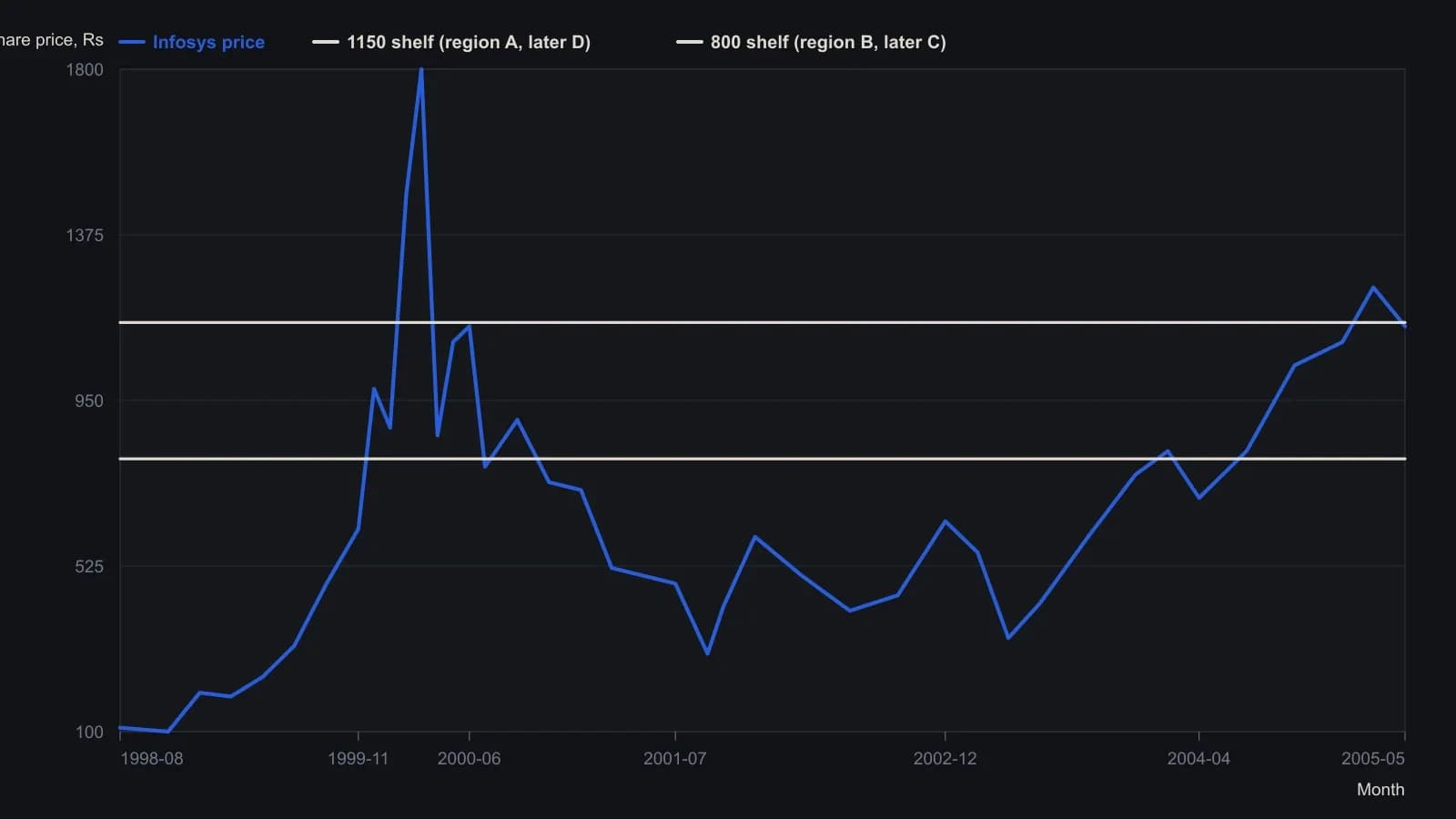
Visual samples of the printed bar chart, rounded to the nearest 10 rupees; the raster cannot support finer precision. Volume was not digitized.
Major versus minor, and nearby positioning
A broken major support is described as later major resistance, while a broken minor support is described as later minor resistance. The distinction is that a widely respected shelf, once broken, is expected to oppose the next move more strongly than a lesser shelf.
The positioning framework associates long initiation or short covering with nearby support and long covering or short initiation with nearby resistance.
Editorial reading: the next target zone is the next crowd test on the ladder, not a forecast of a final destination.
All readings on this track · 12 readings
- 1989A daily checklist that separates the screen from the entry
- 2002Prior-week high and low as this week's support and resistance
- 2004A daily veto that left only a two-point afternoon short
- 2005A real-time audit after overriding a moving-average filter
- 2006Discretionary rules before leverage in forex
- 2008Flipped support and resistance as target zones
- 2011When expected chart setups fail, trade the pop
- 2012A mechanical rule set from the gold positioning reports
- 2014Volume-backed support and resistance construction
- 2015SMA-confirmed supply and demand breakouts as one mechanical procedure
- 2016Trade within your league as one decision process
- 2018Building a pre-trade checklist with stops and levels