2012issue C1143-48
A mechanical rule set from the gold positioning reports
A documented gold workflow shows how to cut a weekly public positioning file set down to one net series and treat that series as the input to a mechanical decision on entry, abstention, and exit.
- The weekly public positioning file set spans seven compressed report types, but commonly cited categories use only a small slice of the monthly data.
- A documented preparation path extracts the gold futures-and-options combined series, adds matching closes, and writes a clean file for association testing.
- In the worked gold example, total reportable longs and total reportable shorts showed the strongest pairwise links to the gold ETF.
- Netting those two counts produced one compact series that can feed a mechanical rule for entry, abstention, and exit.
A weekly file larger than the usual columns
The weekly public positioning file set is easy to treat as a pile of loosely related columns. It comprises seven compressed historical report types covering disaggregated, financial-futures, combined futures-and-options, and commodity-index-trader views.
In a single month those seven reports can contain on the order of 700,000 data points across more than 500 contracts. Commonly cited categories use only about 29,000 of those points.
The documented gold preparation
The archive records a preparation procedure for gold. It extracts the gold futures-and-options combined series, deletes unused leading and trailing columns, inserts matching closing prices, replaces blank fields with zero, and saves a comma-delimited file for pairwise association testing.
The worked example aligned gold-contract positioning from 6 January 2009 through 20 December 2011 with same-date gold-ETF closes. It then ran all-pairs and single-variable association scans.
Association scores and a net series
The association scan returned a maximal information coefficient of 0.89483 between the gold ETF and total reportable long traders, and 0.88373 between the gold ETF and total reportable short traders.
Netting reportable longs against reportable shorts produced a single derived series. That series could be plotted against the gold ETF as a compact decision input.
Net reportable-trader count in COMEX gold
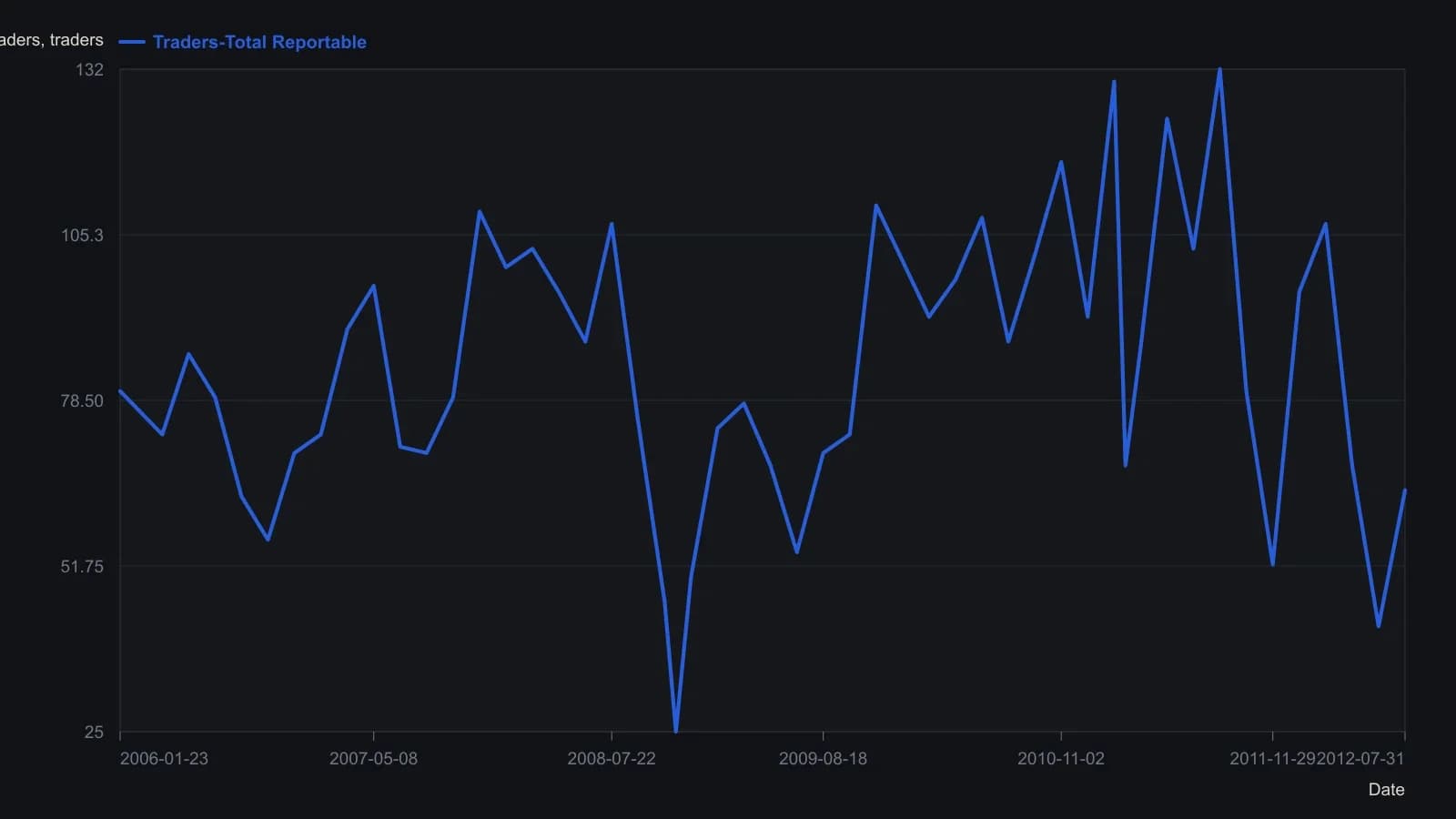
McEwan netted Traders-Total Reportable Long against Short to build this series. The figure also plots gold on a right-hand dollar-per-ounce scale and 5- and 10-period averages of the trader count; those extra lines cannot be separated cleanly on the raster and are omitted. His MINE run used 6 January 2009 through 20 December 2011, but the figure itself runs from January 2006 through July 2012. Readings are approximate to a few traders.
Editorial reading: one procedure, not many columns
Editorial reading: a mechanical trading system can take that net series as its rule input. Rule-based entry, standing aside, and exit then sit in one procedure instead of across leftover columns.
Editorial reading: a plot of the net series against the gold ETF is a chart condition. Support and resistance is the usual name for turning a repeatable chart condition into a falsifiable trade hypothesis. The archive stops at the compact series. It does not define those later chart rules.
All readings on this track · 12 readings
- 1989A daily checklist that separates the screen from the entry
- 2002Prior-week high and low as this week's support and resistance
- 2004A daily veto that left only a two-point afternoon short
- 2005A real-time audit after overriding a moving-average filter
- 2006Discretionary rules before leverage in forex
- 2008Flipped support and resistance as target zones
- 2011When expected chart setups fail, trade the pop
- 2012A mechanical rule set from the gold positioning reports
- 2014Volume-backed support and resistance construction
- 2015SMA-confirmed supply and demand breakouts as one mechanical procedure
- 2016Trade within your league as one decision process
- 2018Building a pre-trade checklist with stops and levels