2004issue C101-2
A daily veto that left only a two-point afternoon short
A daily S&P 500 chart first barred new long entries. After that daily veto, the written procedure waited for a post-lunch session window, a volume-backed momentum trigger, a two-point objective, and a resistance stop, or else it treated the day as complete with no trade.
- Price below the 50-day average and a break of 1080 support on the daily S&P 500 chart were used as a daily veto that barred new long entries before any e-mini order was considered.
- The planned session window was after the lunch return, not the cash open, so the day's average range could be used to locate stop-loss orders.
- On 12 August 2004 a downside momentum trigger with a volume spike authorized a short at 1066, a fixed-point objective closed it at 1064, and a resistance stop had already been fixed at 1067.25.
- The abstention rule treated a missing setup as a completed day, and holding past the two-point target required a continuation test that was not marked on this instance.
The daily chart decided the long side first
A daily S&P 500 chart was checked first as a stand-in for e-mini direction. Price below the 50-day average and a break of 1080 support were used to bar new long entries. That pairing is the daily veto, a higher-timeframe condition that forbids one side of the market before any intraday order is considered.
Editorial reading: after that veto, the session was no longer a two-sided search. The long side was closed. The remaining procedure could only qualify a short or stand aside.
Daily S&P 500, 1080 veto line, Sep 2003–Aug 2004
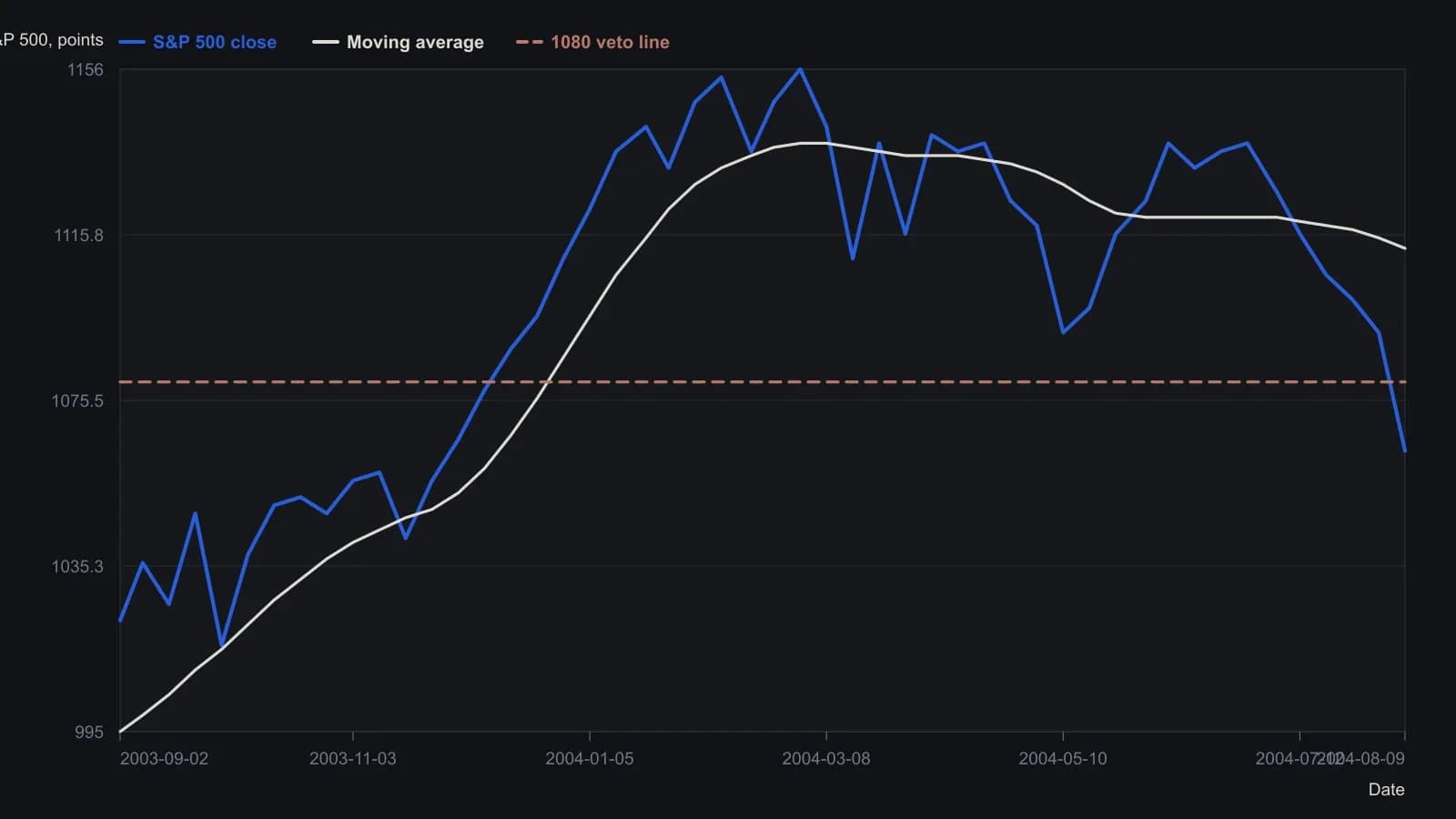
Digitized from the daily candlestick field, sampled on the dated weekly ticks. Intermediate closes are approximate to the nearest index point. The overlay length is not labeled on the plot.
The watch began after lunch
The planned watch window was after the lunch return rather than the cash open. That session window is a predefined part of the cash session used for observation and execution instead of the opening print. The later start let the day's average range be used to locate stop-loss orders.
A volume-backed burst authorized the short
On 12 August 2004 the first hour was read as weak. At 10:05 PT a five-minute e-mini chart showed a downside-momentum burst with a volume spike. That burst is the momentum trigger, an intraday burst of directional pace, often confirmed by a volume spike, that authorizes a rule-based entry. A short was entered at 1066.
The two-point exit and the resistance stop were already named
The written exit rule was a two-point objective. That fixed-point objective is a pre-stated exit distance in index points that closes the trade unless a separate continuation test is met. The short was closed at 1064 about three minutes later because momentum was not judged to be still expanding. Holding past the two-point target was reserved for cases where momentum continued to increase, and that continuation test was not marked on this instance.
A protective stop was fixed before entry at 1067.25 after 1067 was identified as nearby resistance on the same five-minute chart. That placement is the resistance stop, a stop placed just beyond a nearby resistance reading so the loss bound is known before entry.
No setup would have counted as a finished day
The procedure treated a missing setup as a completed day: no qualifying opportunity meant no trade. That abstention rule is the explicit instruction to skip the session when the entry conditions never appear. Editorial note: the skip instruction belongs to the same written procedure as the fill. It is not a fallback invented after an empty session.
All readings on this track · 12 readings
- 1989A daily checklist that separates the screen from the entry
- 2002Prior-week high and low as this week's support and resistance
- 2004A daily veto that left only a two-point afternoon short
- 2005A real-time audit after overriding a moving-average filter
- 2006Discretionary rules before leverage in forex
- 2008Flipped support and resistance as target zones
- 2011When expected chart setups fail, trade the pop
- 2012A mechanical rule set from the gold positioning reports
- 2014Volume-backed support and resistance construction
- 2015SMA-confirmed supply and demand breakouts as one mechanical procedure
- 2016Trade within your league as one decision process
- 2018Building a pre-trade checklist with stops and levels