2013issue C0710-17
Equity-curve filters as drawdown brakes
A historical Donchian-style book used a 150-period moving average of account equity as a trend-filter. The overlay reduced trade count and drawdowns and was framed as a survival tool, not a replacement for the entry system.
- An equity-curve-filter gates a system or market when account equity is above or below a moving-average or drawdown rule.
- A 150-period simple moving average of silver equity was used to stop and restart that market on crossovers.
- The same 150-period filter on the full 18-market book reduced trade count relative to the unfiltered benchmark-simulation.
- The archive frames the overlay as a survival tool that bounds loss and drawdown, not as a new entry system.
A second series on the same system
An equity-curve-filter is a gate that activates or deactivates a system or market when account equity is above or below a moving-average or drawdown rule. The account line is the series. A moving-average of that line is the lookback baseline. A trend-filter then lets new risk only when that series is aligned with the baseline.
The archive applied this overlay to a Donchian-style trend system that was otherwise left unchanged. The unfiltered run of the same system, portfolio, and sample window is the benchmark-simulation.
What the unfiltered book showed
The benchmark-simulation covered 18 markets from January 2004 through January 2012. In that unfiltered run, five of the 18 markets finished with losses, and silver was the weakest of those five.
How the silver filter worked
A 150-period simple moving average of silver equity was used as a trend-filter to stop and restart trading that market on crossovers. The moving-average here is an equity-curve baseline, not a price forecast.
The same rule on the full book
Applying the same 150-period equity-curve moving-average filter across the full 18-market book reduced trade count relative to the unfiltered run.
A bound, not a new entry
The author frames equity-curve filters as survival tools whose job is to bound loss and drawdown, not as a replacement for the underlying entry system. That bound is the work of a drawdown-limit: a pre-set rule that bounds loss or exposure before a trade is placed and while a position remains open.
In the supplied tests, slope-of-moving-average and multi-close confirmation variants of the equity-curve-filter did not outperform a basic crossover, but the filters still reduced drawdowns.
Unfiltered book equity, January 2004 to January 2012
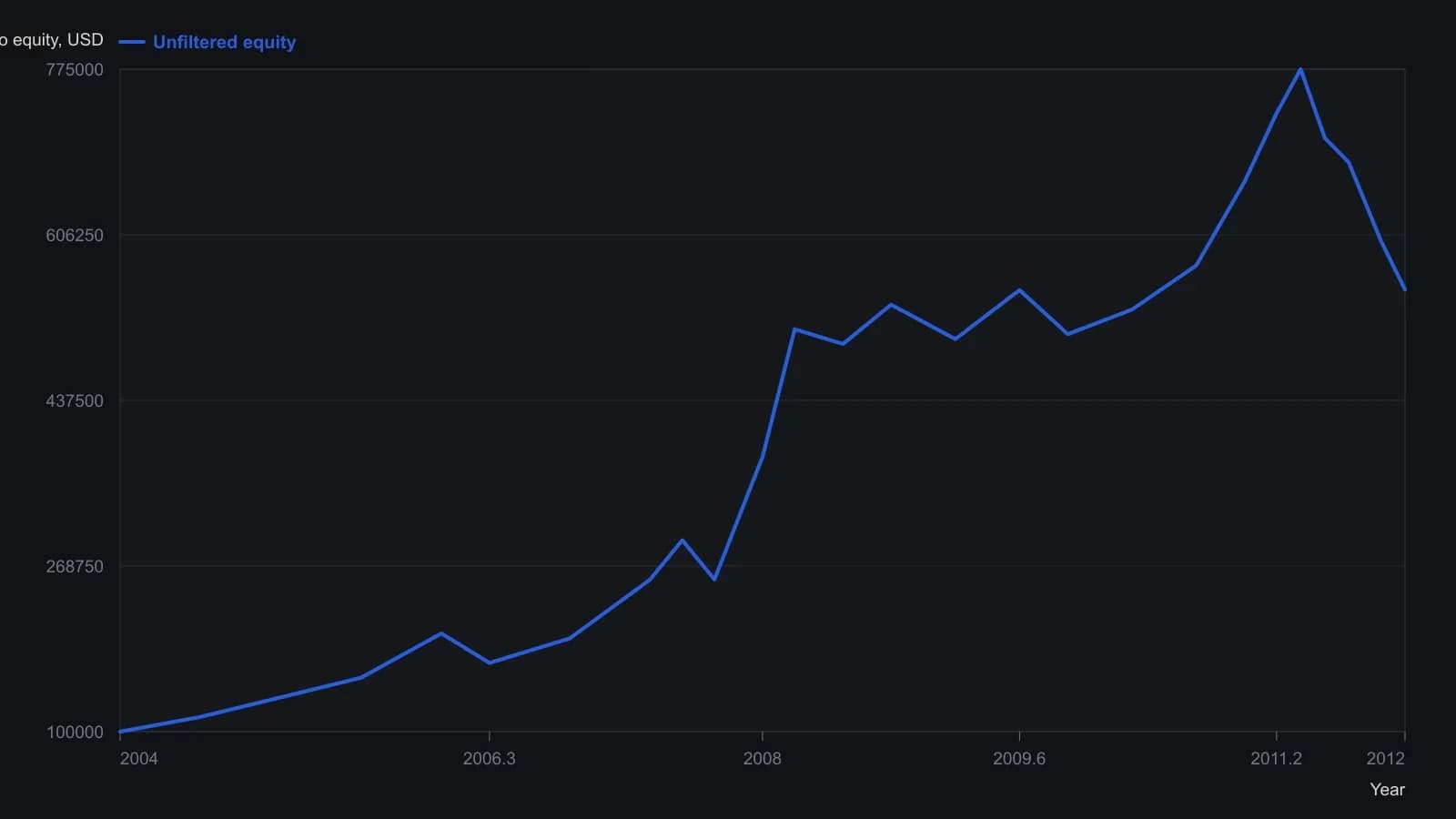
January 2004–January 2012, 18 liquid futures and FX markets, no equity-curve filter. Start ($100,000) and finish ($550,338) come from the printed net-profit table and the figure label; waypoints are a visual reading, rounded to $5,000.
All readings on this track · 22 readings
- 1992Probability stops from winning-trade drawdowns
- 1994Monthly drawdown limits when cash competes with equity
- 1994Keep constant leverage left of the equity peak
- 1995Evaluate mechanical systems as a three-way fit test
- 1997Limits as a single trading decision procedure
- 1998Drawdown limits before a trend system is allowed to trade
- 1998Evaluating trailing stops as two-parameter loss filters
- 1998Walk-forward evaluation of a noise-filtered bond-futures breakout
- 2002The pattern-day-trader equity floor as a leverage governor
- 2003Evaluating a one-rank mutual-fund switch
- 2004Keep entry, exit and abstention balanced as one procedure
- 2006A stated daily multiplier is a risk contract, not a return promise
- 2007Walk-forward probation for intraday systems
- 2008A mechanical futures procedure is unfinished without a drawdown limit
- 2010Evaluating mechanical index timing under drawdown limits
- 2013Predefined small losses outrank market analysis
- 2013Equity-curve filters as drawdown brakes
- 2014Critique of chasing recovery after a large drawdown
- 2015Loss thresholds and equilibrium as trade filters
- 2015Constructing mechanical systems under a drawdown cap
- 2018Evaluating system rules for robustness and livable drawdowns
- 2020Regime-aware equity halts and volatility entry filters