2003issue C061-7
Evaluating a one-rank mutual-fund switch
One-rank is a same-day sequence rule evaluated as one procedure. Measure whether a fund's daily up-down sequences persist enough to offset two lost days at every flip, then check whether maximum drawdown stays smaller than buy-and-hold when the system is out of the market.
- Treat one-rank as a single rule set: enter on a down-then-up daily return sequence and exit on an up-then-down sequence.
- Use yearly switching rate as the main candidate screen. A chance model of 252 trading days and no persistence produces 63 buy-sell signals a year, so a lower rate is the persistence filter.
- Subtract two days for each switch when counting net up days, then run the buy-and-hold comparison with bias and the yearly switch count.
- In the 39-fund evaluation set every fund had a smaller maximum drawdown under one-rank than under buy-and-hold, but delayed quotes, switch limits, and trading costs still belong in the same test.
Treat the switch as one rule set
The one-rank procedure is defined as a single rule set. Enter on a down-then-up daily return sequence and exit on an up-then-down sequence.
Editorial: judge entry, exit, and abstention together, including the days the system stays out of the market.
Screen with yearly switching rate
Under a chance model of 252 trading days and no persistence, the same sequence rule would produce 63 buy-sell signals per year. A lower yearly switching rate is used as the screen for funds that persist beyond chance.
The historical workflow treats yearly switching rate as the more important of the two outputs, bias and switching rate, when judging whether a fund is a candidate for the procedure.
Compare net up days after the two-day cost
Each switch is treated as costing two days because the entry flip can miss the first up day and the exit flip can absorb the first down day. A random fund with 63 switches and two net up days is framed as a zero net-day result.
Net up days for buy-and-hold are written as N times (two times bias minus one). One-rank net up days are written as bias times N minus two times the yearly switch count.
The comparison of one-rank minus buy-and-hold equals N times (one minus bias) minus two times the switch count. The historical workflow uses that comparison to argue that a low enough switch rate can still beat buy-and-hold even when bias is below one half.
A tabulated grid of bias and yearly switching rate shows that when bias is positive and switches per year are below 63, one-rank net up days match or exceed buy-and-hold.
DFSCX one-rank equity versus buy-and-hold in the opening month
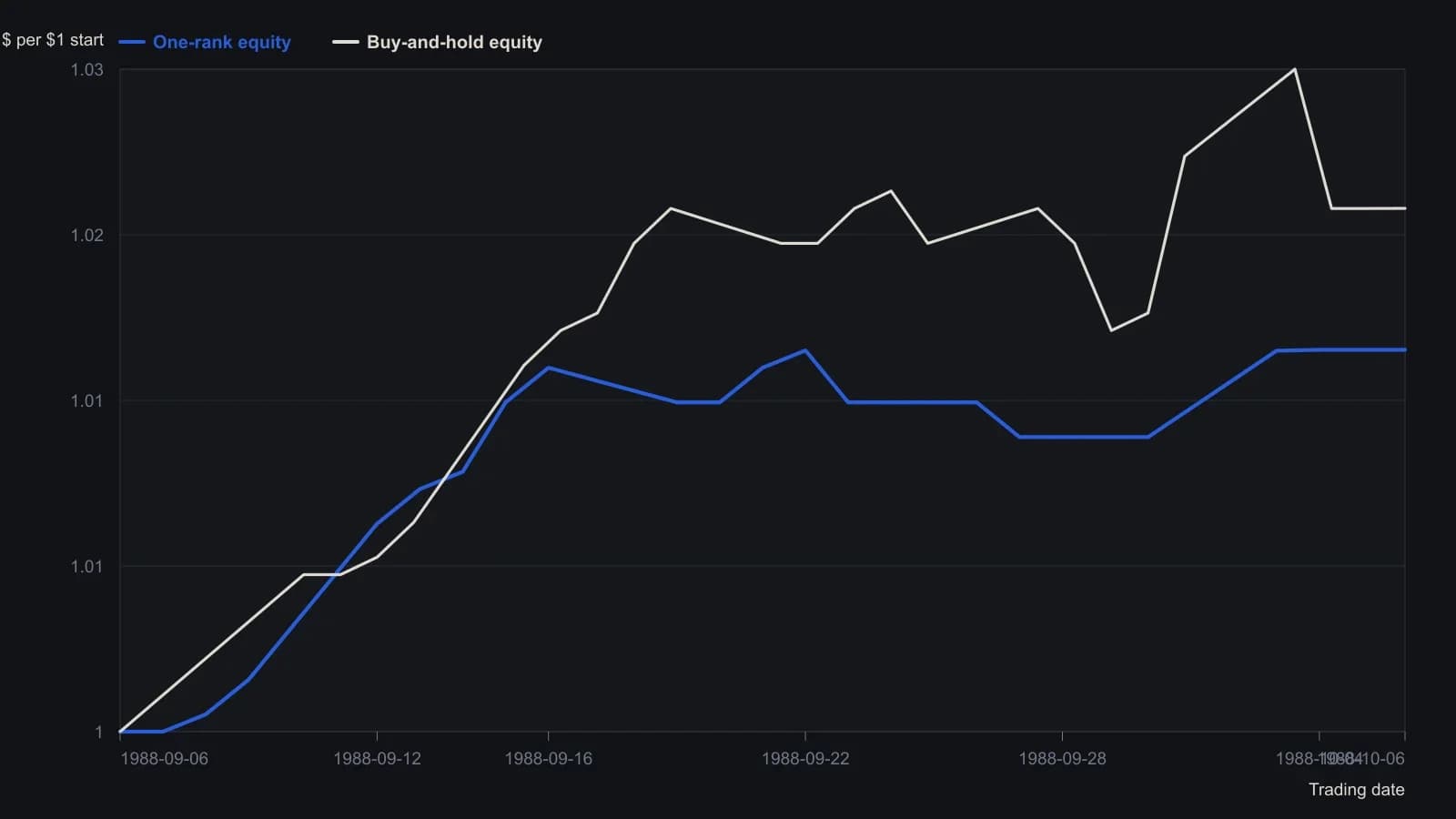
Each day's one-rank return is gated on the prior day's change versus a −0.001% threshold, with zero implementation delay. Only the first month of the 13.75-year sample is printed on the sheet; the same worksheet's full-sample annual returns are 16.14% buy-and-hold, 38.95% one-rank into cash, and 41.53% one-rank into a money-market fund.
Read maximum drawdown on the out-of-market path
The evaluation set was 39 mutual funds over 13.7 years: 30 Fidelity Selects, three equity funds, four indexes, and two index funds.
Across that 39-fund sample, every fund showed a smaller maximum drawdown under one-rank than under buy-and-hold, and some reductions were described as more than two-to-one.
Editorial: after the yearly switching rate screen, confirm that the drawdown bound still holds on the path that spends time out of the market.
Keep quote delay and costs inside the procedure
Practical evaluation of the same rule must still account for delayed net-asset-value quotes, funds that cannot be switched at the required rate, and trading costs that can erase a thin per-trade edge.
Editorial: when a fund's net asset value is known only after the close, treat a surrogate quote (a real-time index or related series used as a stand-in) as part of the same test, not as a later operational note.
All readings on this track · 22 readings
- 1992Probability stops from winning-trade drawdowns
- 1994Monthly drawdown limits when cash competes with equity
- 1994Keep constant leverage left of the equity peak
- 1995Evaluate mechanical systems as a three-way fit test
- 1997Limits as a single trading decision procedure
- 1998Drawdown limits before a trend system is allowed to trade
- 1998Evaluating trailing stops as two-parameter loss filters
- 1998Walk-forward evaluation of a noise-filtered bond-futures breakout
- 2002The pattern-day-trader equity floor as a leverage governor
- 2003Evaluating a one-rank mutual-fund switch
- 2004Keep entry, exit and abstention balanced as one procedure
- 2006A stated daily multiplier is a risk contract, not a return promise
- 2007Walk-forward probation for intraday systems
- 2008A mechanical futures procedure is unfinished without a drawdown limit
- 2010Evaluating mechanical index timing under drawdown limits
- 2013Predefined small losses outrank market analysis
- 2013Equity-curve filters as drawdown brakes
- 2014Critique of chasing recovery after a large drawdown
- 2015Loss thresholds and equilibrium as trade filters
- 2015Constructing mechanical systems under a drawdown cap
- 2018Evaluating system rules for robustness and livable drawdowns
- 2020Regime-aware equity halts and volatility entry filters