1998issue C091-11
Walk-forward evaluation of a noise-filtered bond-futures breakout
A historical bond-futures evaluation tested a long/short breakout with separate buy and sell noise filters, then rolled a four-year optimization window every six months. Unused intervals were judged by whether open-trade drawdowns stayed near the original window or widened after price dynamics changed.
- The breakout used separate buy and sell noise filters, with a one-way ratchet that held the opposite lookback extreme still while a position was open.
- In-sample curve-fitting was not treated as enough evidence. Walk-forward tests rolled a four-year window every six months so newer bond-price dynamics could enter the parameter set.
- Outside one adverse year, unused intervals kept open-trade drawdowns in a similar band to the original window. Larger drawdowns after a shift in price dynamics were treated as the clue to refresh the rules.
- Drawdown and gain percentages were stated on full contract value. More walk-forward work on additional whipsaw years was still required before live use.
This archive article reconstructs a historical evaluation of a long/short breakout procedure on bond futures. The procedure entered when price crossed a lookback high or low by more than a penetration amount. Separate noise filters governed buys and sells, and a one-way ratchet held the unused extreme still while a position was open.
The evaluation did not treat a fitted in-sample curve as enough. It required unused intervals long enough to show multiple price variations, then asked whether open-trade drawdowns stayed in a similar band or widened after price dynamics changed.
Separate filters for buys and sells
Entries used a lookback high plus a penetration amount. Exits and shorts used a lookback low minus a penetration amount. While short, the buy-side highest high was not allowed to rise as the lookback window rolled. While long, the sell-side lowest low was not allowed to fall.
The unused side was held in one direction so an open position did not inherit a drifting opposite extreme as the lookback window moved.
Unused intervals instead of a fitted curve
The historical workflow treated in-sample curve-fitting as insufficient evidence. A rule set was treated as more than a concept only after out-of-sample observation long enough to show multiple price variations.
How the window rolled
Walk-forward testing used a four-year optimization window starting in 1989. That window advanced every six months so newer bond-price dynamics could enter the parameter set faster than a yearly roll. Each step optimized the rules on the in-sample window, then applied those parameters to the next unused interval.
When drawdowns left the familiar band
Outside one adverse year, later unused intervals produced open-trade drawdowns that stayed in a similar band to the original four-year test window. A change in price dynamics left the prior window's best parameters invalid and produced larger drawdowns. The historical workflow treated that widening as the practical clue that the rule set needed refresh.
1989 daily continuous T-bond futures with noise-channel filters
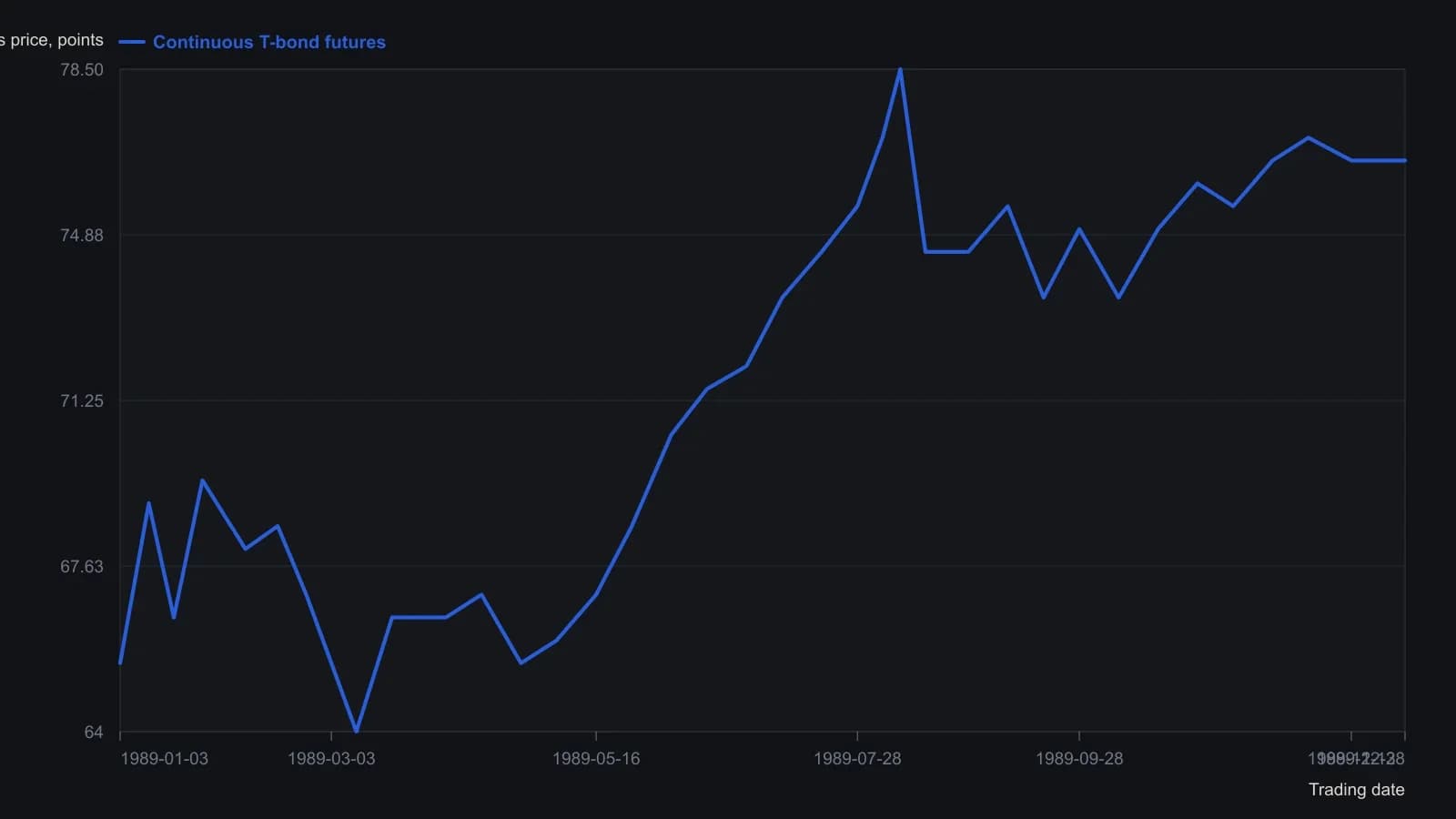
Digitized from the published daily candlestick pane (about half a point). The study used a back-adjusted continuous contract of CBT day-session prints only and omitted slippage, commissions and rollover costs.
What still stood in the way of live use
The historical workflow concluded that more walk-forward work on additional whipsaw years was still needed before treating the procedure as ready for live use.
All readings on this track · 22 readings
- 1992Probability stops from winning-trade drawdowns
- 1994Monthly drawdown limits when cash competes with equity
- 1994Keep constant leverage left of the equity peak
- 1995Evaluate mechanical systems as a three-way fit test
- 1997Limits as a single trading decision procedure
- 1998Drawdown limits before a trend system is allowed to trade
- 1998Evaluating trailing stops as two-parameter loss filters
- 1998Walk-forward evaluation of a noise-filtered bond-futures breakout
- 2002The pattern-day-trader equity floor as a leverage governor
- 2003Evaluating a one-rank mutual-fund switch
- 2004Keep entry, exit and abstention balanced as one procedure
- 2006A stated daily multiplier is a risk contract, not a return promise
- 2007Walk-forward probation for intraday systems
- 2008A mechanical futures procedure is unfinished without a drawdown limit
- 2010Evaluating mechanical index timing under drawdown limits
- 2013Predefined small losses outrank market analysis
- 2013Equity-curve filters as drawdown brakes
- 2014Critique of chasing recovery after a large drawdown
- 2015Loss thresholds and equilibrium as trade filters
- 2015Constructing mechanical systems under a drawdown cap
- 2018Evaluating system rules for robustness and livable drawdowns
- 2020Regime-aware equity halts and volatility entry filters