1995issue C081-5
Evaluate mechanical systems as a three-way fit test
Editorial reading: evaluate a mechanical trading system as a three-way fit test that keeps the rules one procedure after costs and missed-signal constraints, treats the drawdown limit as the binding gate, and scores the trading psychology process by whether the operator can still take the next signal after a plausible losing streak.
- A mechanical trading system is supposed to match one operator's profit objective and risk tolerance, so evaluation starts from those limits rather than from a single best formula.
- Historical profitability is incomplete until commissions and slippage are charged, and ranking by total profit can hide a peak-to-valley drawdown some accounts will not accept.
- A drawdown-limit comparison must match the sizing method, because identical profit-drawdown ratios can still open with a decline that closes out a pooled account.
- A trading psychology process must tolerate probable losing streaks, not the shortest streak in a test, or operators abandon the mechanical rules.
Start from the operator, not a formula
Editorial reading: treat system evaluation as a three-way fit test. Keep the mechanical trading system one procedure after costs and missed-signal constraints. Make the drawdown limit the binding gate rather than a leftover statistic. Score the trading psychology process by whether the operator can still take the next signal after the worst plausible losing streak.
A mechanical trading system is supposed to match one operator's profit objective and risk tolerance. Evaluation starts from those limits rather than from a single best formula.
Keep the mechanical rules one procedure
Historical profitability of a mechanical trading system is incomplete until commissions and slippage are charged. In one worked case, 100 trades and a 5,000-unit gross result become a 2,500-unit net loss at 75 units of cost per trade.
Agreement between a tested mechanical procedure and later results is described as rising with the number of trades in the sample and falling when the sample is small. High-activity rules pay more fixed costs, while lower-activity rules leave more room for path-to-path variation.
Scarce capital can omit a later signal while other positions are open. For mechanical trend procedures that win 35 percent of trades or fewer, missing one winner can change live results relative to the test.
Make the drawdown limit the binding gate
Ranking systems by total profit can hide equity declines some accounts will not accept. A 50-percent drawdown may sit inside one operator's limit and outside another's.
A drawdown-limit comparison must match the sizing method. Read peak-to-valley drawdown in cash for single-contract tests, and as percentage peak-to-valley equity change when a fixed fraction such as 2 percent of the account is risked per entry under equalized-risk sizing.
The profit-margin ratio can rank the same dollar result higher in a lower-margin market and therefore mislead, even though posted margin still blocks that capital from other signals.
Identical profit-drawdown ratios do not imply identical fitness. Procedures that share the ratio can still open with a 5,000-unit drawdown against a 10,000-unit account, a 50-percent decline treated as a common close-out threshold for pooled accounts.
When historical risk is 10 percent of equity on two contracts at 500 units of risk each, the smallest whole-contract scale is one contract, so the drawdown limit can be cut only in half unless a smaller contract exists.
Three systems with the same profit-to-drawdown ratio
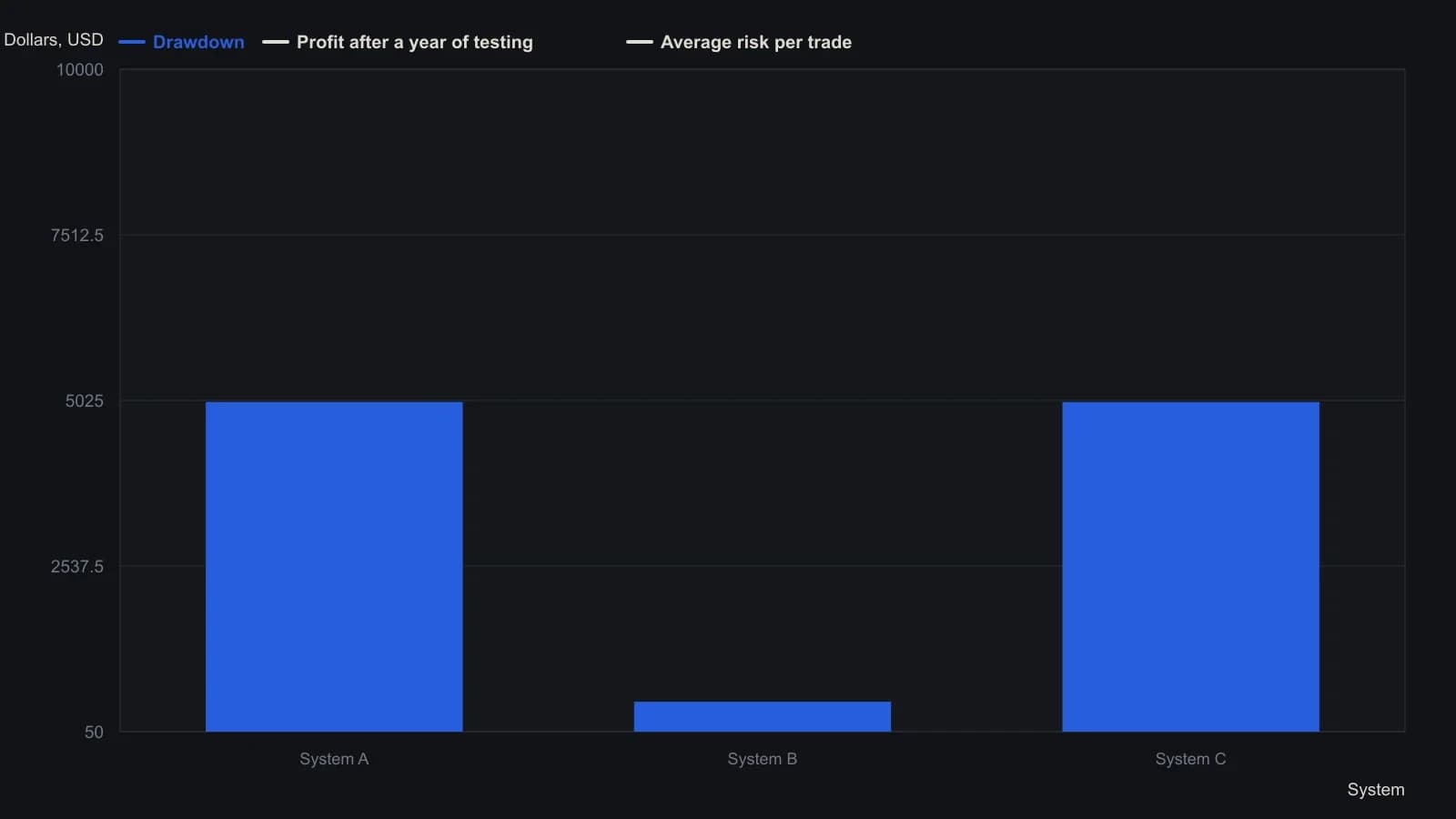
Every column starts at $10,000. System C matches A on profit and drawdown but B on average risk per trade ($50), so the source says it can be scaled down; A is limited by a $500 risk per contract.
Score the process by the next signal
A trading psychology process must tolerate probable losing streaks, not the shortest streak in a test. A 50-percent win rate that printed four consecutive losers can still produce about ten losers in a row in a sample of roughly 1,000 trades.
Operators abandon mechanical rules that do not match those limits. Editorial reading: the process fails the fit test when the operator cannot take the next signal after that plausible streak.
All readings on this track · 22 readings
- 1992Probability stops from winning-trade drawdowns
- 1994Monthly drawdown limits when cash competes with equity
- 1994Keep constant leverage left of the equity peak
- 1995Evaluate mechanical systems as a three-way fit test
- 1997Limits as a single trading decision procedure
- 1998Drawdown limits before a trend system is allowed to trade
- 1998Evaluating trailing stops as two-parameter loss filters
- 1998Walk-forward evaluation of a noise-filtered bond-futures breakout
- 2002The pattern-day-trader equity floor as a leverage governor
- 2003Evaluating a one-rank mutual-fund switch
- 2004Keep entry, exit and abstention balanced as one procedure
- 2006A stated daily multiplier is a risk contract, not a return promise
- 2007Walk-forward probation for intraday systems
- 2008A mechanical futures procedure is unfinished without a drawdown limit
- 2010Evaluating mechanical index timing under drawdown limits
- 2013Predefined small losses outrank market analysis
- 2013Equity-curve filters as drawdown brakes
- 2014Critique of chasing recovery after a large drawdown
- 2015Loss thresholds and equilibrium as trade filters
- 2015Constructing mechanical systems under a drawdown cap
- 2018Evaluating system rules for robustness and livable drawdowns
- 2020Regime-aware equity halts and volatility entry filters