2007issue C021-4
Walk-forward probation for intraday systems
A daytrading procedure should be judged as one market-specific unit of entry, exit, and abstention. It should pass a reserved unused confirmation, a paper-trade walk-forward check, and a prewritten live drawdown cap before size is increased.
- Judge a daytrading procedure as one market-specific unit of entry, exit, and abstention, not as a design that must show similar expectancy on every instrument.
- Fix assessment criteria, including whether trade frequency fits the operator, before any optimization begins.
- Hold back the newest unused window for a single confirmation pass with no further optimization, and treat a weak match as overfit.
- Write a live drawdown cap before deployment, and use paper trading as a walk-forward check before size is increased.
Judge the procedure as one unit
A daytrading procedure should be judged as one market-specific unit of entry, exit, and abstention. It should not be required to show similar expectancy on every instrument.
Assessment criteria should be fixed before any optimization begins. Those criteria include whether trade frequency fits the operator.
Walk-forward analysis as a reserved confirmation
Development should use recent data with about 200 or more trades. The newest unused window should be held back for a single confirmation pass with no further optimization.
Walk-forward analysis is that confirmation pass. A weak match between the development report and the unused confirmation report is treated as overfit rather than as a ready system.
Intraday equity path versus a rising trend line
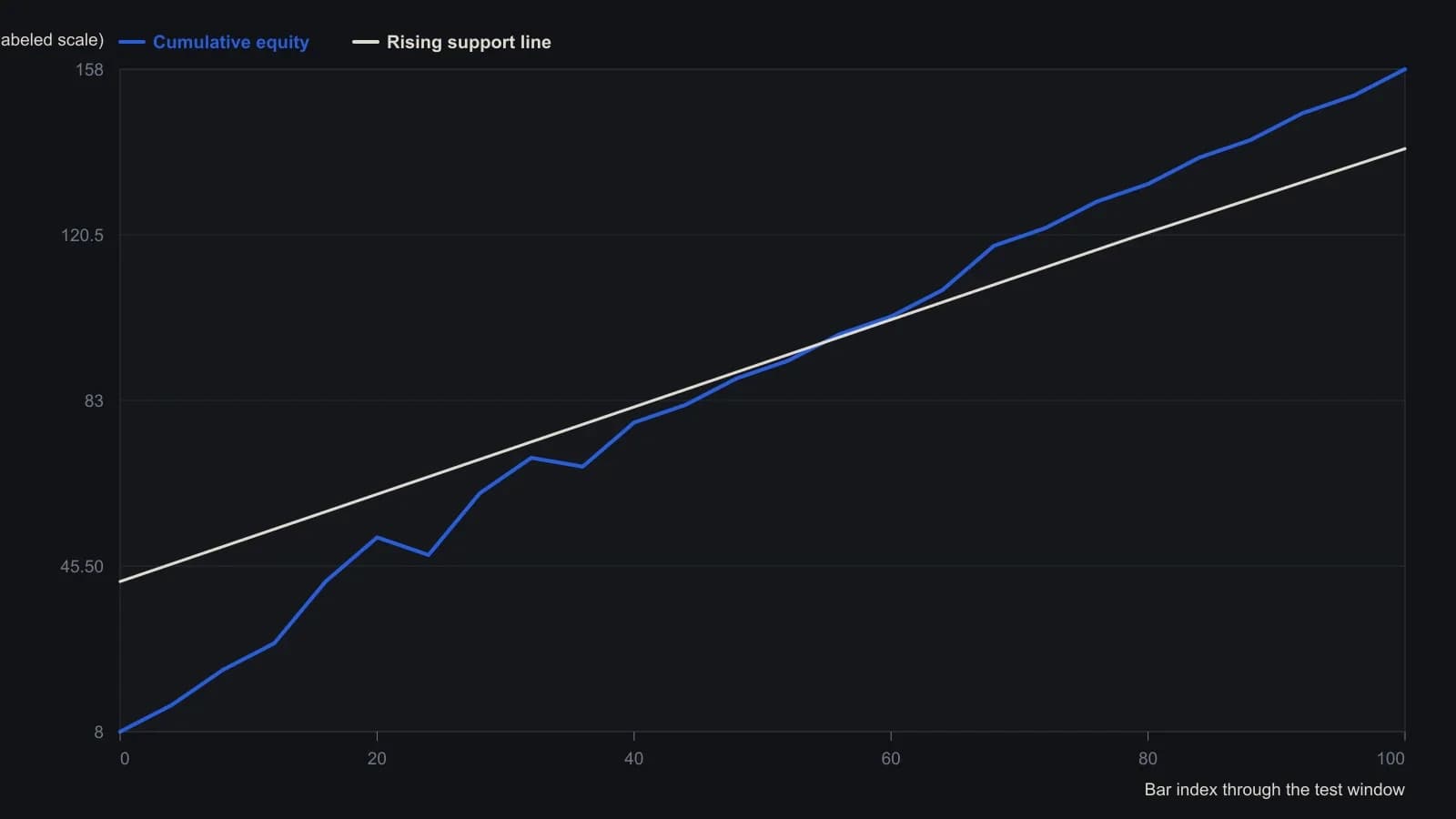
No axis labels or dollar scale appear on the raster; y is recovered as relative equity from the plotted path only, not as published dollar P&L.
Robustness testing beyond net profit
Robustness testing should compare profit factor, percent profitable, average trade net profit, and maximum drawdown rather than net profit alone.
In-sample values are expected to exceed a profit factor of 2. An in-sample profit factor above 4 is treated as a warning of excessive fitting.
Tests that omit realistic commission and slippage are treated as unreliable for daytrading procedures.
Paper trading before size is increased
Paper trading is used as a walk-forward check that fills and logic still match the intended procedure before size is increased.
Write the drawdown limit first
A Drawdown limit should be written before deployment. A live-drawdown cap is commonly a live loss beyond the historical maximum drawdown or a break of the equity-curve trendline.
The procedure advances only after historical testing, real-time monitoring, and small-size live trading each pass predefined gates.
All readings on this track · 22 readings
- 1992Probability stops from winning-trade drawdowns
- 1994Monthly drawdown limits when cash competes with equity
- 1994Keep constant leverage left of the equity peak
- 1995Evaluate mechanical systems as a three-way fit test
- 1997Limits as a single trading decision procedure
- 1998Drawdown limits before a trend system is allowed to trade
- 1998Evaluating trailing stops as two-parameter loss filters
- 1998Walk-forward evaluation of a noise-filtered bond-futures breakout
- 2002The pattern-day-trader equity floor as a leverage governor
- 2003Evaluating a one-rank mutual-fund switch
- 2004Keep entry, exit and abstention balanced as one procedure
- 2006A stated daily multiplier is a risk contract, not a return promise
- 2007Walk-forward probation for intraday systems
- 2008A mechanical futures procedure is unfinished without a drawdown limit
- 2010Evaluating mechanical index timing under drawdown limits
- 2013Predefined small losses outrank market analysis
- 2013Equity-curve filters as drawdown brakes
- 2014Critique of chasing recovery after a large drawdown
- 2015Loss thresholds and equilibrium as trade filters
- 2015Constructing mechanical systems under a drawdown cap
- 2018Evaluating system rules for robustness and livable drawdowns
- 2020Regime-aware equity halts and volatility entry filters