1996issue C031-5
Constructing volume-confirmed average-cross entries
A price-only average-cross version stays fully invested and reverses on each break. A volume-average-gate that requires a volume-ratio above 1 before a new position is opened forces separate open and close rules, because the book is no longer always invested.
- Write a close-versus-average skeleton first, then decide whether a volume-average-gate applies only to new entries.
- A long entry can be a price-average-cross with volume above its moving-average, or a state in which close and volume are both above their averages without a same-bar cross.
- Long and short exits used only the price-average condition and omitted the volume filter.
- Encoding each lookback-input, and swapping simple, exponential, or weighted form, keeps the same procedure inspectable on other markets.
Start with a close-versus-average skeleton
System construction can start with a comparison of close to a moving-average of close, and only later add a second test on volume. A moving-average is a lookback smoother of ordered closes or volume that supplies an explicit baseline for that later comparison.
A price-average-cross is the discrete event in which close moves from one side of its average to the other. That event can be used as an entry, an exit, or a reverse.
A price-only cross version stays fully invested and reverses from short to long, or long to short, on each average break. That book is an always-in-reversal procedure.
Two encodings of the long entry
A long entry can be specified as close crossing above a moving-average of close while volume is above a moving-average of volume. The same long entry can be written as close above its average and volume above its average, without requiring a same-bar cross event.
Construction defaults set the price-average lookback at 20 periods and the volume-average lookback at 10 periods. Encoding the two lookbacks as a lookback-input for each length lets those lengths be varied so the same procedure can be inspected on other markets.
Why the volume test changes the rule set
Long and short exits used only the price-average condition and omitted the volume filter. The volume-average-gate is therefore not copied onto the close side of the book.
Writing the volume-average-gate as current volume divided by its average, and requiring that volume-ratio above 1 before a new position is opened, forces separate open and close rules because the book is no longer always invested. The result is a discrete-entry-exit procedure.
What can change without rewriting the rules
The price average inside the cross formula can be swapped among simple, exponential, and weighted forms without rewriting the surrounding signal and rule skeleton. The lookback-input for price and the lookback-input for volume stay in place while those forms change.
One implementation compressed daily observations to weekly bars to reduce noise in the volume series used by the second gate.
T-bond continuous with 20-bar average and overlaid equity
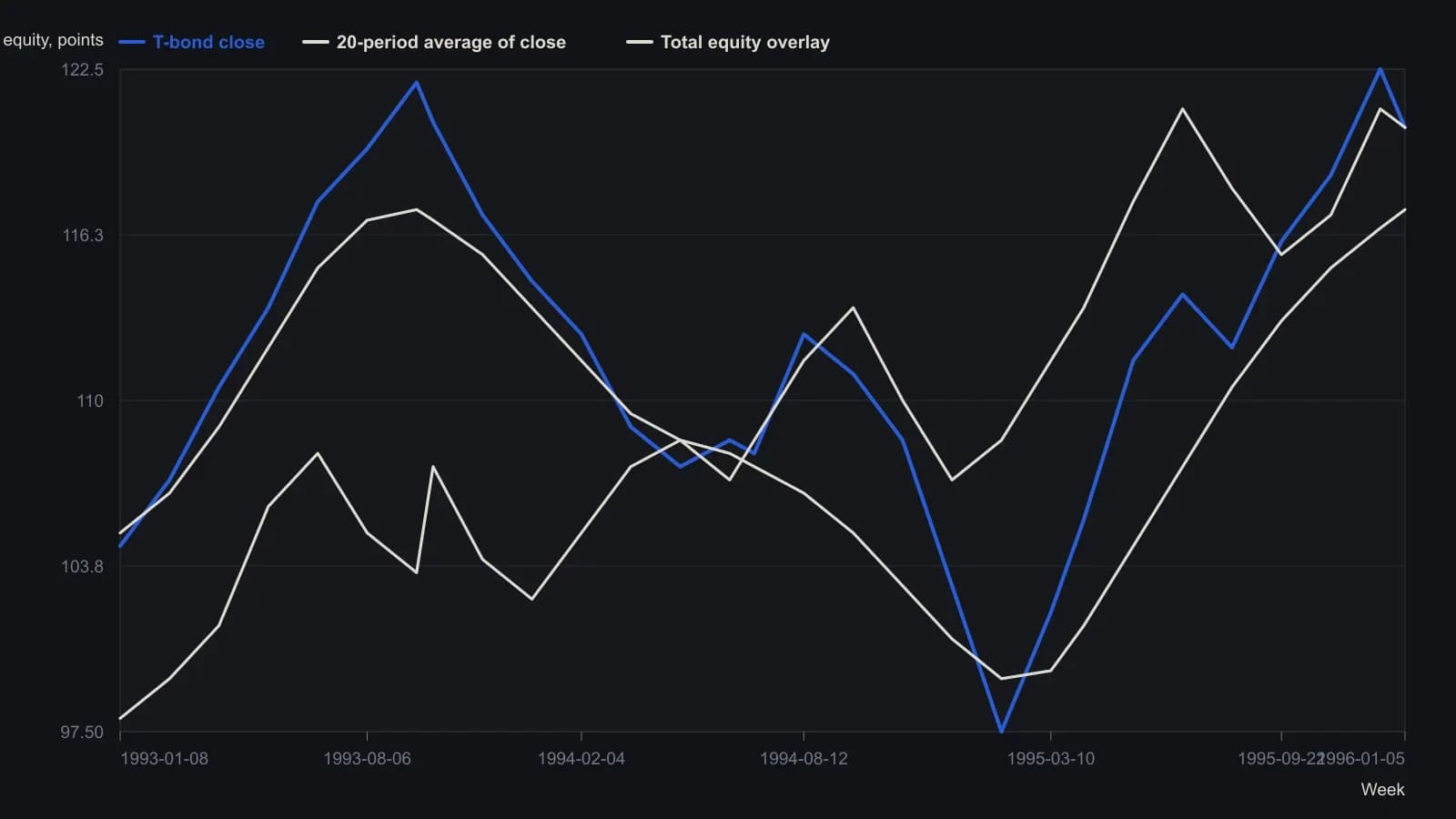
SmarTrader compressed the test to weekly bars after daily volume proved too noisy. Length defaults are a 20-period average of the close and a 10-period average of volume; entries also require volume above that volume average. Overlay shares the bond-price axis, so equity is in the same numeric units as the futures price, not a separate dollar account scale.
All readings on this track · 19 readings
- 1989T-bond volume-price boxes and a withheld rectangle top
- 1990Constructing ease of movement from volume-scaled boxes
- 1990Weekly four-stage mapping with average, range, and volume
- 1996Constructing volume-confirmed average-cross entries
- 1996Constructing four MFI bar states from range and volume
- 2001Building in-gear volume-price overlays
- 2004Constructing index volume for price-volume signals
- 2004Auditing volume-on-retest rules for prior highs and lows
- 2004Wait-rule collapse in a mistaken sale cascade
- 2005Constructing a volume and change weighted moving average
- 2005Daily average support and Friday volume holds
- 2007Match a volume-price oscillator to a range, not to a policy rebound
- 2008Volume confirms chart pattern breakouts
- 2011Color-coded volume bars for rule-based swing entries
- 2012Go or no-go checklist at repeated resistance
- 2012Pocket-pivot volume rules before a later breakout
- 2014Constructing defended price lines from volume spikes
- 2016Closing score from range location as a volume-checked sentiment filter
- 2019Volume follows price as auction state