2018issue C068-14
Five-rule technical rating as a rotation filter
A five-rule technical score, weighted to a maximum of 6, was used as a selection cutoff on S&P 500 names and as a time-limited guidepost after the signal. The write-up presents it as a list-narrowing filter rather than a complete strategy.
- Each of the five conditions is a binary flag. Four count as one point and the market-direction rule counts as two, for a maximum score of 6.
- The main selection cutoff is a score of 5 or higher. A perfect score of 6 is noted to cut the number of trades sharply.
- The coded procedure buys when the cutoff is met and exits after a fixed bar count, then treats the score as a guidepost over holds from one to twelve months.
- The score is a list-narrowing or position-review filter, not a complete trading strategy and not a permanent grade.
How the score is built
A five-rule technical score can be assembled so each condition carries a weight of one except the market-direction rule, which is weighted two, for a maximum score of 6. The coded Mechanical trading system treats that score as a weighted sum of five binary flags.
The five conditions are a long-horizon Money Flow Index reading above zero, a close above a 100-period average, that average higher than four days earlier, fewer than seven closes below that average over 63 days, and a 100-day index exponential average that is flat or rising versus two days earlier. The market-direction condition is described as the most important of the five.
How the procedure trades
The main tests use a score of 5 or higher as the selection cutoff, while a perfect score of 6 is noted to cut the number of trades sharply. The coded procedure buys when the score meets the cutoff and exits after a fixed bar count rather than a separate sell signal.
The write-up treats the score as a time-limited guidepost after the signal, scanning holding windows from one to twelve months rather than treating the grade as permanent. The score is presented as a list-narrowing or position-review filter rather than a complete trading strategy.
What was tested
Consensus labels on S&P 500 names were mapped to a 1-through-5 scale and tested over five years with weekly rebalancing and four-week and three-month holding periods.
The technical score was applied to S&P 500 names over a ten-year window, holding one month or three months, filling at the next open, with no extra exit or stop rules and with commissions omitted for a buy-and-hold comparison.
Reward/risk by holding period after the buy signal
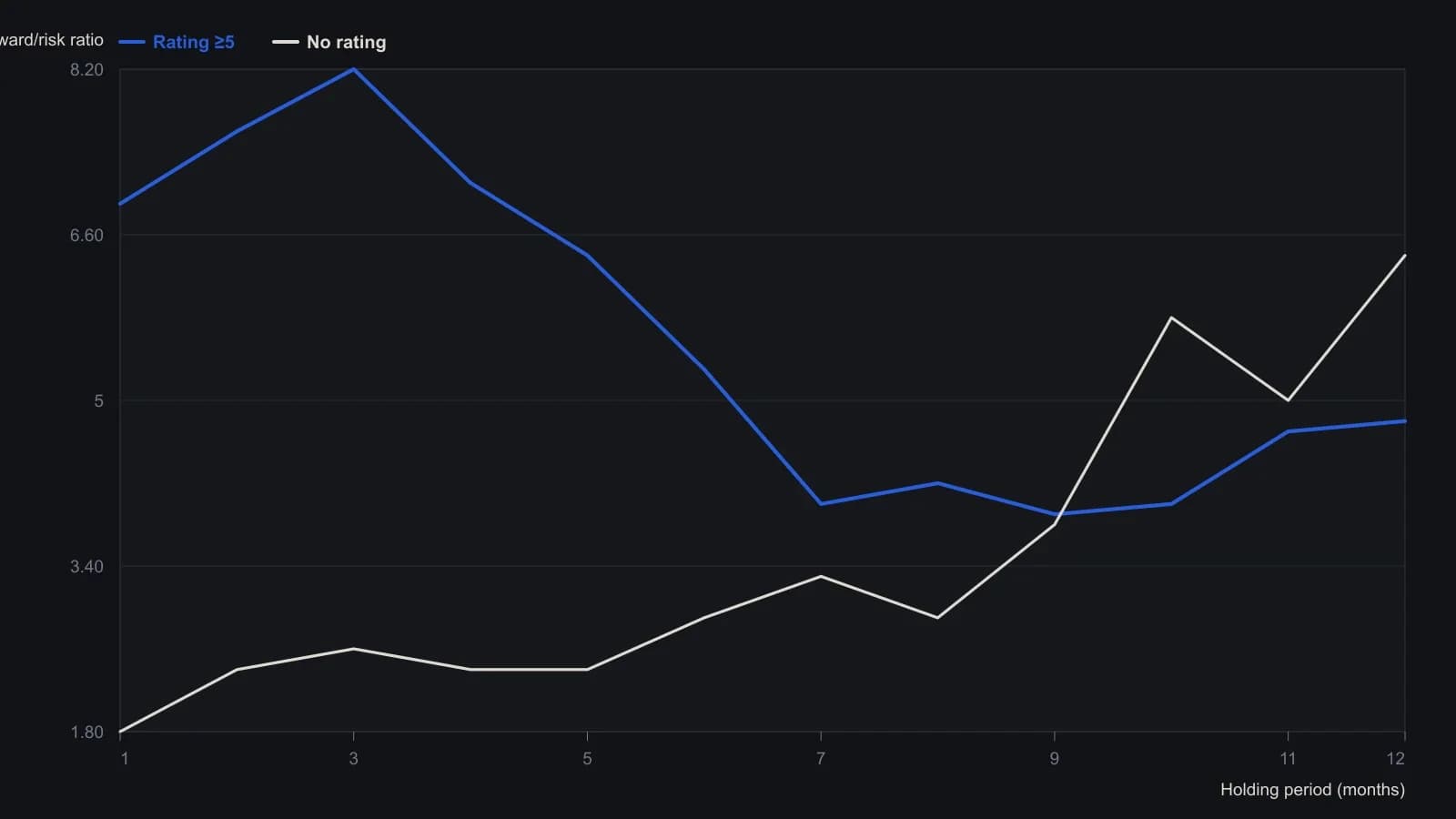
The source used a score cutoff of 5 or more out of 6. Reward/risk is net profit divided by maximum system drawdown. Positions were $1,000 on a $300,000 book, filled at the next open, with no commissions.
All readings on this track · 13 readings
- 1988Constructing tick-weighted money flow and price divergences
- 1989Four-state money-flow-index as permission for a next-bar breakout-system
- 1989Constructing a suggest-then-confirm Money Flow Index
- 1993Five-rung money flow from signed print volume
- 1993Physics analogies for building cycle and money flow indicators
- 1994Keep a wave count as a draft until money flow and a trendline agree
- 1999Take the rectangular-base breakout from money-flow confirmation, not from a late strength average
- 2004Constructing a volume-flow rule from money flow
- 2006Classify the regime before the bar read
- 2015Constructing a bounded money-flow oscillator from range and volume
- 2016Combining RSI, moving averages, and money flow
- 2018Five-rule technical rating as a rotation filter
- 2020Combining money-flow, RSI, and breadth for dynamic pressure zones