2001issue C101-5
Sector rotation, timing and leverage as a regime case study
The archive compares untimed sector holdings with timing, relative-strength selection, and combinations that add leverage. This editorial reading treats that stack as a repeatable regime decision: judge the climate, apply a moving-average filter, then decide whether extra leverage is allowed.
- The archive frames sector-fund investing as a way to concentrate on one industry slice of the market rather than only grouping holdings by company size or by growth versus value.
- Three premises support sector rotation: some sectors can outperform when the broad market is weak, relative strength can identify stronger sectors, and leadership stretches can last long enough to act on.
- A moving average of fund closing prices is used as a timing filter, while leverage control treats built-in fund leverage as a magnifier of gain and loss rather than a replacement for timing or rotation rules.
- Sector rotation is described as needing daily price checks and mechanical follow-through, because skipped trades or overridden signals undermine the tested process.
What the archive compared
The archive frames sector-fund investing as a way to concentrate on one industry slice of the market, rather than only slicing holdings by company size or by growth versus value.
It compares several ways to hold sector funds. Those approaches range from untimed buy-and-hold through market timing, relative-strength selection, and combinations that add leverage.
Buy-and-hold results across a broad set of industry-aligned sector funds are used as a baseline risk-return map before any timing or rotation is applied.
Premises for sector rotation
Three premises are given for sector rotation. Some sectors can outperform even when the broad market is weak. Stronger sectors can be identified by relative strength. Those leadership stretches can last long enough to act on.
Timing first, then leverage
A moving average of fund closing prices is presented as a simple timing filter. Stay invested when price is above the average, and step aside when price falls below it.
The archive treats built-in fund leverage as a magnifier of both gain and loss, not as a substitute for the timing or rotation rules. Leverage control, in this case, is the decision to allow or withhold that magnifier after the rotation and timing rules are already set.
Backtested annualized returns by sector rule, 1987–2000
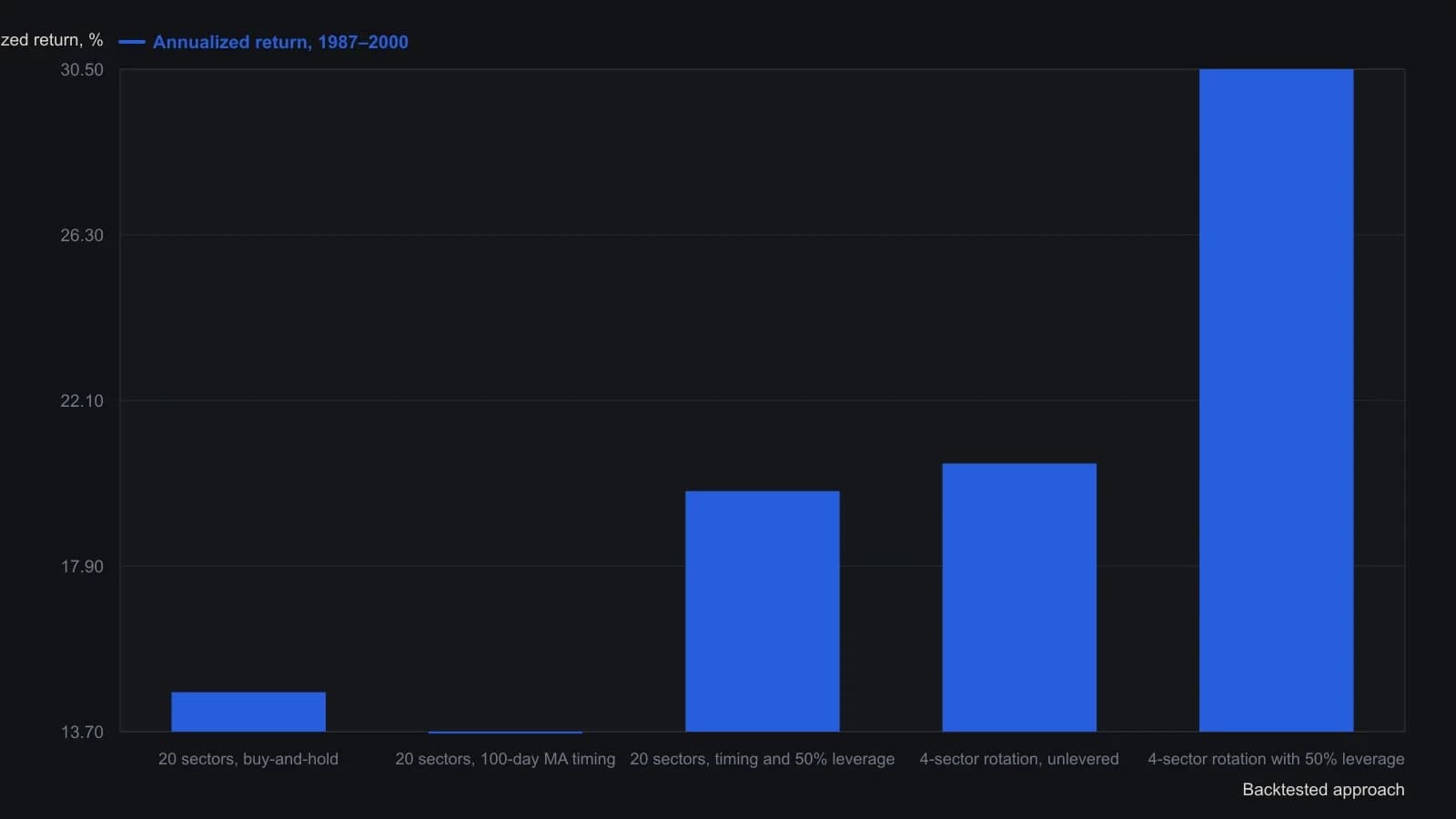
Timing uses a 100-day moving average. Rotation holds the four highest 100-day relative-strength sectors that also have a buy rating. Leverage is the 1.5 beta of the ProFunds-style sector funds. The source presents the figures as hypothetical backtests, not as a forecast.
All readings on this track · 10 readings
- 2001Constructing relative-strength ratios for spreads and rotation
- 2001Sector rotation, timing and leverage as a regime case study
- 2004Read one stock idea as a late-cycle puzzle
- 2004Always-on delayed-weak and live-strong sector sleeves
- 2012Building a sector-rotation histogram from rate-of-change spreads
- 2012Constructing a bull-bear sector rotation overlay
- 2012A relative-performance heatmap for pairs trading and sector rotation
- 2014Evaluating an annual contrarian sector rank-rotation
- 2014A ranking workflow that treated sector rotation as an abstention procedure
- 2015A nine-sector sleeve drill on the business-cycle map