1999issue C071-9
Rank-based sector-fund rotation with cash
A weekly rank-and-hold sleeve can stay concentrated in a few leading industry groups, leave empty slots in cash, and treat rotation as one testable procedure instead of a search for a single hot fund.
- The recommended sleeve holds at most five industry-group funds, and unused slots stay in cash until new names meet the buy rules.
- Rank-rotation is a weekly ranking of sector funds by relative-strength that decides which names, if any, occupy the limited sleeve slots.
- Momentum-rotation holds the currently strongest funds only while they remain in an uptrend and drops them when that condition fails.
- Concentrated industry-group funds are treated as a high-risk, high-reward sleeve and are limited to 15-20% of investment capital.
A small sleeve, not a whole book
The recommended sleeve holds at most five funds. Unused slots stay in cash until new names meet the buy rules, so the sleeve can become mostly cash when most groups are declining.
The archive treats concentrated industry-group funds as a high-risk, high-reward sleeve and limits that sleeve to 15-20% of investment capital.
Weekly rank-rotation
Rank-rotation is a weekly ranking of sector funds by relative-strength that decides which names, if any, occupy the limited sleeve slots.
The procedure is weekly. Ranks and holdings are reviewed once a week, and there can be long stretches with no transaction as well as periods of frequent changes. A weekly-review is that once-a-week check of ranks and holdings, and it can produce entries, exits, or no action.
How relative-strength is built
Relative-strength is a comparison of each fund's multi-horizon price change used to rank candidates against one another.
Ranking can be built by comparing each fund's 240-day percent price change, or by using paired short-term and long-term relative-strength lists.
Hold strength, otherwise stay out
The operating rule is to buy and hold the strongest Select funds only while they are trending higher, and to stay out when no industry group is outperforming or qualifying.
Momentum-rotation means holding the currently strongest funds only while they remain in an uptrend, and dropping them when that condition fails.
Sector-rotation and the cash-buffer
Sector-rotation concentrates a small sleeve in industry-group funds that are leading, and parks unused slots in cash when few groups qualify. The cash-buffer is the uninvested remainder of the sleeve when fewer than the maximum number of funds meet the buy rules.
The design thesis is that some sector is often advancing, so a strongest-sector focus can participate in extended advances, while a cash default can reduce exposure when most sectors turn negative.
Historical test window
The historical test window for the sector-fund sleeve begins on December 30, 1988, chosen because enough industry-group funds then had usable price history.
Fidelity Select Construction weekly NAV versus 28-week EMA
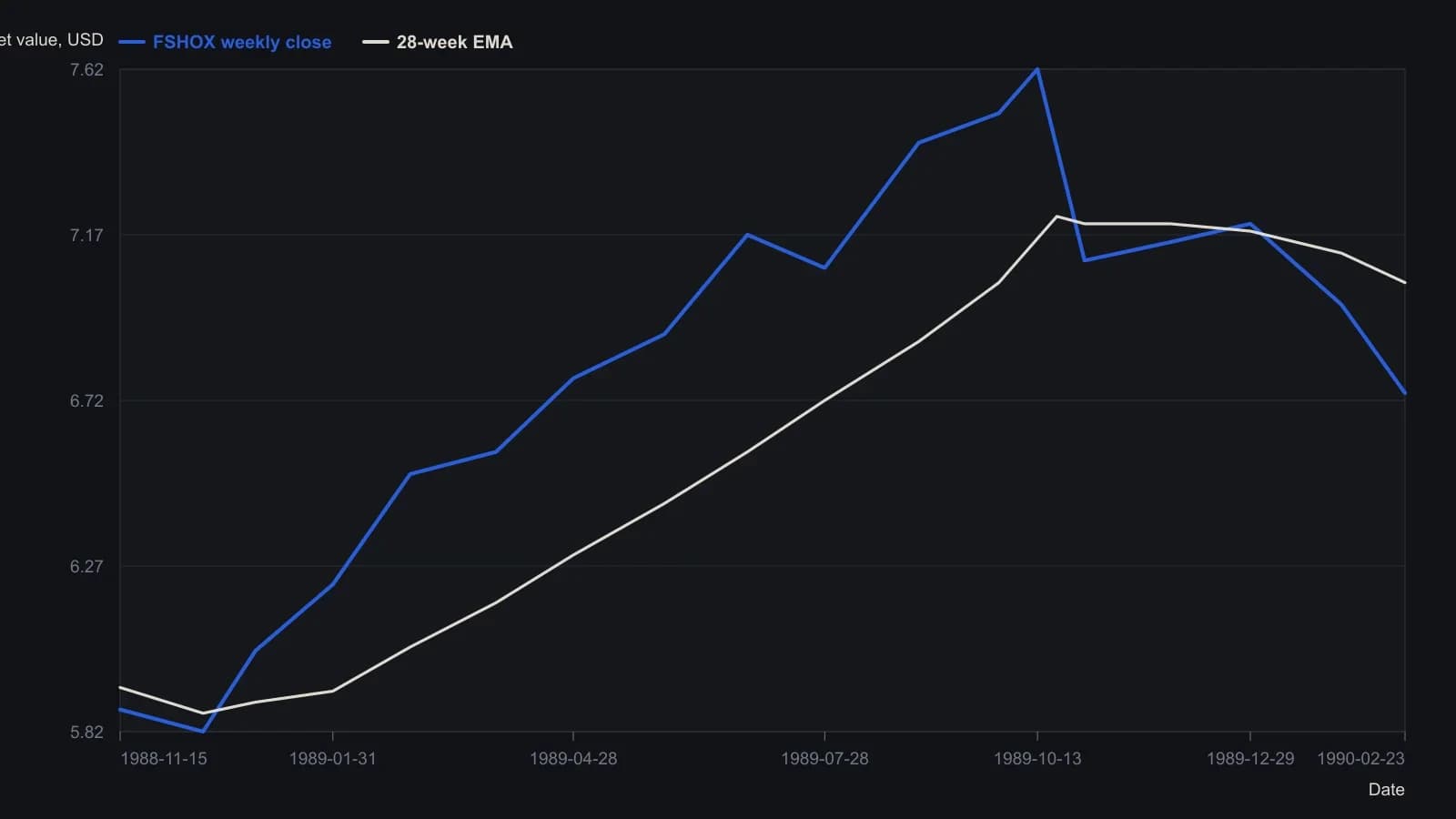
The source seeds the 28-week EMA from a 28-week average and updates it with a 0.069 factor; a weekly low more than two cents under that EMA is the sell. Digitized levels follow the printed NAV scale and are approximate between those stated prints.
All readings on this track · 7 readings
- 1998Evaluating a binary relative-strength allocation
- 1999Rank-based sector-fund rotation with cash
- 2017Classroom rotation across a short factor-ETF menu
- 2017Evaluating momentum ETF rotation engines
- 2018Rotating international sleeves on relative-strength cycles
- 2019Rank-based sector rotation failed a late-2018 defensive-shift test
- 2020A five-phase compass for sector rotation and book context