1991issue C031-4
Calendar-spread divergence as a demand clock for commodity reversals
The nearby contract shows where a commodity has stretched. The calendar-spread tests whether near-horizon-demand still agrees. Entry, exit, and sit-out belong to one procedure that fires only when that second clock confirms or contradicts the price structure.
- A calendar-spread is the price difference between two delivery months of the same commodity, read as a month-to-month demand and carrying-charges clock rather than as a standalone outright bet.
- When carrying-charges are relatively stable, that spread tracks near-horizon-demand against longer-horizon anticipated demand.
- Spread-price-divergence at a chart extreme is a possible early warning of reversal, and the procedure uses the settlement-spread so thin deferred months do not distort the session.
- The same directional split is described as helpful but not always reliable, so sit-out stays inside the rule instead of sitting outside it.
Two prices for one commodity
The same commodity can print one price for prompt delivery and another for later delivery. That difference is the calendar-spread: a month-to-month reading of demand and carrying-charges, not a standalone outright bet.
Calendar spreads are the joint product of carrying-charges such as interest and storage and of relative demand. When those factors are relatively stable, the spread tracks near-horizon-demand versus longer-horizon anticipated demand.
When nearby demand dominates
In the 1990 Iraq-Kuwait crude-oil episode, nearer contracts were bid above farther contracts amid a feared short-term supply break. That pattern is term-structure-inversion: a short-horizon supply scare dominating longer-horizon pricing.
Editorial bound: financial and gold calendar spreads are treated as harder to read because they trade mainly on actual and expected interest-rate gaps, so this procedure stays with commodity markets where carrying-charges and relative demand can still be told apart.
July–September 1989 coffee calendar spread
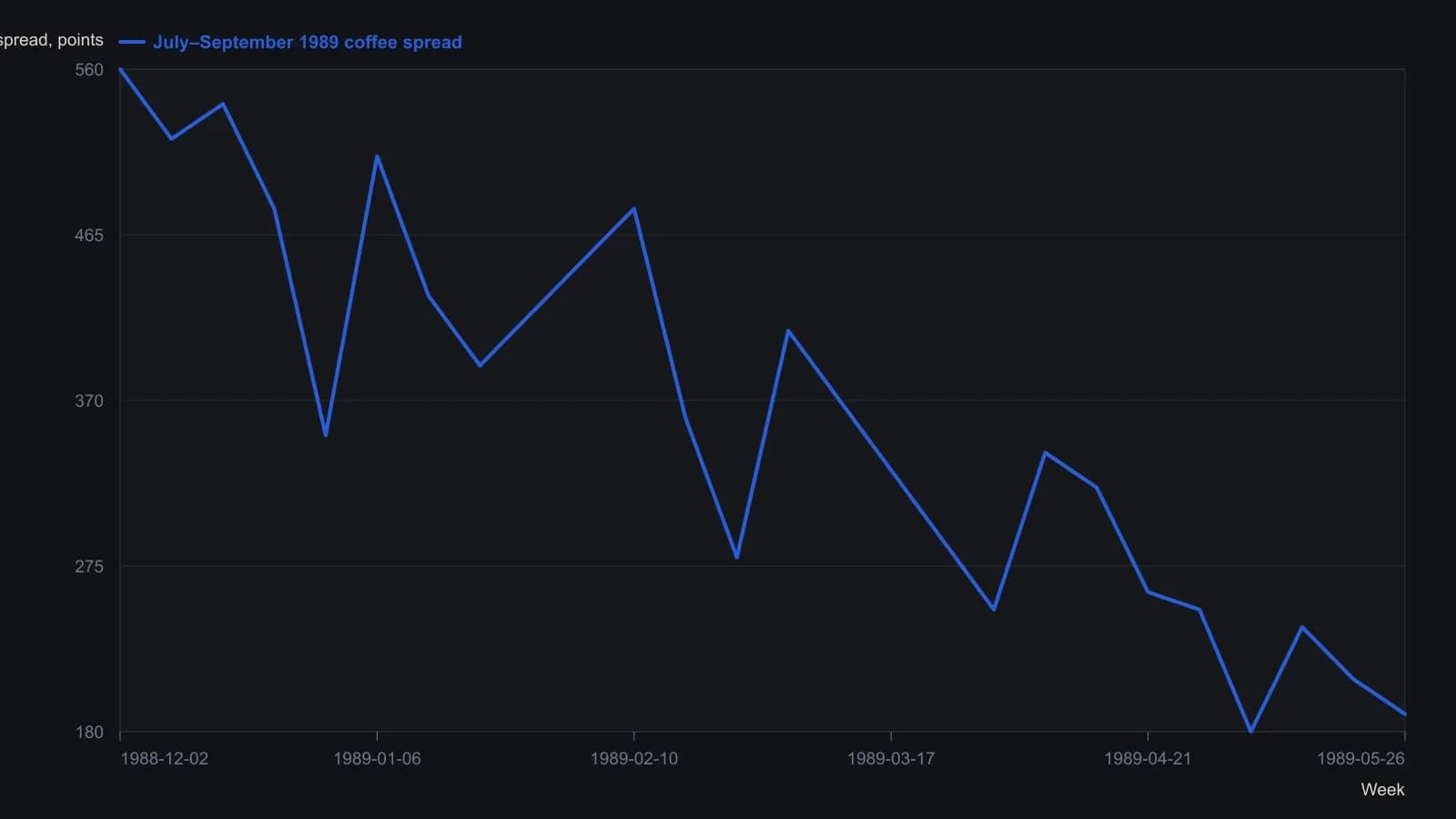
Y values are approximate weekly closes lifted from the scanned Figure 1b grid. Axis numerals print as 500/400/200/800 and are treated as spread points (hundredths of a cent per pound), the usual quote for that coffee calendar. Do not treat the last digit as exact.
Entry, exit, and sit-out as one procedure
The archive workflow specifies closing prices for the spread. Intra-session month-to-month differences can swing widely when not every contract month trades continuously. The working input is therefore the settlement-spread.
A TradersWeek editorial reading writes the rest as a single procedure. Sit out while the current contract and the calendar-spread still agree. Consider a reversal only when spread-price-divergence appears near a chart extreme: the outright and the month-to-month spread split. Stay with that reversal reading only while the demand clock keeps contradicting the stretched price structure. Return to sit-out if the two series realign or if the split fails to hold. The procedure fires on confirmation or contradiction, not on the outright extreme alone.
A directional split between the current contract and the month-to-month spread is presented as a possible early warning of reversal. It is described as helpful but not always reliable.
Historical alignments
In the July 1989 coffee case, a February-March double bottom in the outright lined up with a later-March higher low in the July-September spread, after which the market advanced.
In the 1989 copper case, a February lower low in the July contract occurred while the July-September spread held a flat base and a rally followed. A later April double top in the outright coincided with a weaker spread and a sharp decline.
Editorial note: the coffee episode and the first copper episode read as the demand clock supporting a turn off an outright extreme. The later copper episode reads as the clock contradicting a topped-out contract.
All readings on this track · 18 readings
- 1982Constructing commodity spreads, calendar legs, and option straps
- 1987Seasonal calendar spreads as financed capital slots
- 1989Seasonal dates, confirmation, and reconstructed spread bars
- 1991Calendar-spread divergence as a demand clock for commodity reversals
- 1992Expiration-forced convergence for basis, calendar, and option-income trades
- 1993Write the soybean intercrop calendar as one procedure
- 1996A commodity-basket redesign read as a proxy and a calendar-spread
- 2003Calendar spread construction by volatility skew
- 2003Livestock calendar spreads during a commodity-index roll
- 2004Same-strike calendar construction, decay income, and account gates
- 2004Range-bound calendar spreads and precommitted exits
- 2007Construct futures size from the good-faith deposit and the spread
- 2007Critiquing calendar spreads when reversals overrun
- 2010Name the spread, then construct the legs
- 2012Monthly calendar income under a volatility-regime process
- 2016A VIX calendar-spread case after the 2015 volatility spike
- 2017Yield curve kinks as spread laboratories
- 2018Bitcoin futures contract choice, percentage margin and calendar spreads