1993issue C031-14
Write the soybean intercrop calendar as one procedure
Treat the two legs, the seasonal date pair, and the close-based money stop as locks in a single procedure. Only after those locks are written does the soybean case add an overlay, and only to list the paths the date window cannot absorb.
- Name the long leg, the short leg, and the signed difference before any date or overlay is written, so a more positive gap is the intended move versus entry.
- Hold a benchmark book between historically chosen seasonal dates, and treat an adverse close of a preset size as a money stop that exits on the next open.
- Keep a second book free to improve the entry or take interim profits so the seasonal window stays occupied while shorter swings can still be harvested.
- List decline, rally, sideways, worst-case, and best-case paths for any overlay, instead of asking the date window to absorb every leftover path.
The difference is the trade
A futures spread is a simultaneous long in one contract and short in another, in the same market or a related market. The object of the trade is the price difference rather than outright direction.
A calendar-spread is a long and a short in different delivery months of the same futures market. A commodity-spread is a long and a short in related commodity contracts, including different crop years of the same commodity. An intercrop-spread is the crop-year case: long one crop-year delivery and short another.
Speak the legs and sign the gap
An internal notation writes the long leg first, the short leg second, and then the difference. A minus means the long leg is at a discount. A plus means it is at a premium. Under that signed-difference, a more positive number is the intended move versus entry.
That speech has to be fixed before dates are written. If the two legs can be named in more than one order, the same close can be read as an improvement or as a deterioration.
Floor language is not one dialect
Floor order language differs by product family. Grains and livestock typically state the buy leg, then the sell leg, then which side holds the premium. Eurodollar and Treasury-bill calendars quote the nearby month first. Intramarket currency calendars quote the deferred month first. Intercommodity currency spreads quote the higher-priced currency first.
Intercommodity rate spreads such as the ten-year note over the bond, municipals over the bond, the five-year over the bond, and the five-year over the ten-year are transacted in the same buy-the-named-spread sense as the bill-over-Eurodollar spread. Those rate spreads are quoted in ticks of one thirty-second of a point.
Lock the date pair and the money stop
A seasonal-benchmark is a historically chosen calendar date whose settlement is used as an entry or exit reference. If that date is not a trading day, the reference rolls to the next session.
Once a spread is on, many spread desks will not accept stop orders. The documented exit is a money-stop: if the spread closes against the position by a preset amount, the trade is exited on the next session's opening. A fresh entry is considered only if the calendar window is still open.
Split size so the window stays occupied
The working procedure splits size into a benchmark-book and a trading-book. The benchmark-book is put on and taken off at the historically chosen calendar dates so the seasonal window stays occupied. The trading-book may improve the entry or take interim profits inside the same window, so shorter swings can still be harvested.
Window-drawdown is the largest close-to-close open loss observed between the entry and exit benchmarks, used when adding or putting on a second book. Window-maximum is the largest close-to-close open profit observed between those same dates, used when deciding where to harvest the trading-book.
The November versus July soybean intercrop
For the November-versus-July soybean intercrop, the case treats November 1 and April 22, or the next session if those dates are not trading days, as entry and exit reference closes. It records the maximum close-to-close open loss and open gain inside that window as inputs for adding or scaling.
The soybean case is framed as a bear calendar, long November and short July, after the late-1970s to early-1980s window. The Southern Hemisphere harvest arriving during the North American spring is offered as a supply reason November can trade at a premium to July.
November versus July soybean spread, seasonal P/L
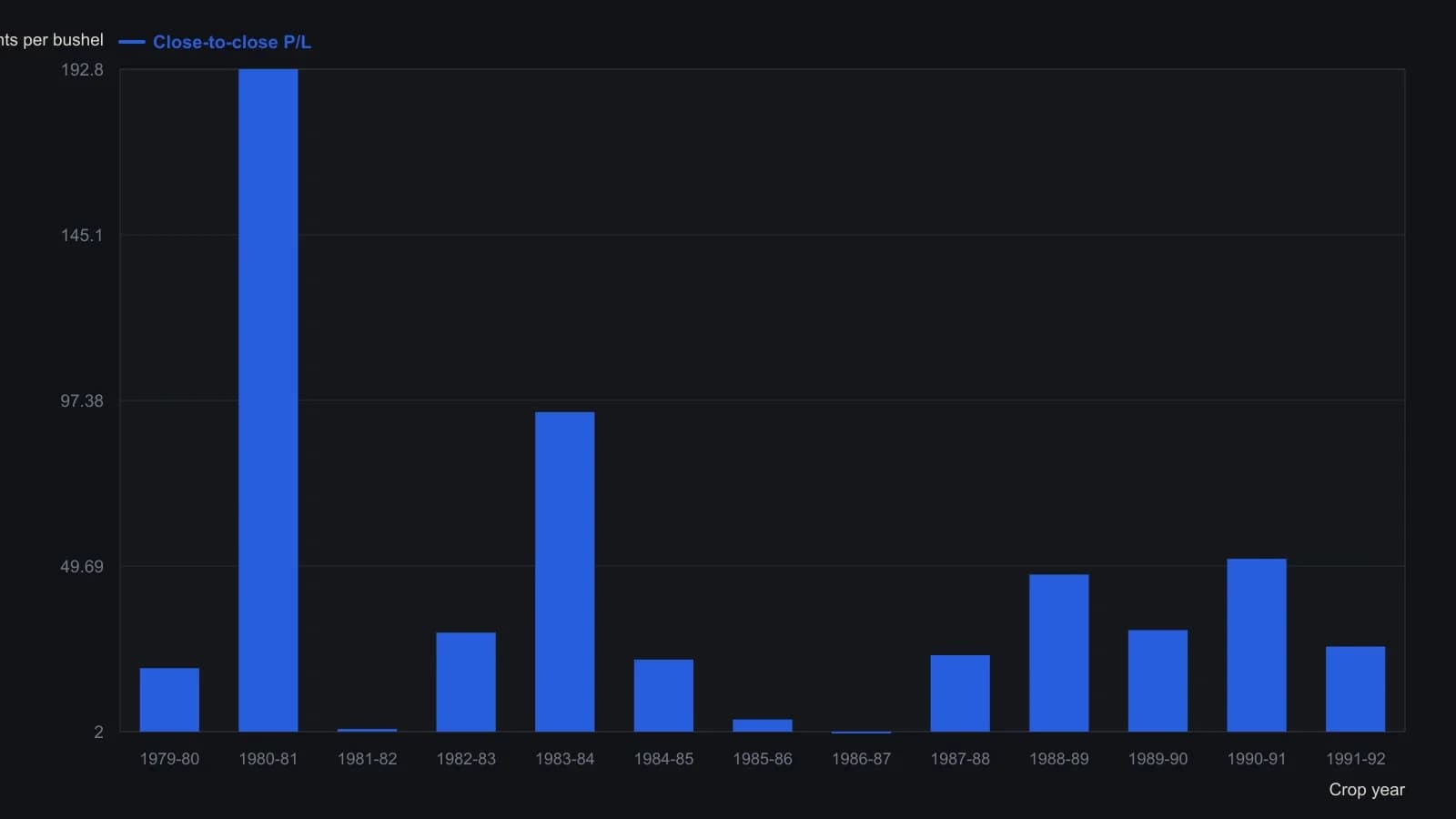
Crop year 1992-93 is omitted because the December 22, 1992 update left that season's April 22 exit and P/L unmarked. When November 1 or April 22 is not a trading day, the source uses the next session's close.
Add an overlay only to list leftover paths
The same case enumerates a combined structure of the November/July futures spread plus two July 650 calls, one of which is sold to recoup premium. It then walks decline, rally, sideways, worst-case, and best-case paths.
The overlay is written so those paths can be listed. It is not written to assert a single outcome, and it is not asked to replace the date window or the money-stop.
All readings on this track · 18 readings
- 1982Constructing commodity spreads, calendar legs, and option straps
- 1987Seasonal calendar spreads as financed capital slots
- 1989Seasonal dates, confirmation, and reconstructed spread bars
- 1991Calendar-spread divergence as a demand clock for commodity reversals
- 1992Expiration-forced convergence for basis, calendar, and option-income trades
- 1993Write the soybean intercrop calendar as one procedure
- 1996A commodity-basket redesign read as a proxy and a calendar-spread
- 2003Calendar spread construction by volatility skew
- 2003Livestock calendar spreads during a commodity-index roll
- 2004Same-strike calendar construction, decay income, and account gates
- 2004Range-bound calendar spreads and precommitted exits
- 2007Construct futures size from the good-faith deposit and the spread
- 2007Critiquing calendar spreads when reversals overrun
- 2010Name the spread, then construct the legs
- 2012Monthly calendar income under a volatility-regime process
- 2016A VIX calendar-spread case after the 2015 volatility spike
- 2017Yield curve kinks as spread laboratories
- 2018Bitcoin futures contract choice, percentage margin and calendar spreads