2003issue C081-3
Livestock calendar spreads during a commodity-index roll
A historical case study turned a production-weighted index roll into one livestock calendar-spread procedure and used maximum adverse excursion to decide whether a brief window was even admissible.
- A production-weighted commodity futures index rolled nearby holdings in one-fifth increments from the fifth through the ninth business day of the month before expiration, each time selling the nearby-contract and buying the deferred-contract.
- The case study expected roll-related relative-price pressure to show more clearly in livestock calendar-spreads than in highly liquid energy or grain markets because livestock open interest was smaller and deliverable arbitrage was weaker.
- The test sold the nearby livestock contract and bought the next deferred-contract from the close of the fourth business day of the preceding month through the ninth business day, using live-cattle and hog month combinations from 1996 onward.
- A two-sided calendar-spread was treated as cost-sensitive, so maximum-adverse-excursion bounded whether the brief roll window was admissible. Summer livestock rolls were isolated as the strongest candidates.
The commodity-index roll as a published clock
The archive described a production-weighted-index of commodity futures that rolled nearby holdings in one-fifth increments from the fifth through the ninth business day of the month before expiration. Each increment sold the nearby-contract and bought the next deferred-contract of the same commodity. That commodity-index-roll is a scheduled sale of nearby futures and purchase of the next delivery month so a long-only commodity index can stay invested without taking delivery.
Editorial interpretation by TradersWeek: those pre-announced increment days are a market-structure clock. The published schedule, not a discretionary timing guess, defines the calendar-spread window.
Why livestock months were the case
The case study judged that roll-related relative-price pressure would show up more in livestock calendar-spreads than in highly liquid energy or grain markets. Livestock open interest was smaller, and deliverable arbitrage was weaker. Live cattle carried a 3.77 percent index weight, described as material relative to that market’s open interest. A calendar-spread is a same-commodity pair that is short one delivery month and long another, expressing a view on relative month pricing rather than outright direction.
The calendar-spread window that was tested
The test sold the nearby livestock contract and bought the next deferred-contract from the close of the fourth business day of the preceding month through the ninth business day. It used live-cattle and hog month combinations from 1996 onward. The pair is a commodity-spread: a long-and-short futures combination used to isolate relative contract performance instead of the cash commodity level.
Historical finishes inside the roll window
From 1996 through 2002, the nearby live-cattle month finished the tested roll window weaker than the next deferred month in 43 of 61 cases. The nearby hog month did so in 42 of 71 cases. Summer livestock rolls were isolated as the strongest candidates because livestock open interest was typically thin then while open interest in the related index futures was rising.
June–August live-cattle Goldman-roll P&L, 1993–2002
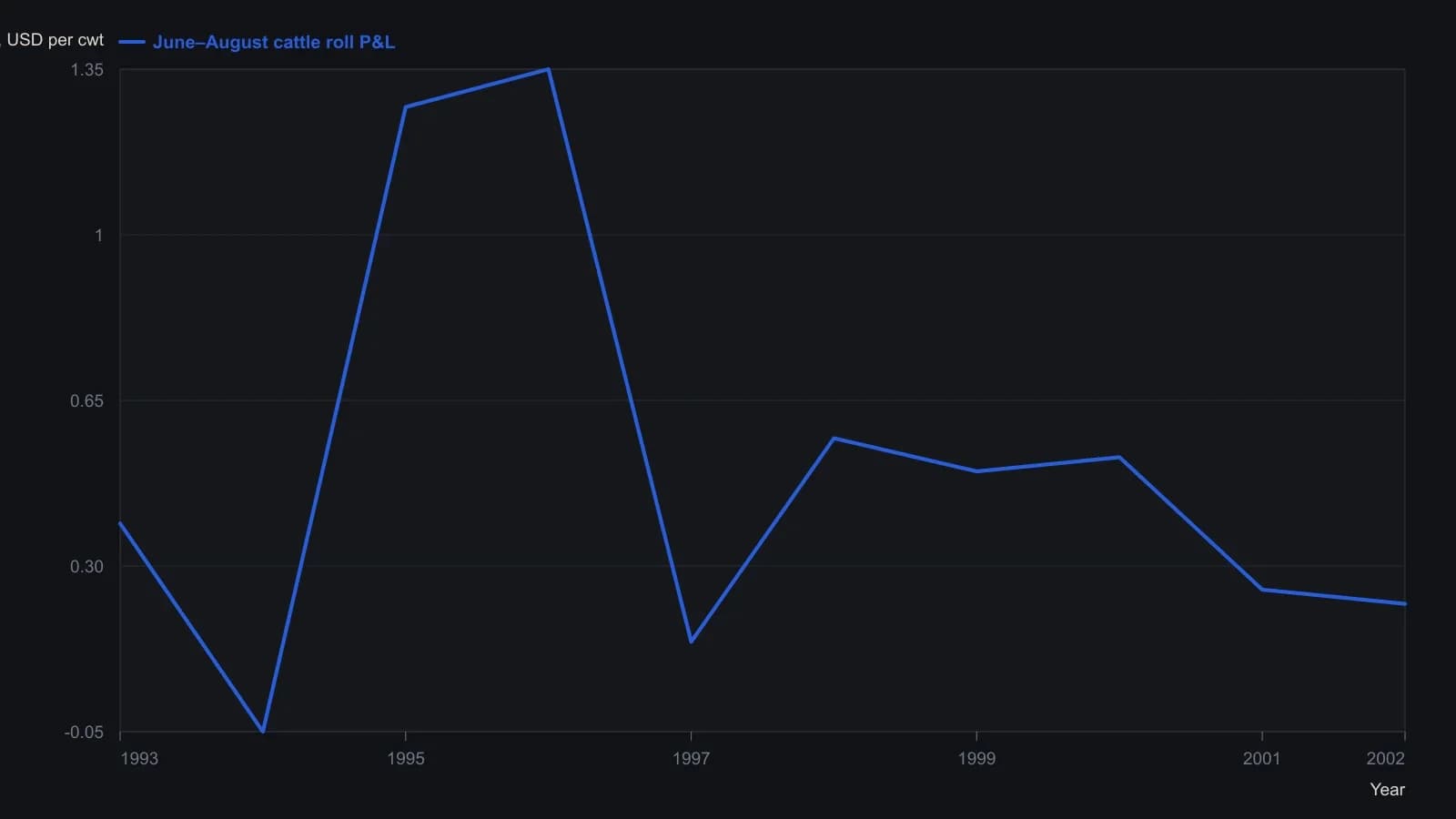
Each point is one discrete May window: short the June contract and long the August contract from the close of the fourth business day through the ninth. Values are dollars per hundredweight. In the same table the worst intra-window adverse excursion was −0.43 in 2002.
Maximum adverse excursion as a window bound
The write-up treated a two-sided calendar-spread as cost-sensitive. Transaction costs could erase a small nearby-versus-deferred discrepancy, so maximum-adverse-excursion was used to bound whether a brief roll window was even admissible. Maximum-adverse-excursion is the largest unfavorable move recorded while a defined spread is open.
For the June-to-August live-cattle roll sample from 1993 through 2002, maximum-adverse-excursion was tabulated on each five-session hold. The worst figure in that ten-event set was -0.43 per hundredweight.
Editorial interpretation by TradersWeek: that tabulated bound is a filter on whether the window may be taken at all, not a later add-on to an already chosen trade.
All readings on this track · 18 readings
- 1982Constructing commodity spreads, calendar legs, and option straps
- 1987Seasonal calendar spreads as financed capital slots
- 1989Seasonal dates, confirmation, and reconstructed spread bars
- 1991Calendar-spread divergence as a demand clock for commodity reversals
- 1992Expiration-forced convergence for basis, calendar, and option-income trades
- 1993Write the soybean intercrop calendar as one procedure
- 1996A commodity-basket redesign read as a proxy and a calendar-spread
- 2003Calendar spread construction by volatility skew
- 2003Livestock calendar spreads during a commodity-index roll
- 2004Same-strike calendar construction, decay income, and account gates
- 2004Range-bound calendar spreads and precommitted exits
- 2007Construct futures size from the good-faith deposit and the spread
- 2007Critiquing calendar spreads when reversals overrun
- 2010Name the spread, then construct the legs
- 2012Monthly calendar income under a volatility-regime process
- 2016A VIX calendar-spread case after the 2015 volatility spike
- 2017Yield curve kinks as spread laboratories
- 2018Bitcoin futures contract choice, percentage margin and calendar spreads