1996issue C031-5
A commodity-basket redesign read as a proxy and a calendar-spread
A long-running listed commodity-price basket was rewritten so energy and metals gained weight and the contract-window ran through nearer months. This archive article treats that historical change as one procedure: first ask whether the new mix still serves as an index-proxy, then ask whether the same listing now reads as a nearby-versus-deferred calendar-spread.
- The rewritten basket used fewer futures components and a smaller agricultural share, so subgroup-weighting gave energy and metals more influence and made agricultural moves less dominant.
- The contract-window was shortened so nearby-contract prices would weigh more, while the series was still treated as a longer-horizon gauge.
- The historical account described a nearby-contract paired with a deferred-contract in the basket futures as one calendar-spread that follows nearby commodity movement and the cheaper deferred prices of the same listing.
- The redesigned basket and its listed futures were presented as a lower-cost index-proxy for a diversified commodity allocation, including for accounts that could not hold every component contract.
What the rewrite changed
A listed commodity-price basket maintained since 1956 was substantially redesigned on 6 December 1995. Earlier component changes had already added crude oil in 1982 and removed some agricultural contracts in 1987.
The redesigned basket used 17 futures components rather than 21, after agricultural contracts that had made up about 57 percent of the prior mix were reduced. Subgroup-weighting was shifted so energy and metals carried more influence. The historical account presented the result as a basket more sensitive to those sectors and less easily dominated by agricultural moves.
The contract-window used to construct the basket was shortened from 10 months to 6 months, so nearby prices would weigh more while the series remained usable as a longer-horizon gauge. Option strikes on the basket futures were listed every 2.00 points instead of every 5.00 points.
The listing as an index-proxy
The redesigned basket and its listed futures were presented as a lower-cost index-proxy for a diversified commodity allocation. That use included accounts that could not efficiently hold every component contract.
In editorial terms, the first readout is whether this new mix still stands in for broad commodity price pressure after energy and metals gained share. The historical account offered the listed product as a stand-in, not as a requirement to hold every component.
KR-CRB subgroup weights before and after the 1995 rewrite
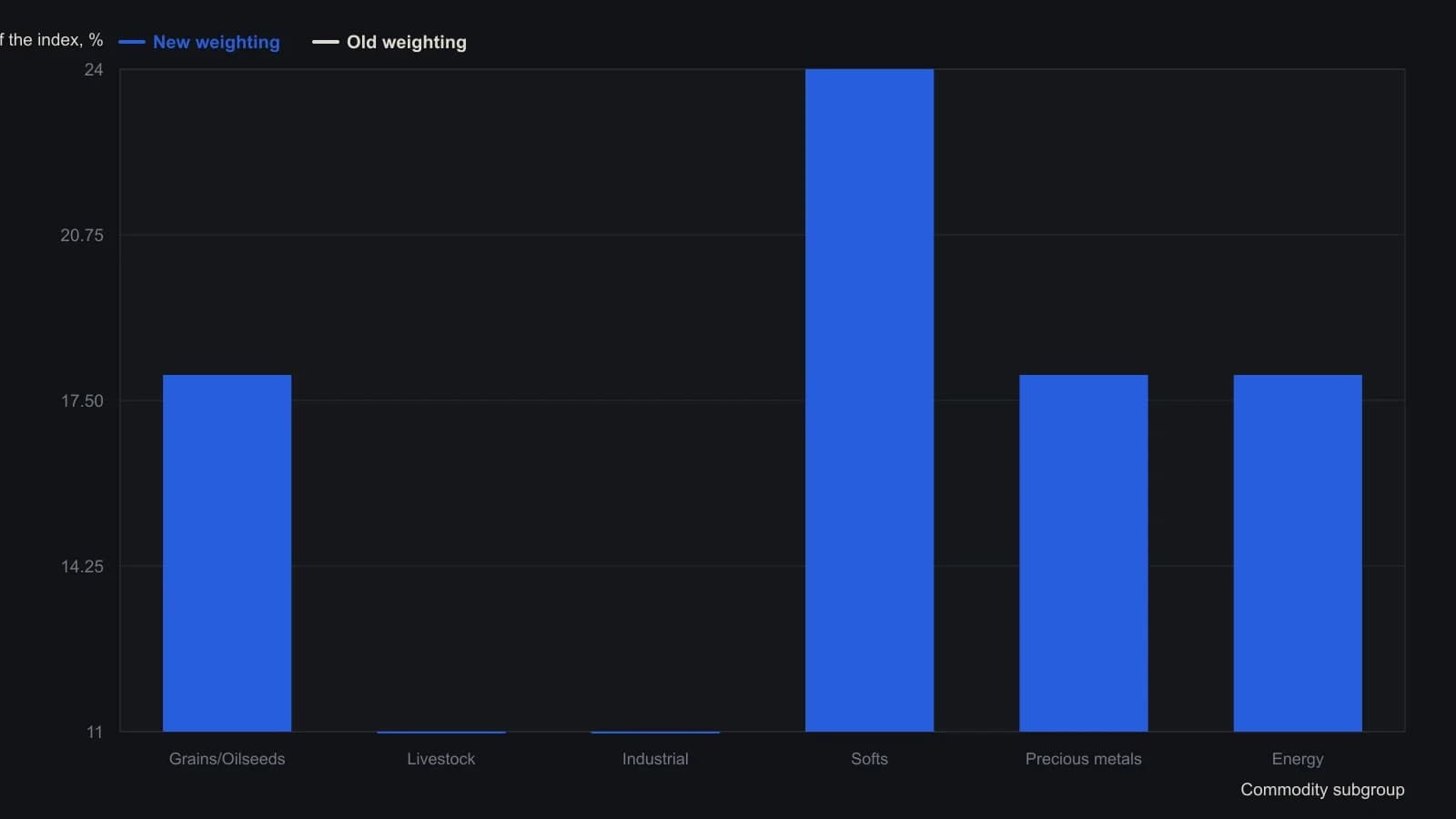
The comparison is the December 1995 KR-CRB redesign. The table marks grains/oilseeds with a percent sign and the other rows as integers; both columns sum to 100.
Nearby and deferred months as one commodity-spread
In the historical account, many component markets and the basket futures themselves were then in steep backwardation. Historical basket calendar-spreads had mostly traded in contango, or with only small deferred discounts.
Pairing a nearby-contract in the basket futures with a deferred-contract was described as a single commodity-spread. That calendar-spread was said to track nearby commodity movement while also capturing the cheaper deferred-contract prices of the same basket.
An editorial reading of the shorter contract-window is that the listed product is no longer only an average of more distant months. The same index-proxy can be handled as a nearby-versus-deferred calendar-spread.
All readings on this track · 18 readings
- 1982Constructing commodity spreads, calendar legs, and option straps
- 1987Seasonal calendar spreads as financed capital slots
- 1989Seasonal dates, confirmation, and reconstructed spread bars
- 1991Calendar-spread divergence as a demand clock for commodity reversals
- 1992Expiration-forced convergence for basis, calendar, and option-income trades
- 1993Write the soybean intercrop calendar as one procedure
- 1996A commodity-basket redesign read as a proxy and a calendar-spread
- 2003Calendar spread construction by volatility skew
- 2003Livestock calendar spreads during a commodity-index roll
- 2004Same-strike calendar construction, decay income, and account gates
- 2004Range-bound calendar spreads and precommitted exits
- 2007Construct futures size from the good-faith deposit and the spread
- 2007Critiquing calendar spreads when reversals overrun
- 2010Name the spread, then construct the legs
- 2012Monthly calendar income under a volatility-regime process
- 2016A VIX calendar-spread case after the 2015 volatility spike
- 2017Yield curve kinks as spread laboratories
- 2018Bitcoin futures contract choice, percentage margin and calendar spreads