1999issue C111-4
Relocating expiration break-even with a bull debit spread
A historical case first priced a January 2000 60 long-call, then rebuilt the same directional view as a 45/60 vertical debit spread so expiration break-even, residual decline room, and the pre-expiration close sat on one worksheet before paper-trading live quotes against the model grid.
- A long-call recovers its debit at expiration only if the underlying finishes above strike plus premium, and it can expire with no value below the strike.
- The illustrated 45/60 vertical debit spread paid a 9.65 debit and broke even at 54.65, about 2.91 below the 57.56 spot, while the single 60 call needed 67.78.
- Full loss of that 9.65 debit required the long 45 call to expire worthless at 45 or below, which the case described as a 19.6 percent decline from 56.
- Both spread legs were to be closed just before expiration to avoid last-minute assignment of the short call, then paper-traded after live quotes were checked against the model prices.
A directional view in two packages
The editorial frame for this archive case is to treat one directional forecast as a two-package lab. The first package is a long-call. The second is an option-spread built as a vertical debit spread, so the capped payoff, the relocated expiration-break-even, residual decline room, and the assignment-window exit can be read on one worksheet.
A vertical debit spread is a same-expiry call pair that buys the lower strike and sells a higher strike, paying a net debit and capping both gain and residual loss. An option-spread is a two-legged options package whose combined payoff replaces a single long option when the trader wants a defined-risk directional stance.
What the long-call needed
A purchased call recovers its premium at expiration only when the underlying is above the strike by at least the amount paid. Below the strike the call can expire with no value. That payoff is the long-call used in the first package.
The January 2000 60 long-dated call was shown at a 7.35 model value plus a 0.43 typical bid-ask increment, for a 7.78 working debit and a 67.78 expiration break-even. Over the 241 days to expiration, one standard deviation of price volatility was given as 32.5 percent, corresponding to an underlying level of 76.27 at which the 60-strike call would be worth 16.27.
Rebuild as a three-strike debit spread
A bull debit spread buys a call nearer the spot price and sells a higher-strike call, producing an initial cash outflow and a limited maximum gain. Candidate call spreads in the case were spaced three strikes apart, using a starting rule of selling a strike at or slightly above the money and buying a strike near 75 percent of that higher strike.
The illustrated package was long the 45 call and short the 60 call for a 9.65 debit. If the underlying finished at or above 60, the spread's value equaled the 15-point strike width.
Where expiration break-even moved
Expiration-break-even is the underlying price at expiry where the position's payoff equals the initial debit. That 45/60 package broke even at 54.65, about 2.91 below the 57.56 spot, whereas the single 60 call needed 67.78 to break even at expiration.
Full loss of the 9.65 debit required the long 45 call to expire worthless, which the case located at an underlying of 45 or below and described as a 19.6 percent decline from 56. Editorially, the capped payoff is what relocates the expiration-break-even and what shows the residual decline the debit can absorb before the long 45 call is worthless.
January 2000 AT&T bull-call expiration break-even by three-strike window
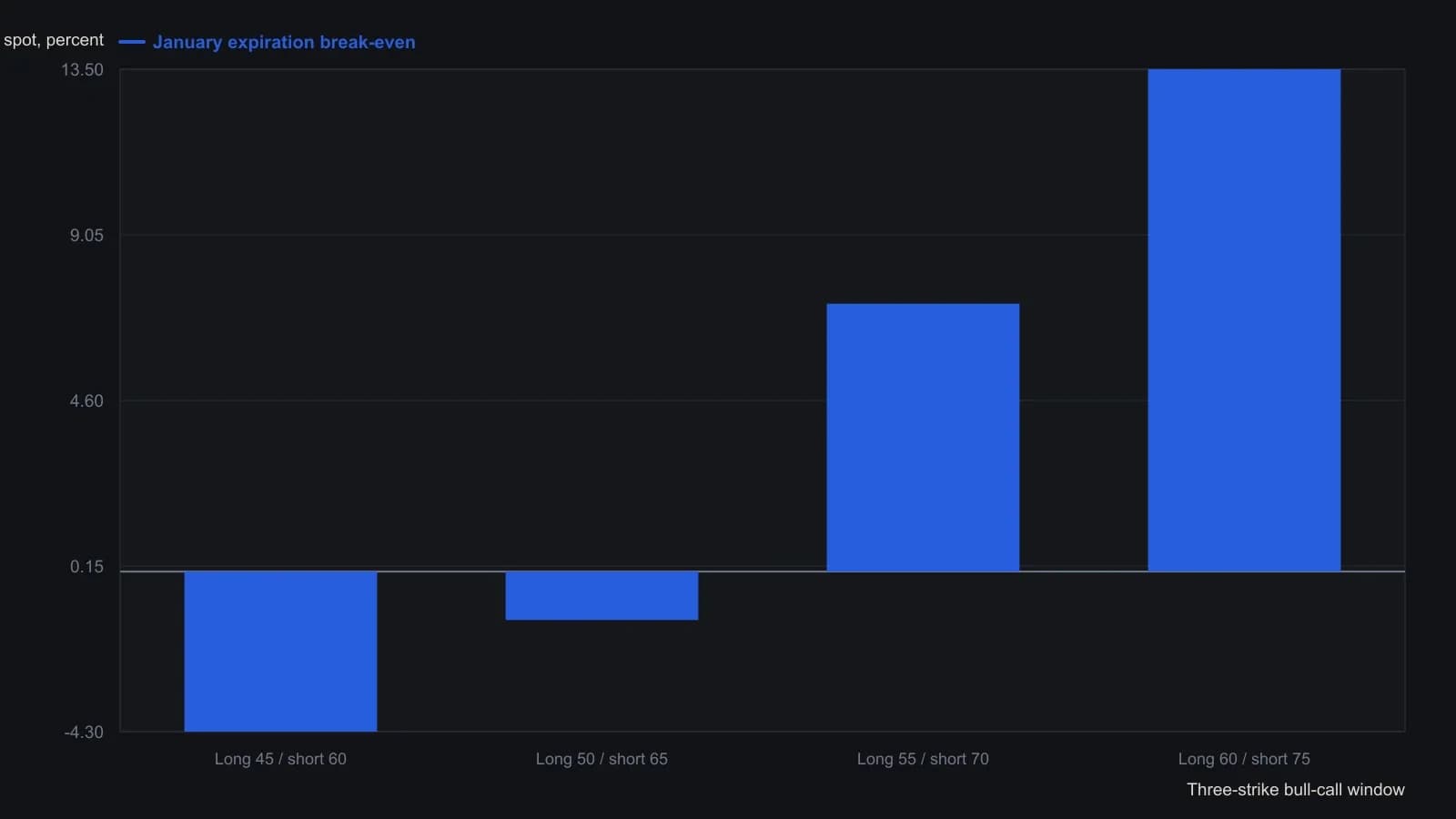
The worksheet buys the low strike and sells the high strike three strikes apart. Printed BE% includes a typical bid/ask increment; the authors also quote a mid-debit break-even of $54.65, $2.91 below the spot.
Assignment window, then paper-trading
Both spread legs were to be closed just before expiration to avoid last-minute assignment of the short call. The assignment-window is the near-expiry period in which a short call can be exercised, which the case treated as a reason to close both spread legs before expiration.
The package was then paper-traded after live quotes were checked against the model prices. Paper-trading is a journaled simulation that records model or live quotes, option symbols, and hypothetical fills so entry, exit, and abstention rules can be tested without committing capital.
All readings on this track · 24 readings
- 1988Process goals, journals, and pre-trade stress checks
- 1989A written plan before impulse takes command
- 1991Step-through construction of a currency range tactic
- 1999Relocating expiration break-even with a bull debit spread
- 2003Rebuild testable trading rules after a drawdown
- 2005Forex stops, lot count, and reward as one budget
- 2010Predefined rules before discretion in a mechanical trading system
- 2010Evaluating euro-gold intraday lead-lag rules
- 2011How to turn an FDA-calendar sample into a testable bio-runup procedure
- 2012First-hour countertrend entries after broken levels
- 2012Time-box simulation before live decision pressure
- 2013Adding markets without liquidity and emotion rules
- 2013Precommit the exits on leveraged trades
- 2013Check the currency cross, the margin, then the demo fill
- 2014Test entry, exit and abstention as one procedure
- 2015Paper-trade the system you refuse to complicate
- 2015Four-step system vetting before live trading
- 2015Price and volume rules over pattern shortcuts
- 2017Closing a Friday news fade into one entry and exit procedure
- 2019Hype-resistant trading process: paper checks and ruin risk
- 2020Paper trading cannot validate a live decision process
- 2020Tenth-size futures as a small-account ruin filter
- 2020Evaluating systems with paper trading and walk-forward windows
- 2020Sizing protective puts with micro index options