2020issue C1125
Sizing protective puts with micro index options
After listed options arrived on micro index futures in 2020, a protective overlay became an increment problem: which listed put size keeps insurance close to the book, and whether that smaller increment can rehearse the same rule before a full-size futures option is used.
- Micro index options listed in 2020 were sized at one-tenth of standard emini notional, which changed the increment used to match a protective put to account equity.
- A 600000-dollar S&P-style book could not be matched with whole standard puts; three standard puts plus five micro puts were shown as a 595000-dollar overlay, closer than either whole-contract choice.
- A long standard emini could be only partly insured with one or two micro puts, and the smaller listing was framed as a live step beyond paper trading.
- Early micro Nasdaq options were thinner than micro S&P options, and even micro-sized index futures were described as large enough to damage an unhedged account in the March 2020 volatility spike.
A smaller listed increment
In 2020, listed options became available on micro S&P 500 and micro Nasdaq 100 index futures, after those micro futures had launched in 2019. A micro-index-option is an option on a stock-index futures contract sized at one-tenth of the standard emini notional.
With the S&P 500 near 3400, one standard emini index futures contract was treated as about 170000 dollars of notional, so one protective put on that contract insured that same allocation slice. Micro listings were sized at about 17000 dollars, which changed the increment used to match insurance to account equity. A protective put is a long listed put used to bound downside on an equity allocation or a long index-futures position.
Whole standard puts left a mismatch
Notional-match is how closely option or futures coverage dollars line up with the equity or futures exposure being insured. A 600000-dollar S&P-style book could not be matched with whole standard puts: three contracts covered 510000 dollars and four covered 680000 dollars, overshooting by 80000 dollars.
Three standard puts plus five micro puts were shown as a 595000-dollar overlay, closer to the 600000-dollar target than either whole-contract choice. Futures contract selection, in this workflow, meant choosing among standard and micro index listings so notional, hedge increment, and liquidity fit the book being protected.
A partial hedge on a long emini
A long standard emini futures position could be only partly insured by buying one or two micro puts rather than one full-size put. That is a partial-hedge: insurance that covers only a slice of an existing long futures or equity position.
A live step after paper trading
The smaller listings were framed as a live step beyond paper trading: the same option structures, less capital, and smaller profit-and-loss swings than the standard contract. Paper trading means running the same entry, exit, and sizing rules without full-size capital before those rules are used on a standard contract.
Early listings were uneven
Early conditions were uneven, with platform glitches and delayed listings. Micro S&P options were described as having tight market-maker spreads, while micro Nasdaq options were thinner and required a bid-ask check before entry.
Venue differences cited in the archive
Relative to cash-equity venues, futures and futures options were cited for simpler tax reporting, different tax-rate treatment, and nearly continuous access from Sunday night through Friday close.
Small size was not treated as trivial risk
During the March 2020 volatility spike, even micro-sized index futures were described as large enough to damage an unhedged account, so small contract size was not treated as trivial risk.
Matching a $600,000 S&P hedge to listed put size
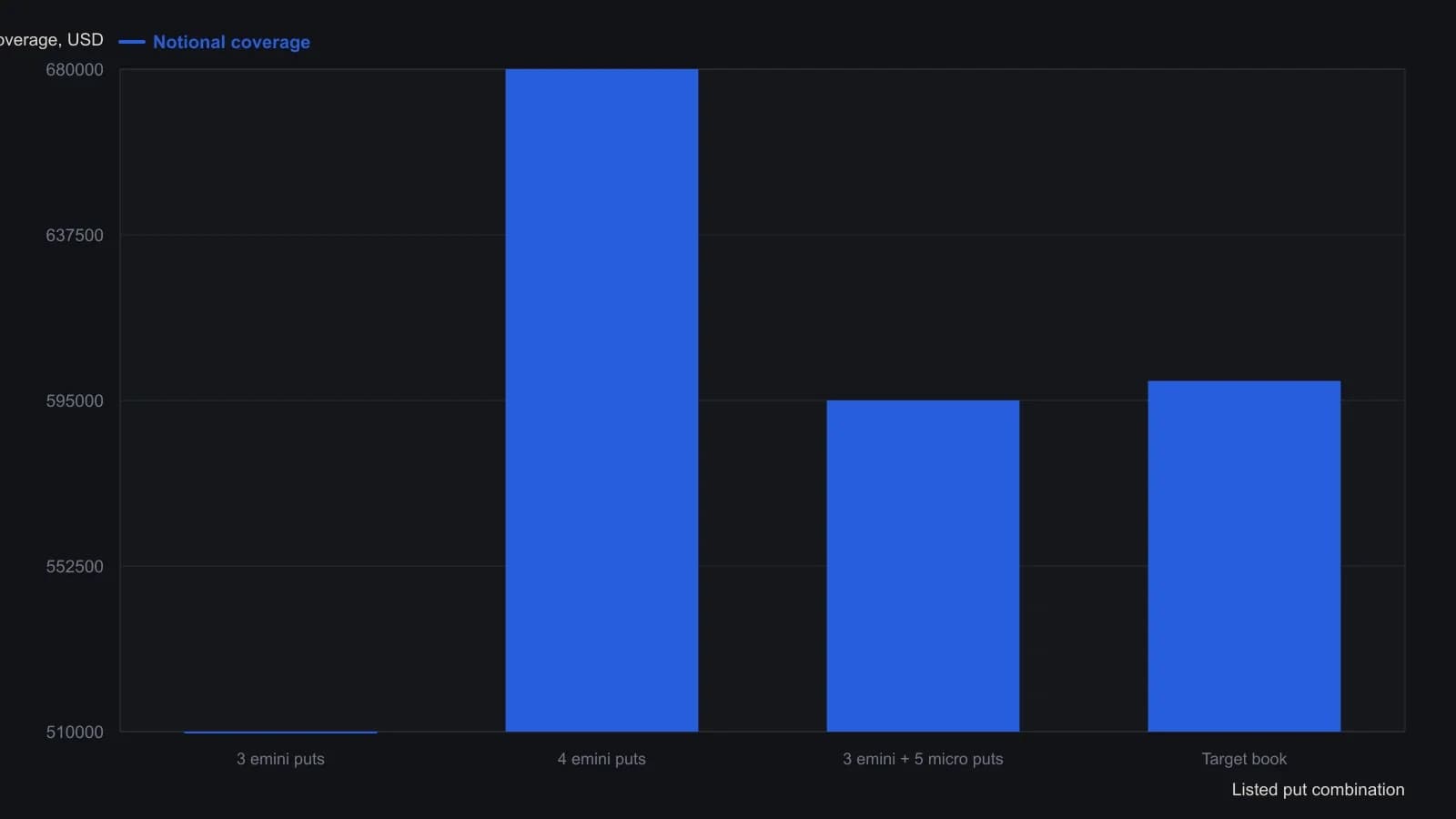
Notional sizes use the article’s S&P 500 at 3,400: $170,000 per emini put and $17,000 per micro put.
All readings on this track · 24 readings
- 1988Process goals, journals, and pre-trade stress checks
- 1989A written plan before impulse takes command
- 1991Step-through construction of a currency range tactic
- 1999Relocating expiration break-even with a bull debit spread
- 2003Rebuild testable trading rules after a drawdown
- 2005Forex stops, lot count, and reward as one budget
- 2010Predefined rules before discretion in a mechanical trading system
- 2010Evaluating euro-gold intraday lead-lag rules
- 2011How to turn an FDA-calendar sample into a testable bio-runup procedure
- 2012First-hour countertrend entries after broken levels
- 2012Time-box simulation before live decision pressure
- 2013Adding markets without liquidity and emotion rules
- 2013Precommit the exits on leveraged trades
- 2013Check the currency cross, the margin, then the demo fill
- 2014Test entry, exit and abstention as one procedure
- 2015Paper-trade the system you refuse to complicate
- 2015Four-step system vetting before live trading
- 2015Price and volume rules over pattern shortcuts
- 2017Closing a Friday news fade into one entry and exit procedure
- 2019Hype-resistant trading process: paper checks and ruin risk
- 2020Paper trading cannot validate a live decision process
- 2020Tenth-size futures as a small-account ruin filter
- 2020Evaluating systems with paper trading and walk-forward windows
- 2020Sizing protective puts with micro index options